 Join
Join Donate
 Acadia National Park
Asiatic bittersweet
(Celastrus orbiculatus)
Help support a diverse and thriving Mount Desert Island by taking action in your backyard!
Help support a diverse and thriving Mount Desert Island by taking action in your backyard!
Asiatic bittersweet (Celastrus orbiculatus) is a widespread, invasive vine that endangers forests, fields, dunes, and beaches throughout Maine. It climbs rapidly on trees, strangling them and weighing down branches, increasing the risk of damage during storms. Asiatic bittersweet outcompetes native vegetation by forming thick mats that block sunlight and prevent native regeneration.
It has been known to take over abandoned fields, transforming them into a vine-dominated community rather than allowing them to grow back into forests. Additionally, thickets of Asiatic bittersweet can harbor disease-carrying ticks and other invasive species, or host bacteria that spread crop and tree diseases such as variegated chlorosis.
Asiatic bittersweet is a woody vine with scalloped or bluntly-toothed margins on their leaves, and distinctive yellow seed capsules that split open in the fall to reveal bright red-orange berries in clusters along the vine. It produces small, greenish-yellow flowers with five petals, grouped around its leaf axils. Asiatic bittersweet can often be found coiling around trees or sprawling across the ground, and early removal is important to prevent future spread.
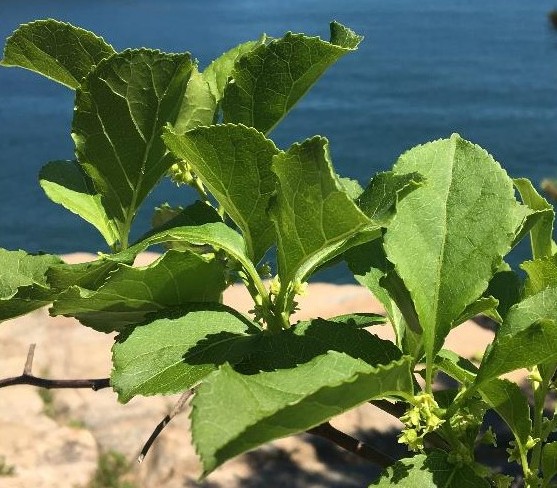
Asiatic bittersweet (Celastrus orbiculatus) has simple, alternate leaves with toothed edges.
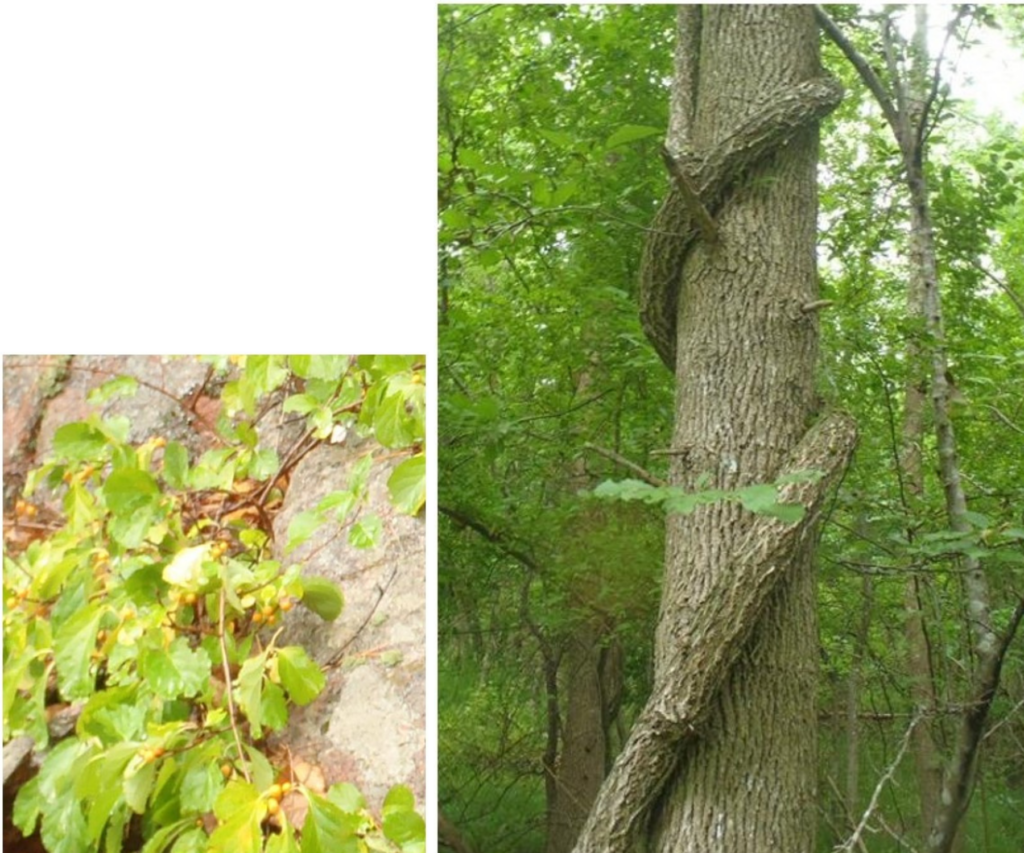
Bittersweet has small green five-petaled flowers in spring and yellow seeds that mature in the fall to reveal bright red arils.

Asiatic bittersweet is woody vine that was introduced as an ornamental plant.
Remove any time after leaf-out in late spring.
Dispose of plants responsibly.
Asiatic bittersweet is likely to re-sprout. Repeat the above methods as needed to eliminate plants from your property.
Consider replacing with native woody vines like river grape (Vitis riparia) or Virginia creeper (Parthenocissus quinquefolia)
Learn even more about Asiatic bittersweet on the maine.gov website: Asiatic bittersweet