 Join
Join Donate
 Acadia National Park
Friends of Acadia History
In 1986 Friends of Acadia founders envisioned a membership-based and volunteer-powered organization that would translate their love for Acadia into tangible good for the park.
In 1986 Friends of Acadia founders envisioned a membership-based and volunteer-powered organization that would translate their love for Acadia into tangible good for the park.
For more than three decades, that vision has guided our work—from modest early volunteer projects and small equipment donations, to major achievements such as Acadia Trails Forever, establishing the nation’s first endowed trail system.
1985 Marianne Edwards and a group of park volunteers discuss the need for a community organization to help Acadia National Park. Park Superintendent Ron Wrye approves the idea.
1986 Friends of Acadia is incorporated with an initial contribution of $50 from Marianne Edwards.
1987 The first Journal of Friends of Acadia is distributed as an insert in area newspapers.
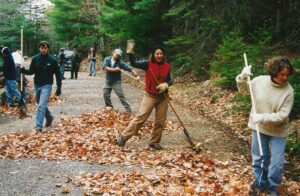
Volunteers rake the drainage ditches along the carriage roads during Take Pride in Acadia Day. (Friends of Acadia)
1988 Friends of Acadia has 350 members.
1990 1.4-mile demonstration restoration project on the Amphitheater Carriage Road section completed.
1991 Friends of Acadia begins support of Acadia Youth Conservation Corps.
1991 Friends of Acadia launches a campaign to restore Acadia’s carriage roads.
1991 The first annual Take Pride in Acadia Day draws 57 volunteers to rake leaves and clear drainage on Acadia’s carriage roads, helping to prevent erosion during the winter storms and spring thaw, and reducing the need for costly repairs.
1993 Friends of Acadia provides matching grant that allows the park to hire a biologist to monitor and interpret endangered nesting peregrine falcons.
1996 The Carriage Road Campaign meets its goal, creating an endowment to maintain the carriage roads in perpetuity.
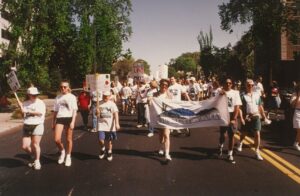
Friends of Acadia volunteers and staff walk and cheer in a parade in 1995. (Friends of Acadia)
1997 Friends of Acadia works with state and local partners to avert a clearcut on 1,600 acres on the Schoodic Peninsula adjacent to park lands.
1996 Friends of Acadia begins hiring Recreation Technicians to assist park staff in efforts to understand visitor use data and trends.
1997 Friends of Acadia hires its first field crew leader to expand volunteer projects in Acadia National Park.
1997 Friends of Acadia begins Village Connector Trails project to improve pedestrian and bike access to Acadia National Park.
1997 Wheelchair-accessible carriages are donated to Acadia National Park, with an endowment for their ongoing maintenance.
1997 The Ridge Runners program is established and endowed.
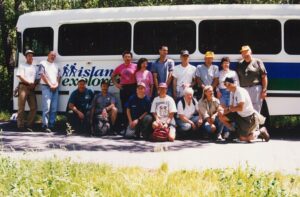
Acadia National Park and Friends of Acadia staff and volunteers next to an Island Explorer bus. (Friends of Acadia)
1998 Working with the park, Friends of Acadia achieves a first-in-nation legislative jet-ski ban on all ponds inside Acadia.
1999 Acadia Trails Forever, the campaign to restore and endow the trails of Acadia, is announced and receives the first-ever $5 million gift to a conservation organization in Maine, making Acadia the first national park in the nation with an endowed trail system.
1999 Friends of Acadia co-develops and co-funds the Island Explorer bus system.
1999 The Acadia Youth Conservation Corps is endowed with an anonymous gift. Each summer, the eight-week program employs high school students from Maine and beyond, offering them the opportunity to work alongside myriad teams at Acadia National Park, from the trails crew to vegetation management. Launched in 1970, the program has grown over the years to give AYCC members a broad hands-on experience of the park while growing their personal strength and perseverance and enjoying the close camaraderie of their fellow teen crew.
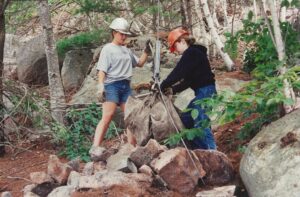
AYCC members moving rocks by highline in Acadia National Park. (Friends of Acadia)
2002 L.L.Bean pledges its first $1 million to support the Island Explorer.
2000 The first Earth Day Roadside Cleanup is held, with volunteers clearing trash from roadways in communities surrounding Acadia.
2005 The Acadia Winter Trails Association is endowed by the family of Elizabeth R. (Leila) Bright in her memory and in honor of her love for skiing in Acadia. The fund provides ongoing support for grooming equipment, safety and training, fuel, and volunteer and staff support.
2005 The George B. Dorr Society for Planned Giving is established.
2005 The Acadia Land Legacy partnership is established to purchase privately owned properties within park boundaries from willing sellers, protecting the land until it can be acquired by Acadia National Park.
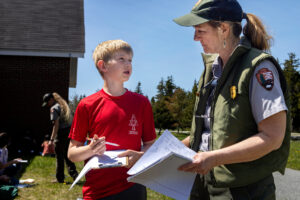
An education technician ranger at Acadia National Park talks with a 6th grader during Schoodic Education Adventure (Ashley L. Conti/Friends of Acadia)
2006 Friends of Acadia begins funding the Schoodic Education Adventure (SEA) program, with support from L.L.Bean. The SEA program connects Maine middle-school students to Acadia’s forests and coastline through an immersive, three-day field trip on Acadia National Park’s Schoodic Peninsula. Students spend their days investigating marine life in tidepools and examining layers of soil. They plot data-collection sites, scout for crabs, and get acquainted with Acadia’s geologic history.
2007 Friends of Acadia purchases and protects 64 acres of land within the park boundary—25 acres on Acadia Mountain and 39 acres of land within Northeast Creek estuary.
2007 Friends of Acadia purchases 369 acres in Trenton to facilitate the development of the Acadia Gateway Center. Roughly 150 acres were later sold to the Maine Department of Transportation for construction of the center and wetland mitigation. Friends of Acadia facilitated construction of the Trenton Community Trail, and donated 217 acres of land to the Town of Trenton for public enjoyment under a conservation easement.
2007 L.L.Bean Acadia Research Fellowships fund nine scientists working in the park, researching topics including water clarity, seabirds, and brook trout.
2008 Acadia Quest is introduced, challenging young people and their families and mentors to explore, discover, and protect Acadia.
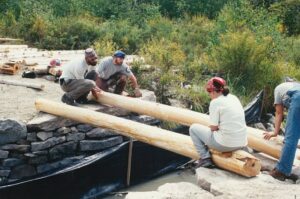
Maine Conservation Corps works to build the bridge on the Great Meadow Loop Trail in Acadia National Park. (Friends of Acadia)
2009 The accomplishments of Acadia Trails Forever’s first 10 years include 5.6 miles of Village Connector Trails built; 1.8 miles of abandoned trails reopened; over 3,000 steps, 16,760 square feet of walls, and 259 culverts repaired or constructed.
2009 Friends of Acadia begins funding the seasonal Acadia Raptor Intern position, supporting Peregrine Falcon and Hawk Watch programs that collect data on raptors and educate park visitors.
2009 Through a partnership with Canon U.S.A., Friends of Acadia begins supporting Acadia’s Invasive Plant Management Team as it works to manage 29 invasive plant species. This funding allows for consistent monitoring and removal, early detection, and experimentation.
2010 The Wild Gardens of Acadia volunteers become part of Friends of Acadia. Created in 1961 and maintained by dedicated volunteers, the Wild Gardens features more than 400 native plant species in 13 sections that represent natural plant communities found throughout Acadia.
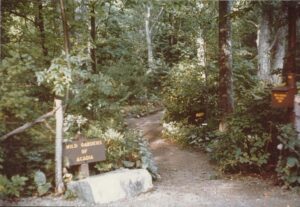
The Wild Gardens of Acadia (Courtesy photo)
2011 Lower Hadlock and Round Ponds are protected through Acadia Land Legacy.
2013 Friends of Acadia funds water-quality monitoring at Jordan Pond, considered one of Maine’s clearest lakes, with leadership support from Canon U.S.A.
2013 The Teacher-Ranger-Teacher program at Acadia, now Acadia Teacher Fellows, is significantly expanded with support from Friends of Acadia. Through an immersive four-to-six-week experience in the park, teachers from Maine and beyond gain tools and training to bring outdoor learning into their classrooms.
2014 The Island Explorer transports its five millionth rider.
2014 Friends of Acadia hires the first Cadillac Summit Steward team to protect Cadillac Mountain’s fragile alpine environment and engage visitors in its stewardship. Later combined with the Ridge Runners program to become today’s Summit Stewards, this team educates visitors, maintains trails and cairns, and assists with emergencies.
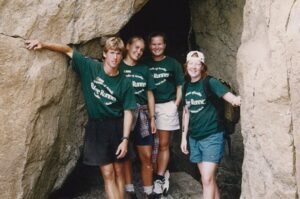
Summit Stewards (Friends of Acadia)
2015 Friends of Acadia partners with the park, Yawkey Foundations, and Musco Lighting to replace 90-plus outdoor lights at the Blackwoods and Seawall Campgrounds with dark-sky-friendly fixtures.
2015 The 1,400-acre Schoodic Woods property opens with a new campground and trails, becoming a permanently protected part of Acadia National Park. Friends of Acadia maintains an endowment to support its long-term upkeep.
2015 Friends of Acadia begins the Yellow Bus Fund grant program to support transportation expenses for local schools bringing students to Acadia.
2015 Friends of Acadia provides a matching grant to support an ambitious vista-clearing program along Acadia’s motor and carriage roads.
2016 The community-based Acadia Centennial engages more than 450 local partners to “celebrate our past and inspire our future.” Friends of Acadia is honored with a National Park Service Director’s Partnership Award for its role in the celebration.
2017 Friends of Acadia launches the Outdoor Classroom grant program to help local schools build outdoor education spaces.
2017 Friends of Acadia launches a new Acadia for All grant program to help reduce access barriers for youth groups.
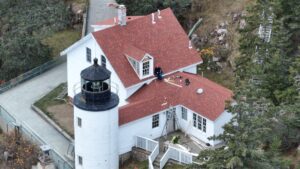
Repairs and new roof for the Bass Harbor Head Light Station. (Kip Wing/Aerial Aesthetic)
2018 Friends of Acadia raises funds to restore the historic Bass Harbor Head Light Station and support ongoing maintenance, including a new roof in 2025.
2019 Friends of Acadia raises funds to support restoration of the park’s 17 historic stone carriage road bridges.
2020 The Acadia Resilience Fund is established, enabling the park to offer virtual educational programming for students during the COVID-19 pandemic.
2020 Volunteers and park staff completed the multi-year reconstruction of the 4,500-foot raised bogwalk on the west side of Jordan Pond.
2020 Friends of Acadia joins park supporters in advocating for the Great American Outdoors Act, passed in 2020 to address deferred maintenance in national parks. At Acadia, funding supports a new maintenance facility and upgrades to the Schoodic Institute’s water treatment system. Friends of Acadia continues to advocate for renewed funding to address the remaining maintenance backlog.
2021 Friends of Acadia provides support for the creation of Cadillac Summit Road Vehicle Reservation System, which dramatically improved congestion, safety, and protection of fragile alpine ecosystems.
2021 Friends of Acadia funds a comprehensive accessibility study to help identify and remove barriers for visitors with disabilities.
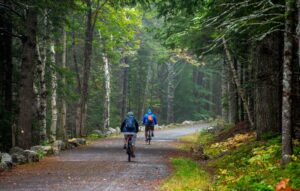
Eagle Lake Carriage Road. (Will Newton/Friends of Acadia)
2021 The Eagle Lake Carriage Road is restored, completing the park’s decades-long effort to restore all 45 miles of the park’s historic carriage road system.
2022 Friends of Acadia launches an initiative to add 130 beds for Acadia’s seasonal staff, purchasing the Kingsley Inn the following year as the first step.
2022 Friends of Acadia leverages federal funding for climate-focused habitat restoration at the Great Meadow Wetland and Bass Harbor Marsh.
2023 Friends of Acadia purchases a boat with a landing craft design for Acadia, allowing park staff to better care for the park’s remote islands.
2023 The first Save Our Summits hike takes place, bringing volunteers together to carry soil to Acadia’s peaks to support vegetation restoration.
2024 Friends of Acadia’s Raise the Roof campaign raises $10 million, unlocking an additional $21 million in federal dollars and a $2 million grant from the National Park Foundation to support seasonal employee housing. Friends of Acadia completes the Dane Farm housing complex, and Acadia National Park breaks ground on Harden Farm.
2024 Friends of Acadia also purchases six two-bedroom townhomes in Trenton, known as Jordan River Road, to support seasonal staff working in Acadia, including Island Explorer bus drivers.
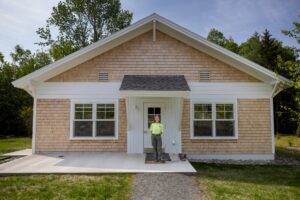
Dane Farm in Seal Harbor. (Rhiannon Johnston/Friends of Acadia)
2024 Severe winter storms cause significant damage across Acadia. Volunteers and donor funds help Acadia address immediate safety issues, and Friends of Acadia helps secure federal storm recovery funding.
2024 The Island Explorer celebrates 25 years and 10 million riders. Since its launch in 1999, the bus system has eliminated an estimated 4 million private vehicle trips within the park.
2024 Acadia celebrates 35-plus years of successful invasive plant management. Thanks to continued monitoring and maintenance, sustained funding from partners like Friends of Acadia, and research support from Schoodic Institute, invasive plants now cover less than one percent of Acadia National Park. In contrast, other eastern national parks have an average invasive plant cover of nearly 14 percent—and in some parks, it can reach up to 40 percent, according to the National Park Service Inventory and Monitoring Program.
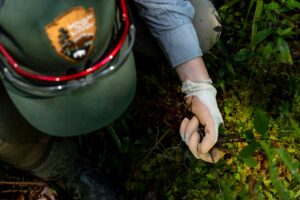
An Acadia National Park biological science technician, removes invasive glossy buckthorn. (Ashley L. Conti/Friends of Acadia)
2025 Friends of Acadia raises more than $200,000 to restore the Carroll Homestead, one of the last remaining examples of 19th-century farm life on the Island.
2025 Friends of Acadia joins park supporters around the country in successfully lifting the hiring freeze for seasonal national park employees. Together with the community, Friends of Acadia also supports the park during the nation’s longest government shutdown.
2025 Park staff, with support from volunteers, help restore Acadia’s views, working on 43 historic carriage road vistas.
2025 Friends of Acadia exceeds 5,000 members.
2026 The Acadia Gateway Center officially opens for its first full season.
2026 Construction begins on the new East-West Connector Trail at the summit of Cadillac Mountain to improve safety and accessibility.
2026 Friends of Acadia raises funds to restore the historic Baker Island Lighthouse.