 Join
Join Donate
 Acadia National Park
Mysterious Sculptures on the Landscape
Acadia’s glacial erratics add geological gravity and sculptural stoicism to the park landscape
– and attract their share of photographers.
BY CARL LITTLE
December 1st, 2025
Acadia’s glacial erratics add geological gravity and sculptural stoicism to the park landscape
– and attract their share of photographers.
BY CARL LITTLE
December 1st, 2025
I have been hiking in Acadia National Park for more than 40 years now, and in my perambulations up and down mountains, through woods, alongside streams, lakes, and ponds, I have made friends, if you will, with a number of glacial erratics, those large boulders that rest in shade and sun, unmoving yet moving.
Many are landmarks, as individual as cairns: stern, rounded, amiable, at times Buddha-like. Some of my favorites have features: a half smile, a generous nose, lichen tattoos. I look forward to revisiting them, being in their presence, as they while away their centuries.
In his booklet Erratica: Boulder Poems, Robert Chute (1926-2021) paid tribute to these mighty masses of stone. Noting that German geologists named them Fundlinge, “the lost children of the Pleistocene,” Chute, who taught biology at Bates College, acknowledged their benevolent presence:
Not ignored but left alone to dream
of the roaring, rumbling, tumbling times
that brought them here to be
good New England neighbors.
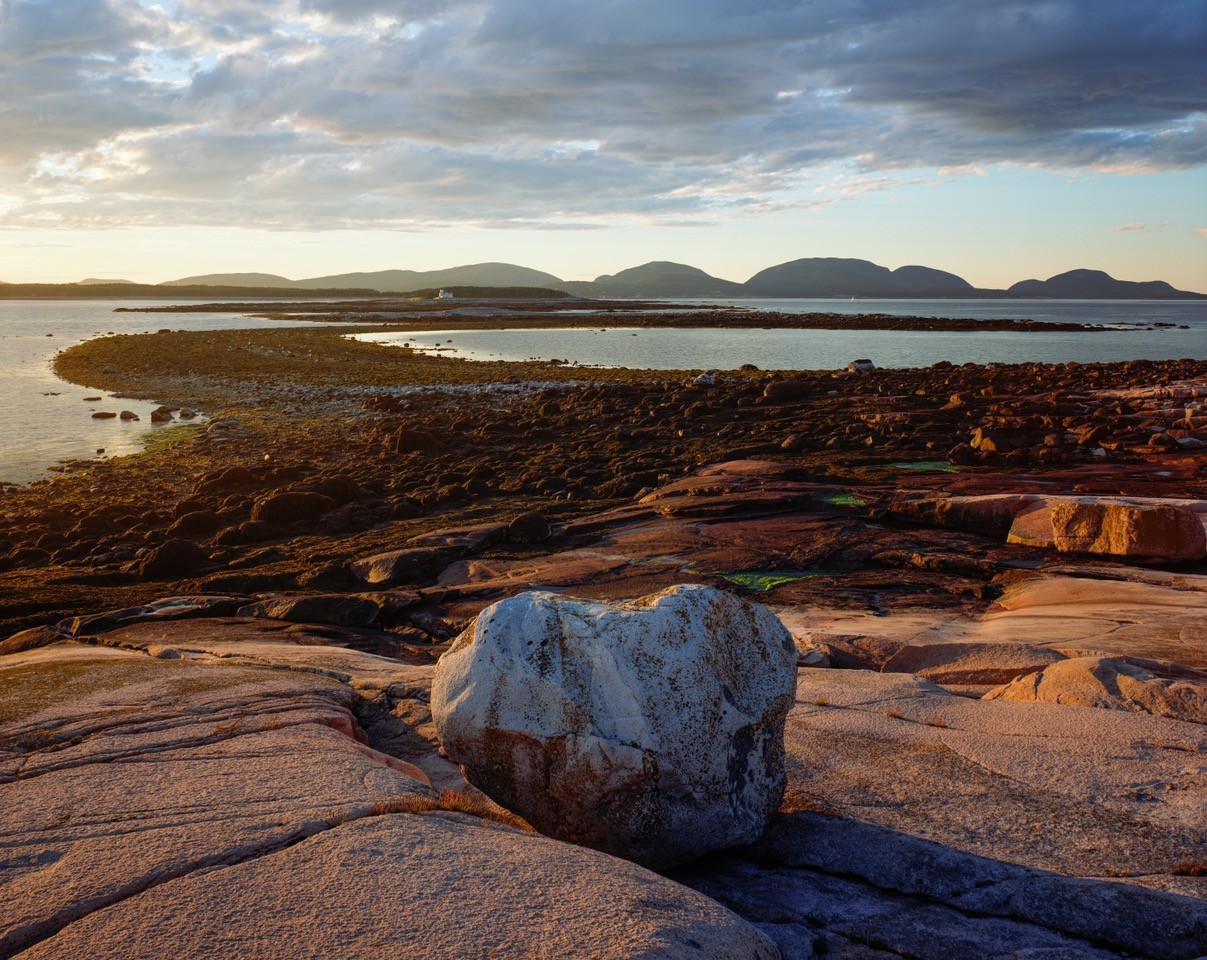
Baker Island Sunset with Boulder (Courtesy Jack Ledbetter)
Mount Desert Island boasts some exemplary glacial erratics. One thinks immediately of Bubble Rock in the park and Balance Rock in Bar Harbor, both renowned for their breadth and girth. How many (mostly young) hikers have posed pretending to tip over the former or had their photo taken in front of the latter, as if the boulder were a family member? And how many of us have hiked through “the Grotto,” that section of the Valley Trail beneath the cliffs of Beech Mountain that features massive erratics, and felt like we had discovered the ruins of some ancient civilization? Those gigantic rocks, some sporting Appalachian polypody, aka rockcap fern, never fail to awe those passing through.
These shapely and misshapen boulders have attracted their share of photographers. Longtime acquaintanceship with an erratic on Bakers Island led photographer Jack Ledbetter to take his camera to the site one summer evening. The enormous boulder plays a starring role in his stunning sunset view of Mount Desert Island.

The Bubble Rock is seen on South Bubble. (Joseph Philipson/Friends of Acadia)

Boulders line the Valley Trail in Acadia National Park, Monday, June 14, 2021. (Ashley L. Conti/Friends of Acadia)
Photographer Pamela Cobb returned to Acadia this past summer after a nearly 20-year absence and rediscovered her passion for those slumbering giants, what she calls “mysterious sculptures in the landscape.” The boulders’ “mere existence,” she writes, “stretches the imagination-to another era and a different world, distances of time and space that are unfathomable.”

Cadillac Erratic, color photograph (Courtesy Pamela Cobb Photography)
Duane and Ruth Braun have devoted a better part of the last several decades educating the public about the geology of Mount Desert
Island, and that includes the glacial erratics in our midst. In their newly revised “Guide to the Geology of Mount Desert Island, the Schoodic Peninsula and Acadia National Park,” the Brauns make note of some noteworthy erratics, including the bulky hunk of Lucerne granite on the Bar Harbor shore path, which was carried by the Laurentide Ice Sheet and deposited some 16,000 years ago.
When I asked Duane Braun what glacial erratics reveal about the geology of Mount Desert Island during a talk he and Ruth presented at the Southwest Harbor Library in August, he answered, “They can tell us where the ice came from.” Writing about the cluster of erratics at Bass Harbor Head, the Brauns reveal their multiple origins. Some are the “foliated Ellsworth schist,” others come from the “layered gabbro-dioritegranite zone,” which stretches along the coast of Maine between Bar Harbor and Machias, and another group of Lucerne granite boulders traveled by ice express “from the hills 35 miles northwest of here between Ellsworth and Bangor.” These millennial movements bring to mind an archaic meaning of erratic: “nomadic.”
These slumbering giants help us understand the origins of our island, but they also represent a kind of natural sculpture garden spread across hill and dale. Let us celebrate, in poet Robert Chute’s words, these “great, gray silent strangers,” each one “an errant vagrant moved by chance / yet immutably here and now/ touching the ground.”
CARL LITTLE, of Somesville, received the Lifetime Achievement Award for his art writing from the Dorothea and Leo Rabkin Foundation in 2021. His latest publications are Blanket of the Night: Poems and John Moore: Portals. He curated “Quarries: Muse & Material” for the Monson Arts Gallery in 2025.