 Join
Join Donate
 Acadia National Park
Keeping Acadia’s Carriage Road Bridges in Tip-Top Shape
Masons Mike Fitzpatrick and Ryan Meddaugh focused on three carriage road bridges for repairs last season.
February 20th, 2026
Masons Mike Fitzpatrick and Ryan Meddaugh focused on three carriage road bridges for repairs last season.
February 20th, 2026
Acadia’s masons keep the park’s carriage road bridges looking as rustically stunning as they did when they were first built nearly a century ago.
These historic bridges span streams, waterfalls, roads, and cliffsides. They’re spectacular photo-opp stops, too. Of the 17 stone-faced bridges built between 1913 and 1940, all but one was funded by John D. Rockefeller Jr. The 17th bridge was funded by the National Park Service and designed to adhere to the same look and feel as Rockefeller’s.
While granite is certainly sturdy in its own right, weather, visitor use, and creeping vegetation cause damage over time. Masons Mike Fitzpatrick and Ryan Meddaugh stay on top of repairs, surveying the structures and prioritizing needs each year.
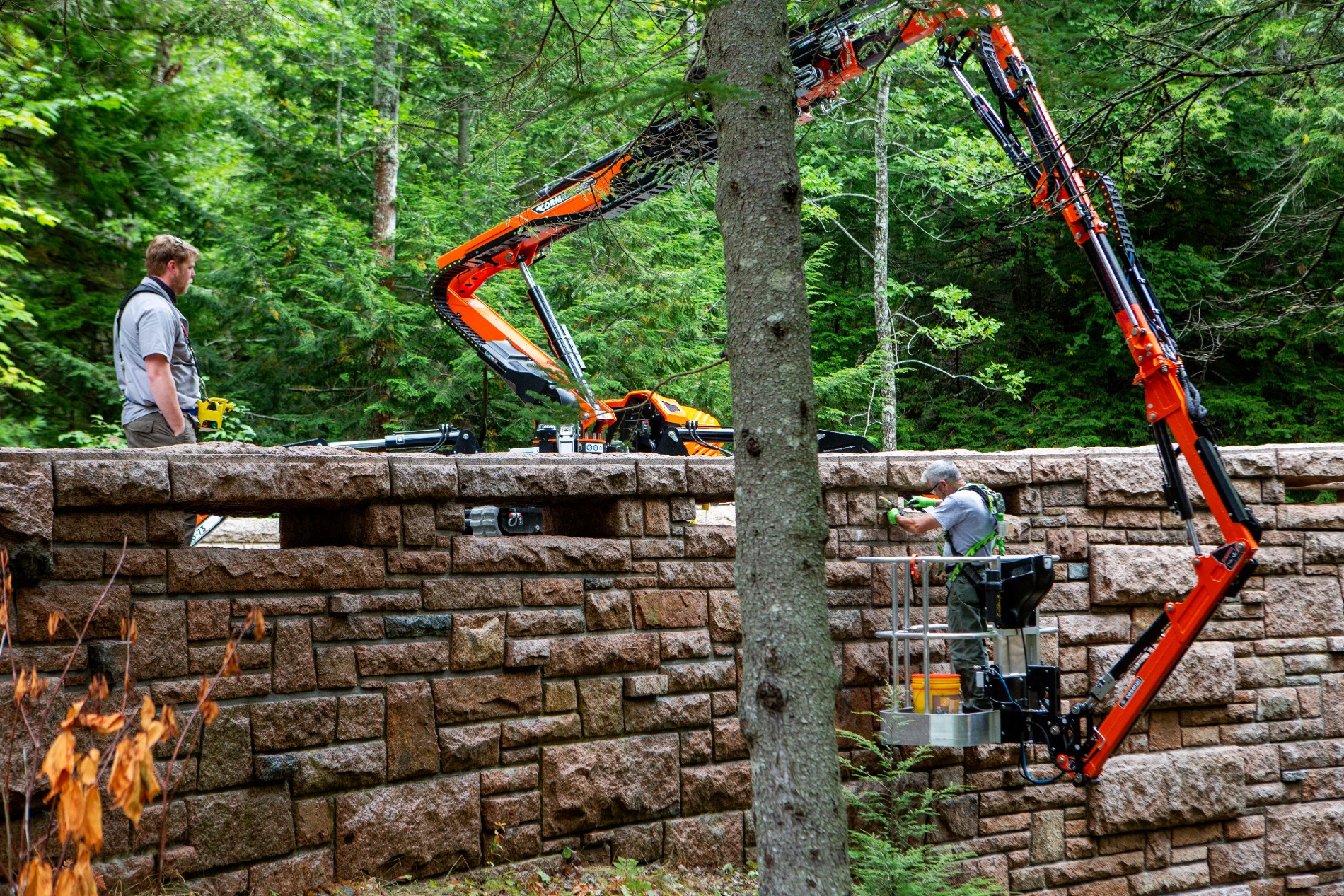
Acadia National Park Mason Mike Fitzpatrick (right) and Mason Tender Ryan Meddaugh clean and repair mortar on the Amphitheater Bridge in 2020. (Photo by Ashley L. Conti/Friends of Acadia)
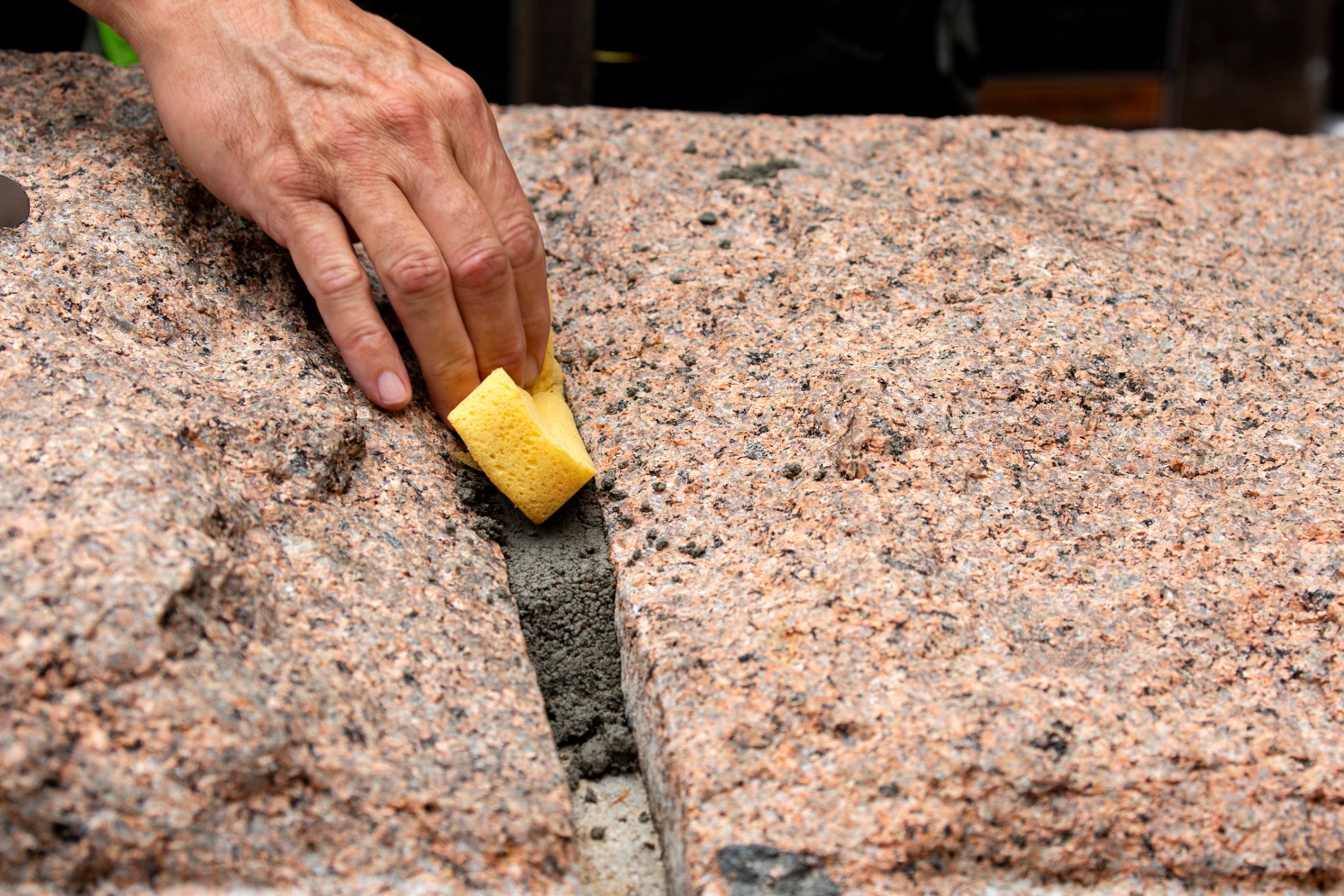
Acadia National Park Mason Mike Fitzpatrick uses a sponge to soak up excess moisture from a mortar mixture in 2020. (Photo by Ashley L. Conti/Friends of Acadia)
Friends of Acadia helps fund this work through our Carriage Road Endowment, which was established to ensure that Acadia’s carriage road system, bridges included, is maintained.
The dedication and expertise of park staff ensure that work is executed impressively well.
“I have a vision of these masons and how rugged and tough they must have been,” Fitzpatrick said in a 2021 story about the work. “The kind of machinery and equipment we have now is so advanced. They had to build their own scaffolding from scratch on this rough terrain. I don’t know how they did it. These were some talented and tough masons.” Read the full story: Forever Young: Acadia’s Masons Toil to Preserve Landmarks
Here’s an overview of bridge repairs completed last year:

Duck Brook Bridge in 2018. (Ashley L. Conti/Friends of Acadia)
Built in 1929, Duck Brook Bridge carries the Witch Hole Pond Loop portion of the Hulls Cove Road over Duck Brook to connect with New Eagle Lake motor road.
Fitzpatrick and Meddaugh continued work started on this bridge in 2024, removing failing mortar from the joints in between the granite stones and replaced it with historically accurate masonry mix. Approximately 60% was repointed, and the exterior of the bridge was treated and pressure washed to remove biological growth and clean the stones and masonry.

West Branch Bridge in 2022. (Avery Howe/Friends of Acadia)
Built in 1931, the West Branch Jordan Steam Bridge carries the Amphitheatre Road (Asticou-Jordan Pond Road) over the west branch of Jordan Stream.
The team completed a thorough inspection of the entire bridge, repaired all failing mortar. Approximately 50% of the bridge joints were repaired and the entire exterior was treated, cleaned, and pressure washed.
Jordan Pond Road Bridge in 2019. (Nathaniel X. Boëchat/Friends of Acadia)
Built in 1932, the Jordan Pond Road Bridge carries the Seal Harbor Road (formerly Jordan Pond Road) over the Day Mountain Carriage Road.
Fitzpatrick and Meddaugh repointed 80-90% of the masonry joints on the top of the parapet wall above the carriage road. Work below the bridge on the spandrel walls will continue this coming season during windows of time with good weather and low visitor use.
On all bridges, cracks in the stonework were repaired with a specialized epoxy and expansion joints were cleaned and patched with a polyurethane sealant.
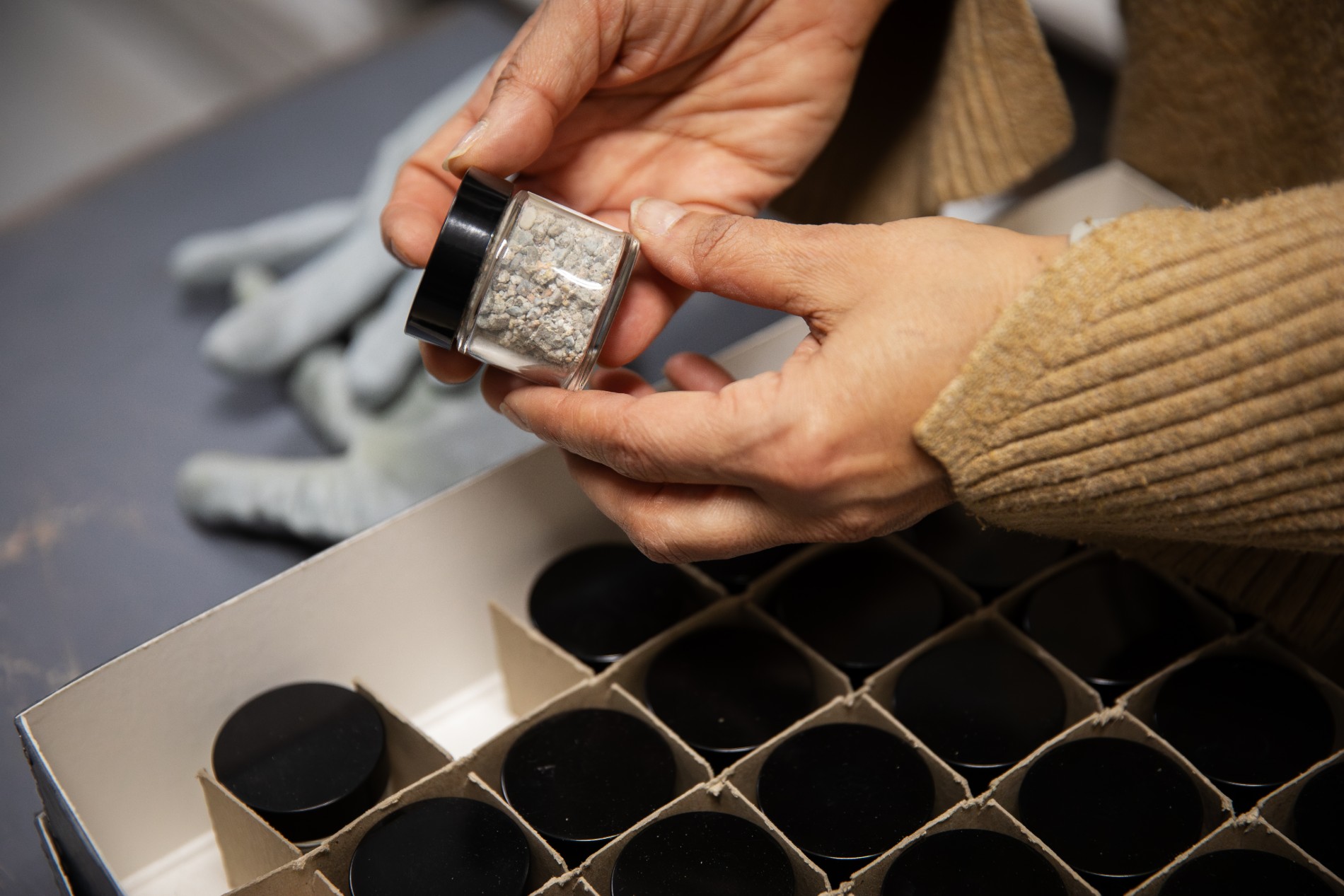
Masonry samples from historic bridges held in the park’s archives,
(Julia Walker Thomas/Friends of Acadia)
To maintain historic accuracy – both in materials and in the bridge aesthetics – mortar samples were taken from 15 of the historic bridges in 2002. Those samples were chemically tested to determine the mortar’s makeup and structural properties (perhaps no surprise, the findings showed the sand and stone used in the original mortar was local).
These samples are permanently stored as part of the park archives, ensuring that employees performing restoration work in the future will have samples and detailed information as guidelines for historic accuracy.
Bridge repairs for 2026 are still an ongoing conversation and will be determined by weather and the presence of bats in consultation with park resource managers.
Read more about the detailed work of Acadia’s masons: Forever Young: Acadia’s Masons Toil to Preserve Landmarks