Teachers Take it Outside with Outdoor Classroom Grants


Friends of Acadia’s Outdoor Classroom grants help teachers create outdoor learning spaces where students benefit from time spent in nature and curriculum that builds connections to Acadia National Park.

BY SHANNON BRYAN

A nature trail winds its mellow way through a red maple swamp between Deer Isle-Stonington’s middle and high schools.

Less than a half mile long, the raised boardwalk path curves around stands of maples and crowds of cinnamon ferns. Colorful letters, in alphabetical order, mark the trail’s sections.

“The first grade has a six-week phenology unit every spring, where they come out with their clipboards and their handheld microscopes and binoculars and their nature journals,” said Mickie Flores, a former math and science teacher at Deer Isle-Stonington Elementary School. Now retired, Flores remains a dedicated advocate for the schools’ outdoor learning spaces.

Students crouch in their designated sections—indicated by those alphabetical letters—and look: what’s going on? What do they see now that they didn’t see last week? In their journals they track changes, those hints of green peeking through the soil, stems reaching upward, leaves unfurling, buds opening.

The meandering nature trail continues on to wide sections—open decks with railings and benches or stools made from tree stumps.

Teachers bring students to these outdoor classrooms to learn under the tree canopy. And that goes for teachers of all subjects.

“These are places to teach,” said Flores. “They’re for English or art or math or social studies. The drama teacher brings people out to practice their lines.”

The school counselor brings students out, too.

The trail also loops around a yellow birch, which has become a popular spot.

“The yellow birch spur became an outdoor classroom,” said environmental educator Martha Bell, who works alongside teachers at Deer Isle-Stonington. “Students sit on the edge, because it’s kind of a circle. And the teachers just gravitate to that place.”
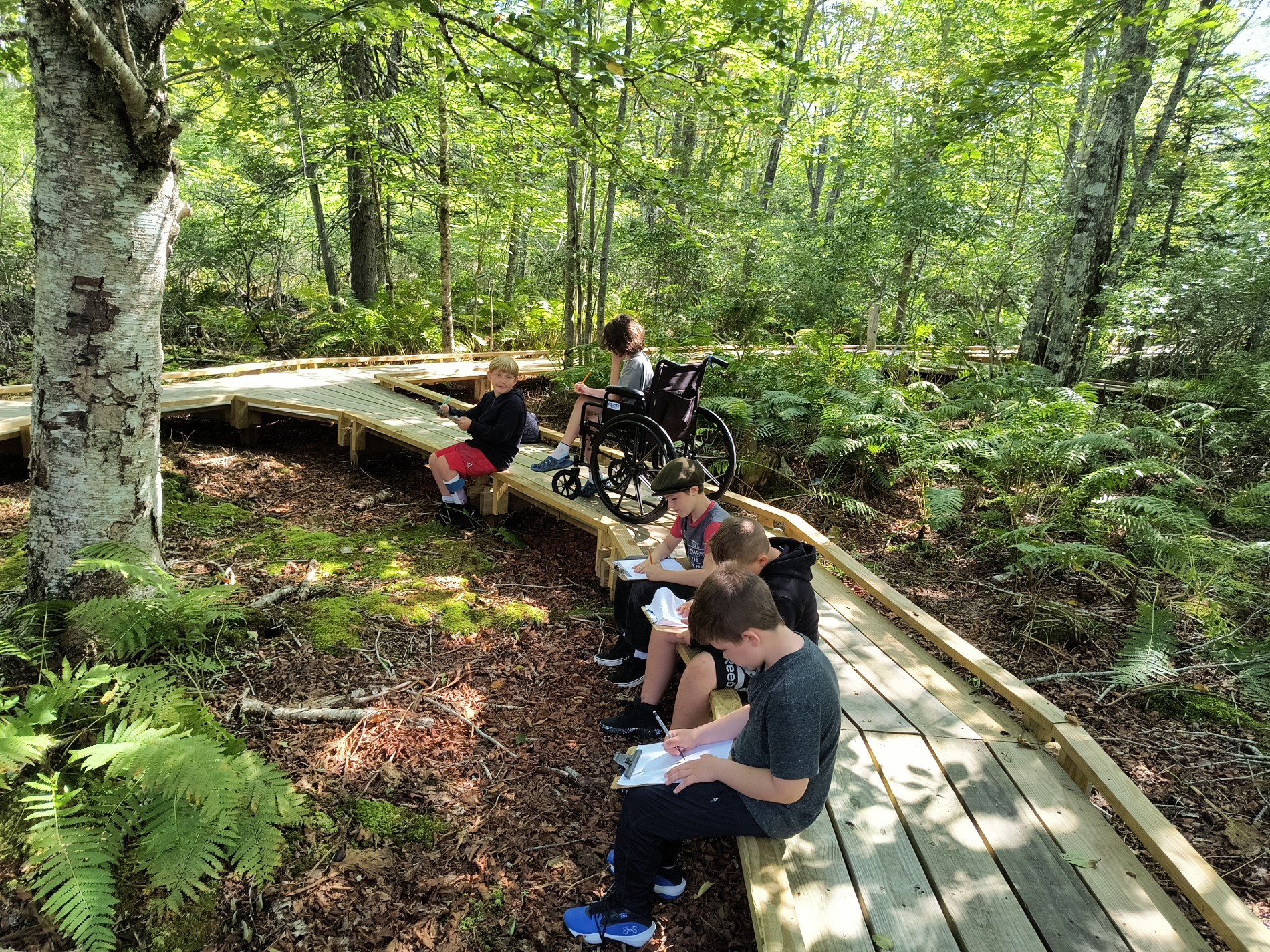
Deer Isle-Stonington students write in their notebooks during class outside on the nature trail. (Courtesy photo)

Deer Isle-Stonington’s nature trail and outdoor classrooms are nine years in the making, said Flores. The project is a collaborative community effort. The school has a tight partnership with Island Heritage Institute. Volunteers have helped design and build trail. Artists from nearby Haystack Mountain School of Crafts work with students to create art that decorates the trail, including the trail sign.

Over the last five years, funding from Friends of Acadia’s Outdoor Classroom grants helped build two of the outdoor classrooms as well as an in-the-works switchback where the trail ends near the middle school. Currently there’s a set of stairs to enter or exit the trail; the switchback will improve accessibility.

Last year’s grant was one of 12 Outdoor Classroom grants awarded by Friends of Acadia to Maine schools. These grants support the creation of outdoor learning spaces and activities on school campuses so that students benefit from time spent in nature and curriculum that builds connections to Acadia National Park. The grants enable teachers to create outdoor opportunities that best suit their students, be that building a trail, tapping maple trees, or solving math equations to the flittering sounds of chickadees.

“Being outside opens the gateway to curiosity,” said Bell. “If you tell students to look for birds and write them down, that’s not nearly as effective as them making their own discoveries.” Outdoors, they have space to explore.

“They come out with hand lenses, and they get right up on the  bark of a tree. They love scientific tools. They’re out here being scientists,” Bell added. The things they find, she said, feel like revelations. “They’re wondering and thinking that they maybe just found a new species.”

And research supports the positive impact of outdoor learning. A 2017 Stanford University review of 119 peer-reviewed studies found that environmental education for K-12 students improved academic performance and critical thinking skills and helped students develop confidence, autonomy, and leadership. It improved their motivation to learn and their interest in school.

“Our Outdoor Classroom grants are helping to support the culture of Maine’s public schools to become more nature-based,” said Paige Steele, Friends of Acadia’s Acadia for All director, who oversees the grant program. “Most folks don’t realize what a wonderful and massive change this is, because for 50-plus years it was mostly students from private or wealthy public-school districts who had access to outdoor learning. Most schools surrounding Acadia are in small, rural towns with modest school budgets.”

Through outdoor classrooms, students connect with the outdoors in ways they might not otherwise have an opportunity to do, building their appreciation for and stewardship of outdoor spaces.
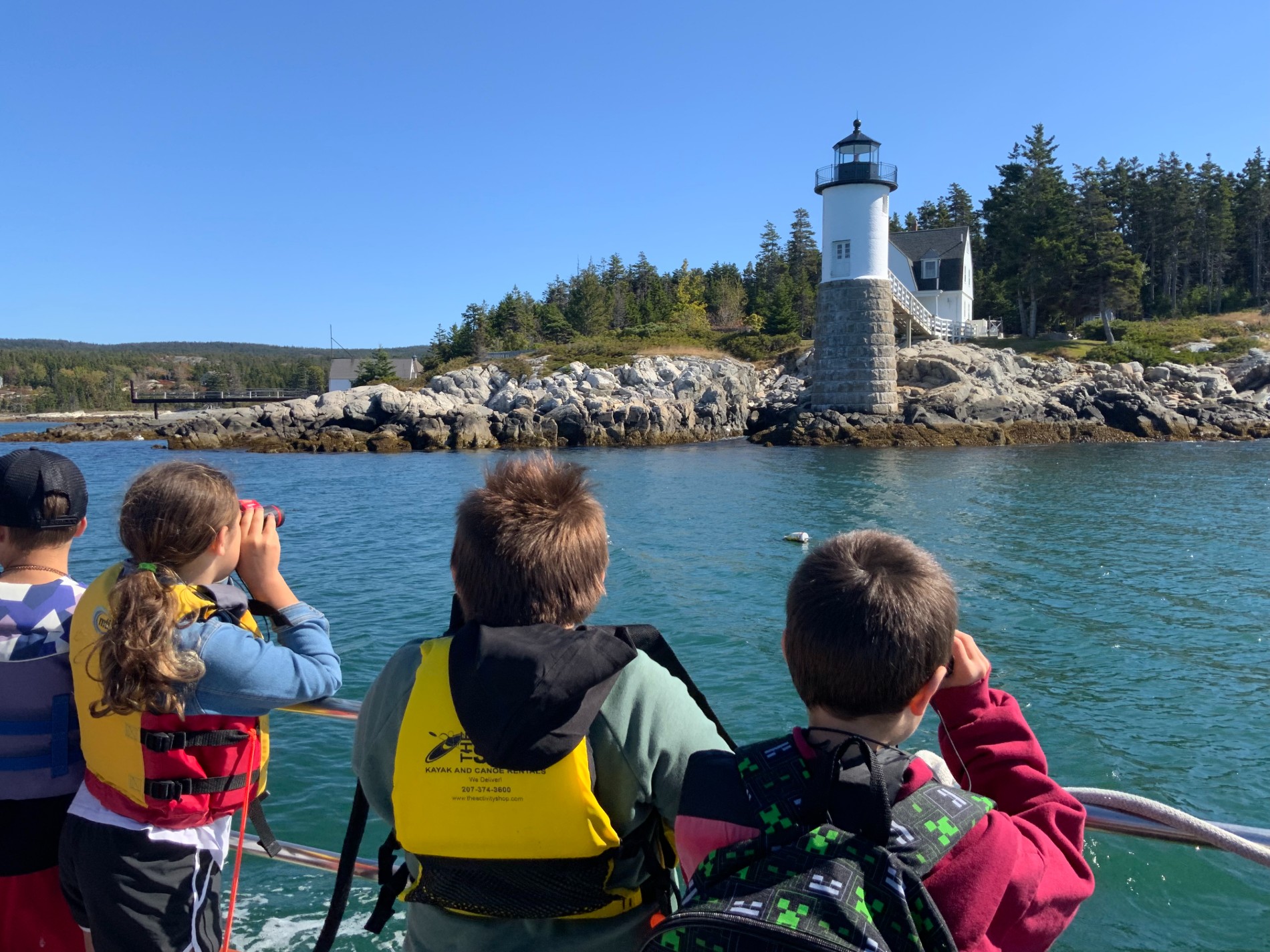
Deer Isle-Stonington students look out at the Isle au Haut Lighthouse during a trip to the island. (Courtesy photo)

For Deer Isle-Stonington, the Outdoor Classroom grants, combined with a Yellow Bus Fund grant from Friends of Acadia to assist with transportation costs, is also connecting students to Isle au Haut, a remote portion of Acadia National Park about six miles off the coast of Stonington.

Every year now, students take the 45-minute ferry ride to the island for a ranger-led program. Many of those students have never to been to Isle au Haut (so close and yet so far from their own
backyards).

The culture at Deer Isle-Stonington has shifted to one that embraces the outdoors in all seasons. Many classrooms are out on the nature trail every week, feeding the birds, conducting experiments, scouting for wildlife. And students continue to benefit.

“Some of the kids who have a hard time inside a classroom thrive outside,” said Bell. “They can decompress. Fifteen or twenty minutes outside and they’re so different when they get back to the classroom.”

This outdoor space is a place for students to learn, but they’re integral to its existence, too.

They moved soil and removed invasive plants. High school students designed and built a railing. They planted a witch hazel shrub that was donated by a neighboring land trust. Kindergarteners fill the bird feeders.

“All of these kids made it,” said Flores. “This place belongs to them.”

“Some of the kids who have a hard time inside a classroom thrive outside. They can decompress. Fifteen or twenty minutes outside and they’re so different when they get back to the classroom.”

– Martha Bell, environmental educator with Island Heritage Trust

Growing Connections to Maine’s Outdoors

Students walking by art teacher Martha Baldwin’s classroom at Ellsworth Elementary-Middle School often pause to whisper to plants.

“Hi, babies,” they might softly say, as they hover curiously over the seedling table, eyeing how much those seedlings have grown since yesterday or last week.

In addition to art instruction, nature is at the root of Baldwin’s approach to teaching. In 2022, she participated in the Acadia Teacher Collaborative program, where educators learn how to cultivate outdoor classrooms at their home schools. Baldwin’s students garden, press apples, and tap maple trees that grow on the school’s property.

She wants them to learn about food sustainability and all the splendid things that grow in Maine soil. She also wants to connect them with the outdoors—be that through planting kale or making syrup.

Those hands-on opportunities are critical, she said. “They often remember the sensory experience because they are more engaged, and I hope this will imprint for lifelong memories and inspiration in their own lives.”

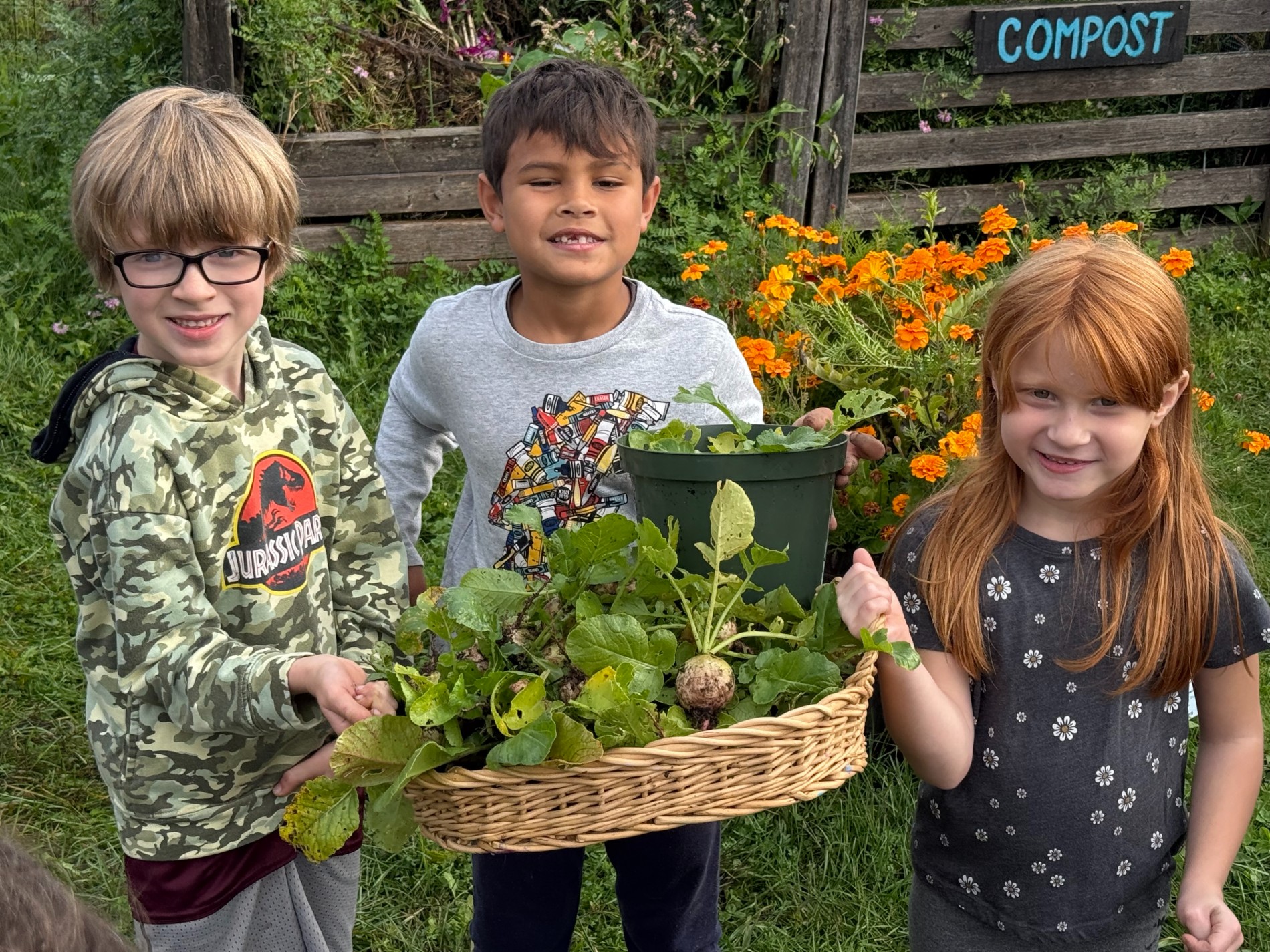
First graders at Ellsworth Elementary-Middle
School harvest watermelon radishes from the school garden last fall. (Photo courtesy Martha Baldwin)

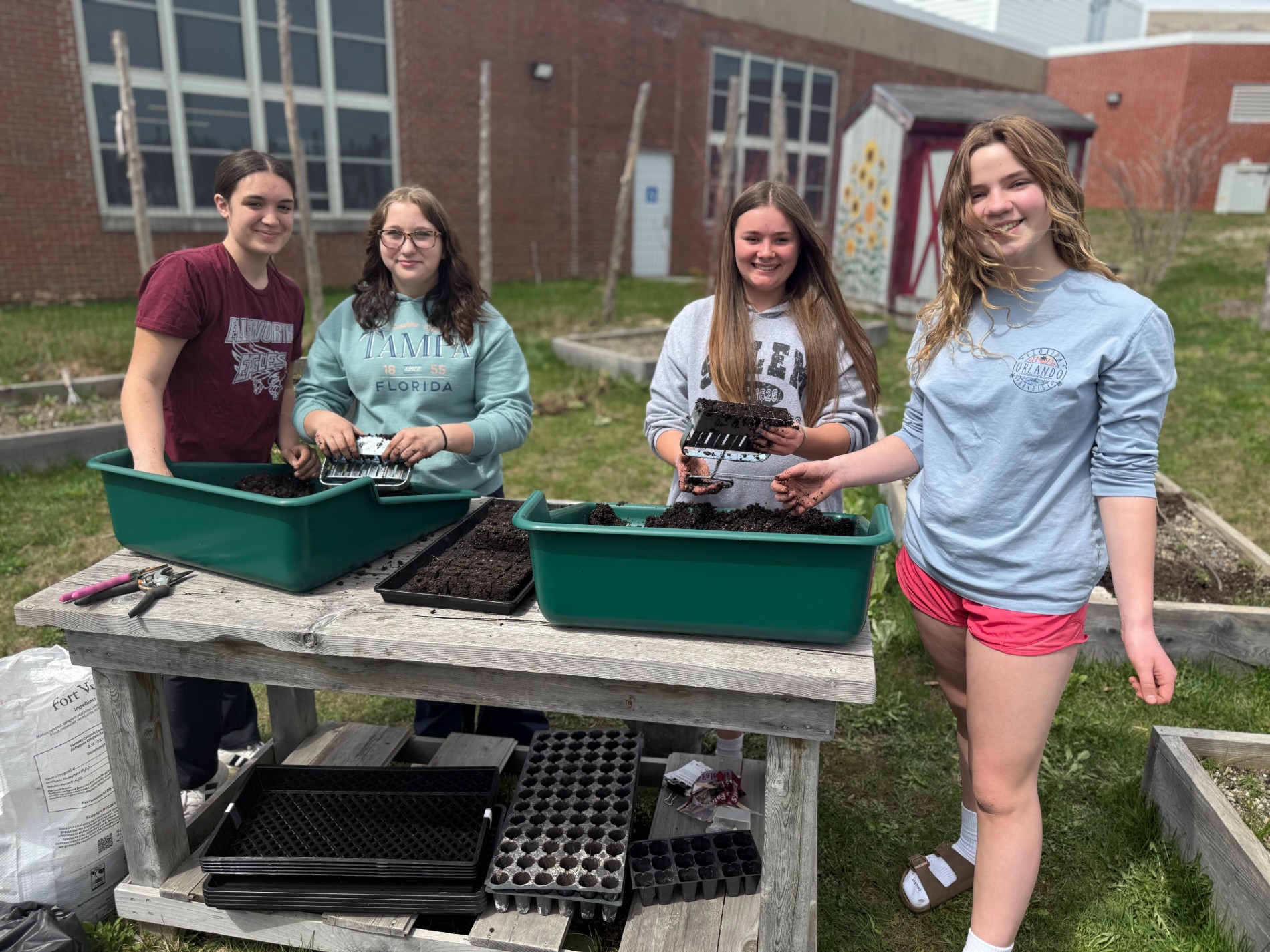
Ellsworth students with garden plantings. (Photo courtesy Martha Baldwin)

To help students get outside and get their hands dirty, Baldwin applied for an Outdoor Classroom grant from Friends of Acadia to purchase an apple press, gardening tools and gloves, wheelbarrows, and trail tools.

To keep the growing going during the cold months of the school year, grant funds also helped Baldwin purchase an indoor hydroponic garden. Stationed near the doorway of her classroom, its bright growing lights are like a beacon in the hallway, luring students over to peer at the vertical rows of sprouting basil, kale, and lettuce—and sometimes whisper their encouragement.

In addition to the hands-on experiences of growing things (and tasting them, of course), produce from those indoor and outdoor gardens will be part of the school salad bars, Harvest of the Month, and eighth grade garden group tastings as well.

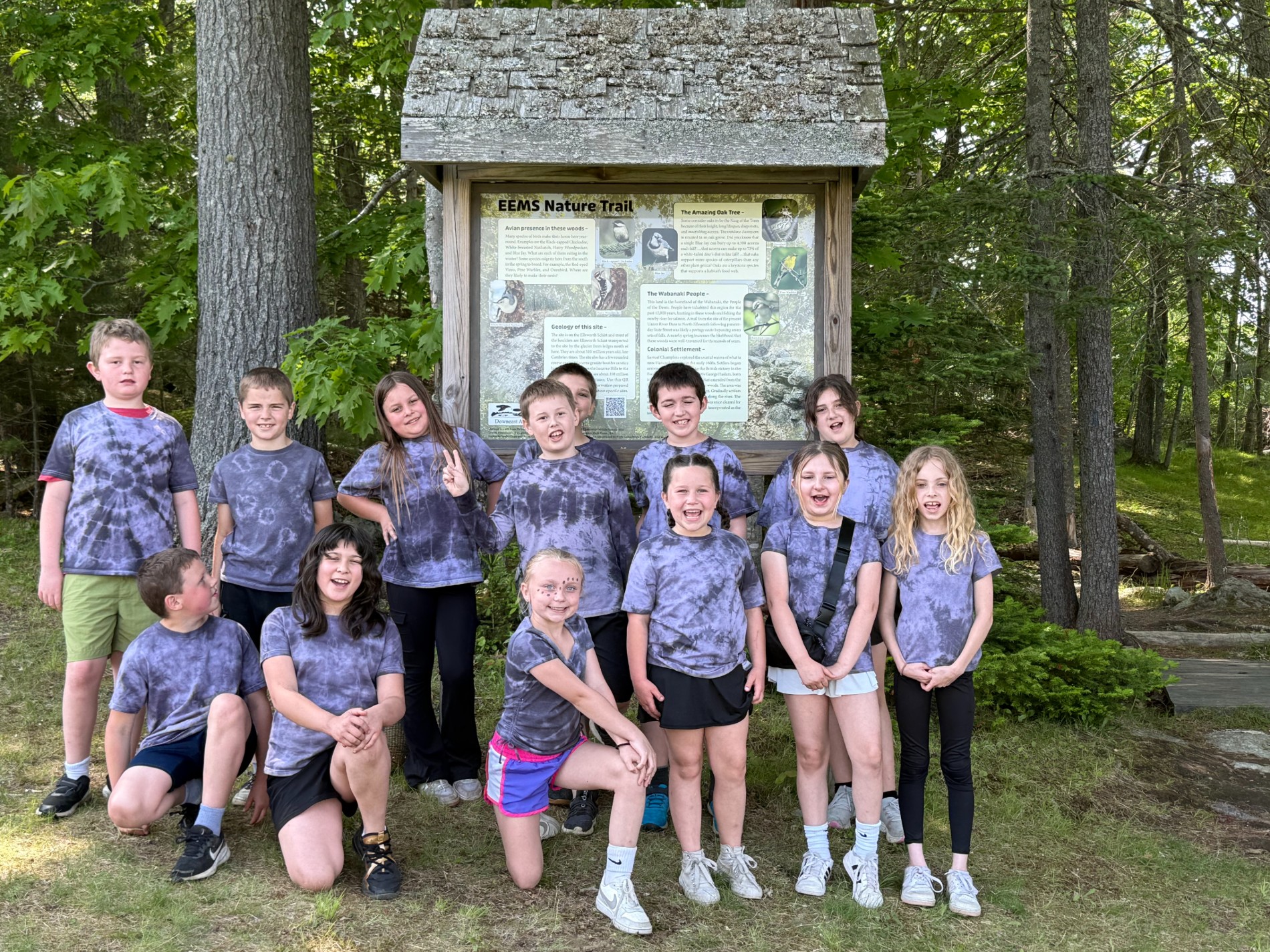
Ellsworth students pose in front of the trail sign. (Photo courtesy Martha Baldwin)

The trail tools come in handy as students work to build up a trail system on school grounds, too. Last year, Friends of Acadia’s Stewardship Manager Nikki Burtis helped seventh and eighth graders revitalize an older riverside trail on the school property.

Burtis also worked with students to build a bridge over a culvert that had made the trail challenging to traverse.

“When we take second graders out to tap maple trees in March, we used to go through the parking lot,” said Baldwin. “It’s magical for them to go on a trail.”

“Supporting Community is a huge part of the program. For many Maine towns, school is the heart of the community—where their children learn and attend after-school, where they hold bean suppers and elections, and so on. These grants help buoy these important Maine communities and send the message, ‘Friends of Acadia sees you, we want the best learning environment for your students, and we want you to feel a strong connection to Acadia National Park.'

Paige Steele, Acadia for All director at Friends of Acadia

Let’s Go for a Ride

“Nature has a calming effect on all of us,” said David Norwood, P.E. teacher at Ellsworth Elementary-Middle School. One of his favorite ways to get outside is on a bicycle.

“I’ve always thought of the freedom of riding a bike,” he said. “The world is just more accessible to you—the distance that you can go in the time you’re allocated.”

As a physical education teacher, he’s dedicated to getting students active and moving. Getting them moving outside is even better.

“It’s been 32 years of teaching, and I’ve watched the steady progression of the dominance of screen time in kids’ lives,” said Norwood. While he can’t stop the advancement of hand-held technology, he can take them for a bike ride.

Norwood sees the positive influence getting outdoors has on students—the shifts in mood, their attentiveness.

“The effects we’re talking about are acute,” he said. “They take place in the moment. We can see it. We can feel it when we go outside with them. But they’re also long-term.”

Riding a bike is simply fun, Norwood said. But it’s also a learned skill. Over the years, he’s learned that not every student has a bike at home. Some never learned how to ride.

“Not all of them have the space or the money or the time to or the family structure to go learn how to ride a bike,” he said.

A few months ago, Norwood received a $7,500 Outdoor Classroom grant from Friends of Acadia to purchase bikes that help fill an important gap in the school’s bike fleet.

The school system already had mountain bikes for the high school program. During Covid, they received funds for balance bikes—pedal-free bicycles for younger kids that help them learn the basics of balance and steering.

But there was a gap for second through fifth graders, particularly those who never learned to ride a bike and were too big now for the small balance bikes. That’s where the Outdoor Classroom grant comes in.

“That grant is a huge deal,” Norwood said. “We’re now going to have cycling from pre-K to high school. Every grade has access to bikes in school and the P.E. program.”

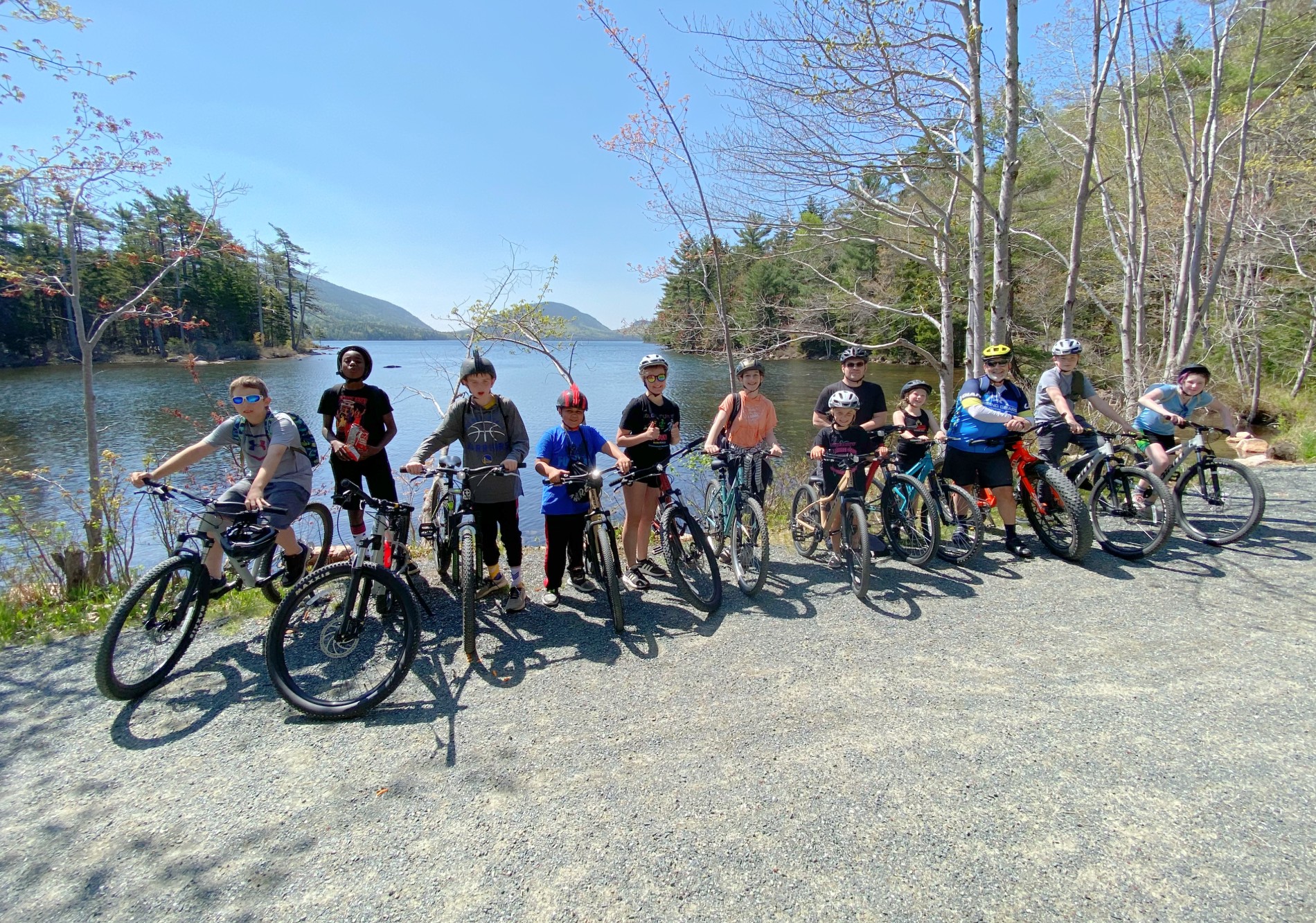
A group of sixth, seventh, and eighth graders from Ellsworth
Elementary-Middle School stop for a photo during their bike trip to Acadia in 2023. (Photo courtesy David Norwood)

Norwood said, to his knowledge, that’s a rare feat for any school in the state.

“We have way more freedom to give them experiences they might not otherwise have,” he said. “This spring, they’ll be able to start riding.”

The school board approved funds to build a storage shed for the bikes, and Norwood hopes to develop a program for students to help maintain them, ensuring the equipment stays in good shape
well into the future.

Learning to ride a bike is a skill the students will keep their whole lives, too.

In addition to riding during school hours, the Ellsworth Elementary-Middle School bike program has also ventured to one of the area’s dandiest car-free places to ride: Acadia National Park’s carriage roads.

In 2023, Norwood and another P.E. teacher took seventh and eighth graders to Acadia on a weekend, transporting students and bikes in a van. They rode the splendid and scenic Eagle Lake loop. Some of those students, Norwood said, had never been on the carriage roads.

School experiences like this open doorways for students, welcoming them to places they might not otherwise find themselves. For Norwood, the cycling program is also a way to give back to a community that supported him.

Several years ago, Norwood was in a bike accident. Hospitalized for four days, it took time for him to recover. It was a tough blow, he said, but one softened by the support of his students, their families, and the school. The community organized a kids’ bike ride to express their appreciation for him and their well-wishes for his recovery.

Out of that inaugural ride came the annual Bike Rodeo, a oneday event held at Ellsworth Elementary-Middle School, where students and parents come to spend the day riding bikes and learning safe riding skills and rules of the road. Local organizations and businesses are on-site to repair kids’ bikes for free and offer refurbished bikes to kids who need them. There’s ice cream, too.

Growing the bike program—helping students learn to ride and enjoy the freedom and fun of riding outside—is his way of supporting the community back.

“I hope this is a legacy I can leave behind,” he said.


SHANNON BRYAN is Friends of Acadia’s Content and Website Manager.