The Bold and the Beautiful:
Loons in Acadia


An icon of Maine’s lakes, the life of a common loon is chock-full of challenges. The Mount Desert Island Loon Monitoring Project tracks the island’s breeding territories and loon nesting sites—including a few that float.

BY JAZMINE DEBEAUCHAMP

There’s a soap opera of sorts playing out on Echo Lake.

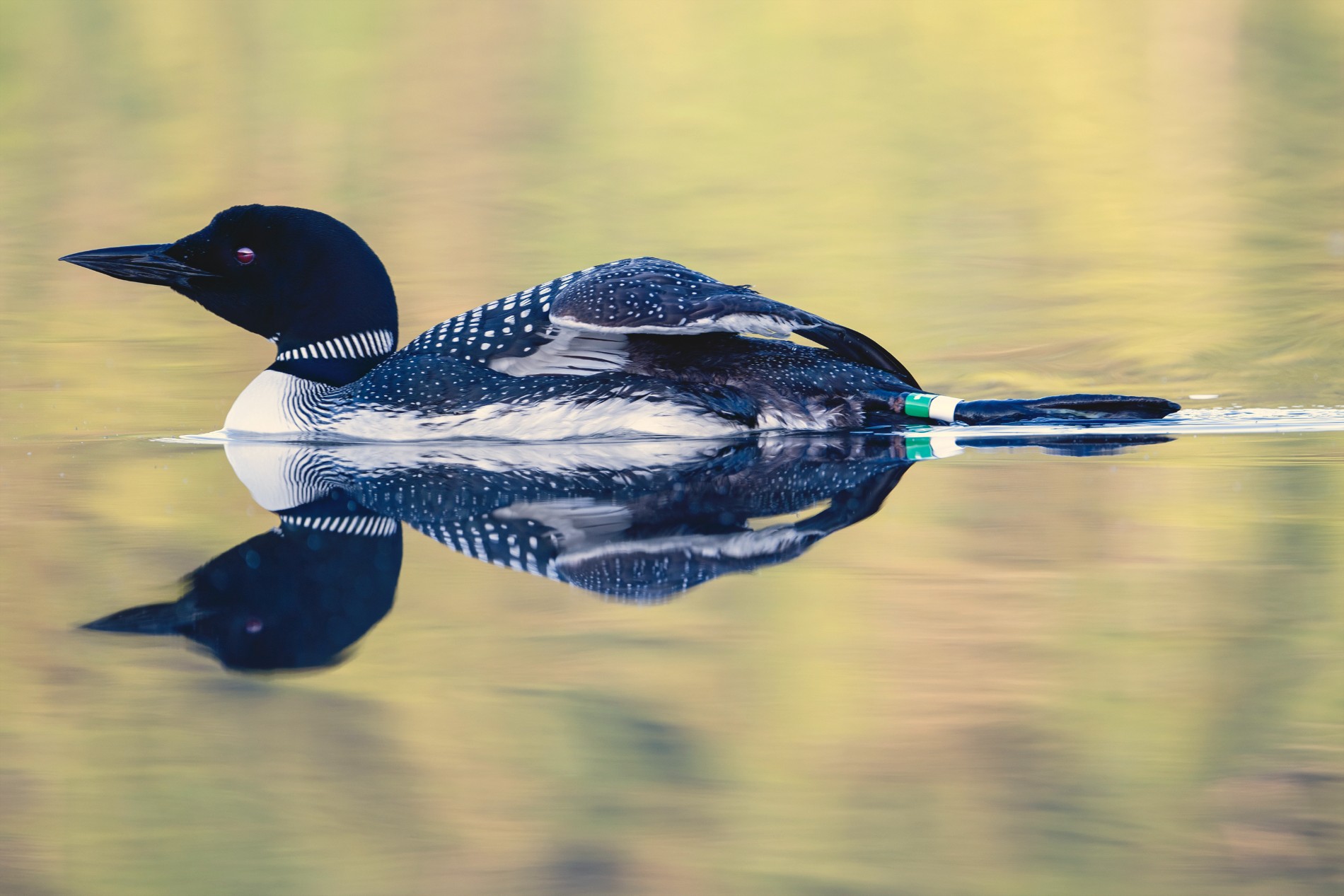
At the center of our story: Lily and Herman, a pair of common loons. Named after characters from 1960s sitcom “The Munsters,” Lily and Herman were the likely territory holders on the south end of Echo Lake for years before being banded by researchers in July of 2019. Banding means the placement of unique color combinations of plastic bands along with an aluminum band with imprinted numbers and letters on the loon’s legs.

The ability of researchers to identify individual birds over long periods of time yields lots of information about their lives. The dapper-looking duo met up each spring to reacquire the territory, mate, and hopefully, raise chicks together. But some of their years together were tough.

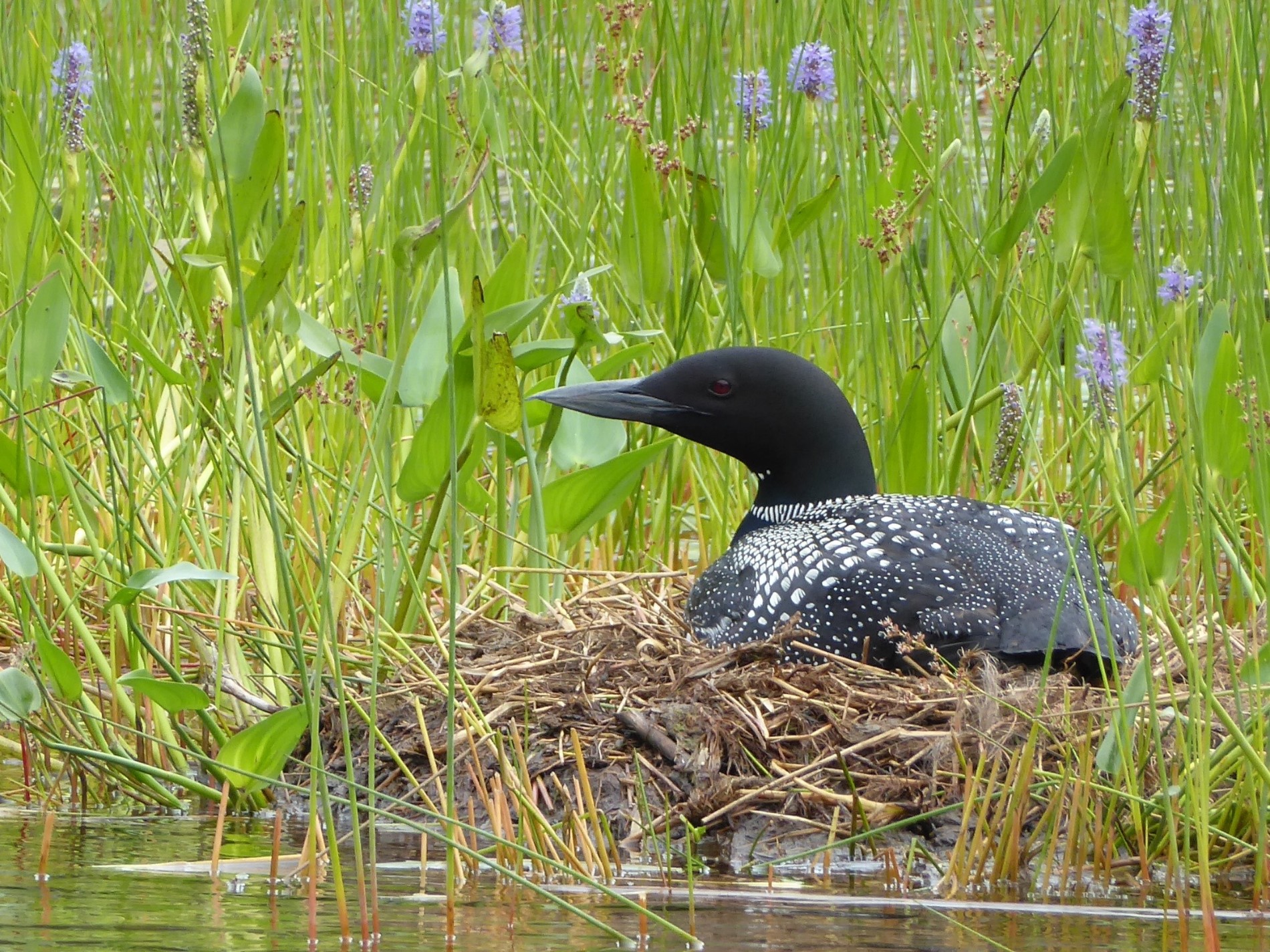
During the summer of 2017, dropping lake water levels due to drought forced Lily and Herman to move their nest site more than once. Keeping their nests at the water’s edge isn’t simply a preference for loons, it’s critical.

“Loons cannot walk, and that’s because of their anatomy,” said Billy Helprin, director of the Somes-Meynell Wildlife Sanctuary, an MDI non-profit conservation and education organization. “They are specialized for chasing fish underwater, not for moving well on land. Their legs are way at the back of their bodies, so their center mass is way forward.”

Helprin spoke about loons during one of Friends of Acadia’s Pints for a Purpose talks last summer. Loons, he noted, are heavy birds, and they lack hollow bones, unlike most other birds. These attributes help them dive easily, but on land, they have to push themselves on their bellies and chest with their legs or pull with their wings.

Loon on nest at water’s edge. (Billy Helprin photo)

“If a lake’s water level starts to decline, as it typically does as the summer progresses, and a loon pair started with a nest in one spot in May, and now the edge of the water is farther away in June, they’re really vulnerable, trying to get back and forth,” said Helprin. “That’s a chance for an eagle or some other predator to pin down an adult or make it harder for the adults to stay on the nest and defend the eggs.”

On the other hand, close proximity to the shoreline can lead to nests getting flooded by sudden big rain events. Large boat wakes can wash over nests and knock eggs into the water. Once they are in the water, there is no way for the loons to get them back into the nest. Loons will often try to re-nest after such an event if it happens early in the nesting period, but they may also give up for the year.

Despite the multiple nest relocations during the 2017 season, a mink ultimately got to Lily and Herman’s two eggs. It was easier for the mink to attack from different angles with more dry land around the nest, flush the incubating adult, and get to the eggs.

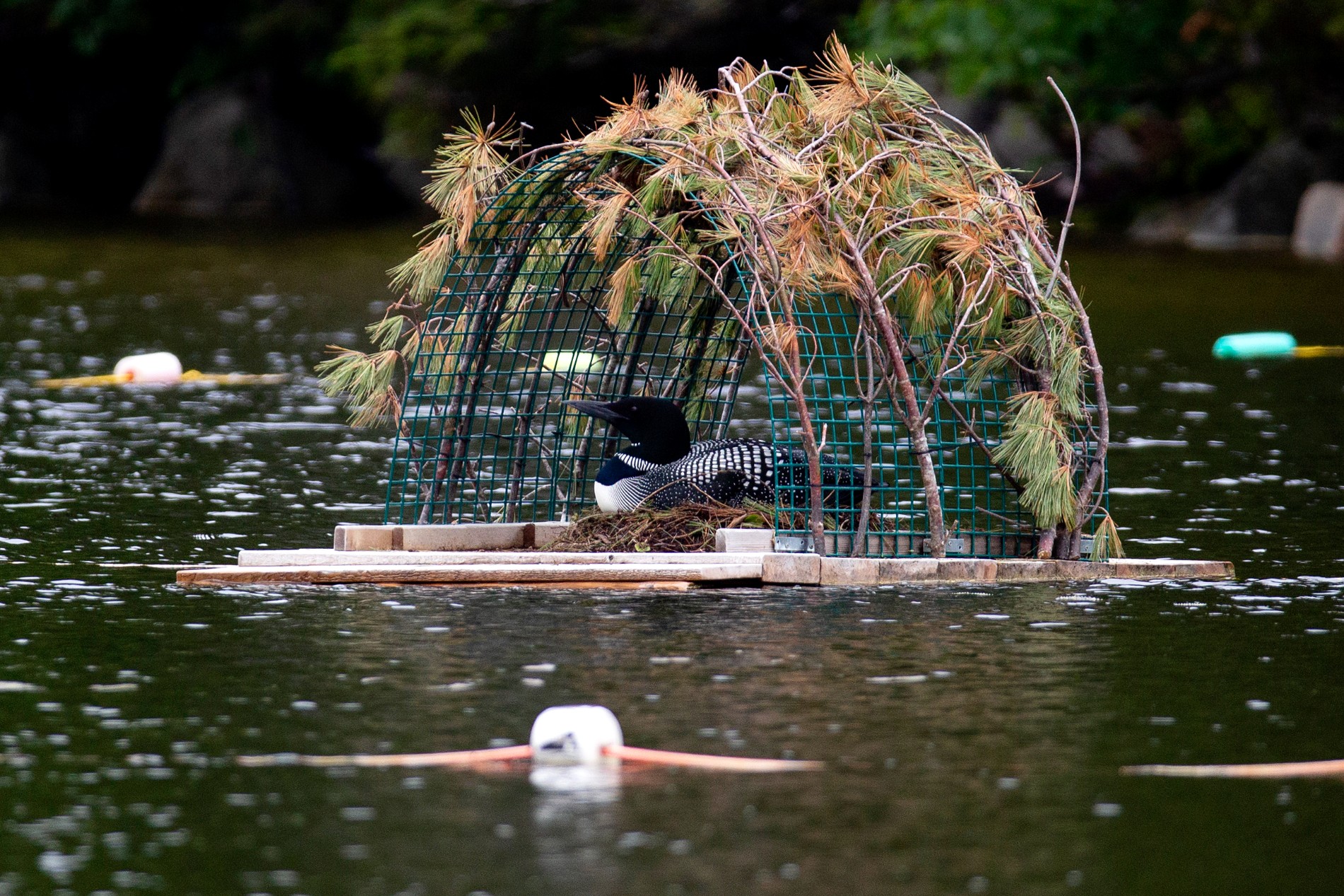
Not long after, Somes-Meynell and Acadia National Park biology staff launched a floating nest raft at the south end of Echo Lake. Nest rafts are human-made structures set away from shore to provide improved nesting conditions for common loons.

“Floating nest rafts can help deal with fluctuating water levels,” said Helprin. They’re able to rise or fall with droughts or flooding events, and because they’re separated from land, they offer more protection from many predators. Placement of a raft has to be done carefully, with many variables to consider, and there is no guarantee that a loon pair will choose to nest on it.

However, Lily and Herman took to their floating nest raft straight away.

“Herman, the male, especially loves that raft,” said Helprin. “Most years, he will jump on it even as I’m paddling it out and getting it into position in the spring. He starts fixing the vegetation on board to his liking, and he makes soft cooing sounds, trying to get the female interested.”

A common loon sits on its nest on a raft at Echo Lake. Many nest rafts have screens along the sides and overhead to provide additional protection. (Ashley L. Conti/NPS/Friends of Acadia)

For the next three years, Lily and Herman hatched and fledged two chicks each season—very good success. All seemed to be going swimmingly for the pair.

That is, until a newcomer arrived.

“I was down by Echo Lake Beach in a kayak in the evening. Herman was there, and there were two other birds,” said Helprin. Those two other birds were Lily and an unbanded female rival.

“I heard some splashing behind me and then a long chase ensued,” he said. “Two of the loons were ‘wing rowing,’ using their wings to pull themselves across the water, like a swimmer’s butterfly stroke. They went from Echo Lake Beach, zigzagging all the way up to Ikes Point, almost three-quarters of a mile away. Then the unbanded female came back, and Lily came back, and they did it all again!”

Herman, meanwhile, waited it out. Much like the fickle-hearted characters on a daytime soap opera, loon attachments don’t last for life.

“Loons show fidelity to the territory more than to the other bird, although some pairs stay together for a long time,” said Helprin. “Herman was like, ‘You two figure it out, I’ll be hanging out down here.’”

The newly arrived female eventually won out—that time anyway.

That summer, she and Herman produced two eggs, tending to them on the floating nest raft. Now and then, Helprin said, Lily made an appearance.

“I saw Lily on those eggs on the raft when no one else was around,” Helprin said. “I wondered if she’d poke holes in the eggs or kick the eggs off.”

She never did. Even still, those eggs didn’t stay on the nest long, although what exactly happened to them isn’t known.

And then another plot twist: “Lily fought her way back in and displaced the unbanded female,” said Helprin. She and Herman eventually had two eggs, but it was late in the season.

“They were sitting on them into August, but their eggs weren’t viable.”

Over the past few years, the unbanded female and Herman have continued to pair up, although they’ve not been as successful as Herman and Lily had been.

“This year (2025) they produced two eggs, one hatched, and that chick survived,” said Helprin. “So that’s good.”

As for Lily in 2025, she was spotted in different places, sometimes on Echo Lake or out in Somes Harbor or the south end of Long Pond.

“Maybe, sometime, she’ll come back and take back over.”

Echo Lake south male with 101-day-old chick in 2025. (Ray Yeager photo)

MDI Loon Monitoring Project

Since 2002, the Mount Desert Island Loon Monitoring Project has gathered data on the reproduction and population of nesting loons on Mount Desert Island (MDI). The project is a collaboration led by Somes-Meynell Wildlife Sanctuary with the BioDiversity Research Institute (BRI), based in Gorham, Maine, and Acadia National Park’s biology team.

“We study all the loons that nest on all the lakes of Mount Desert Island,” said Helprin, who has coordinated the project for a decade. “Working as a bigger, interconnected network is important because it provides multiple layers of awareness and protection for anything of value, in this case, our loon population.”

Nearly every day from spring through fall, volunteers, partner organizations, and staff record information on loon behavior, nesting success, and chick survival on the island’s lakes and ponds. This long-standing monitoring effort helps highlight the annual triumphs and challenges of loons in response to environmental changes and disturbances.

The lakes of MDI and Acadia National Park are highly sought after by loons eager to find a suitable place to build a nest and raise their chicks.

Park visitors can usually spot these large diving birds on Acadia’s lakes in spring and summer, during their breeding season, though their emotive calls often lead to them being heard before they’re seen. Common loons molt to their recognizable black-and-white breeding plumage in early spring and move towards freshwater once the lake and pond ice melts in late March or April to try to claim a nesting spot.

When breeding season arrives, there are more eligible loons ready to mate than there are available nesting sites, which leads to annual territorial drama.
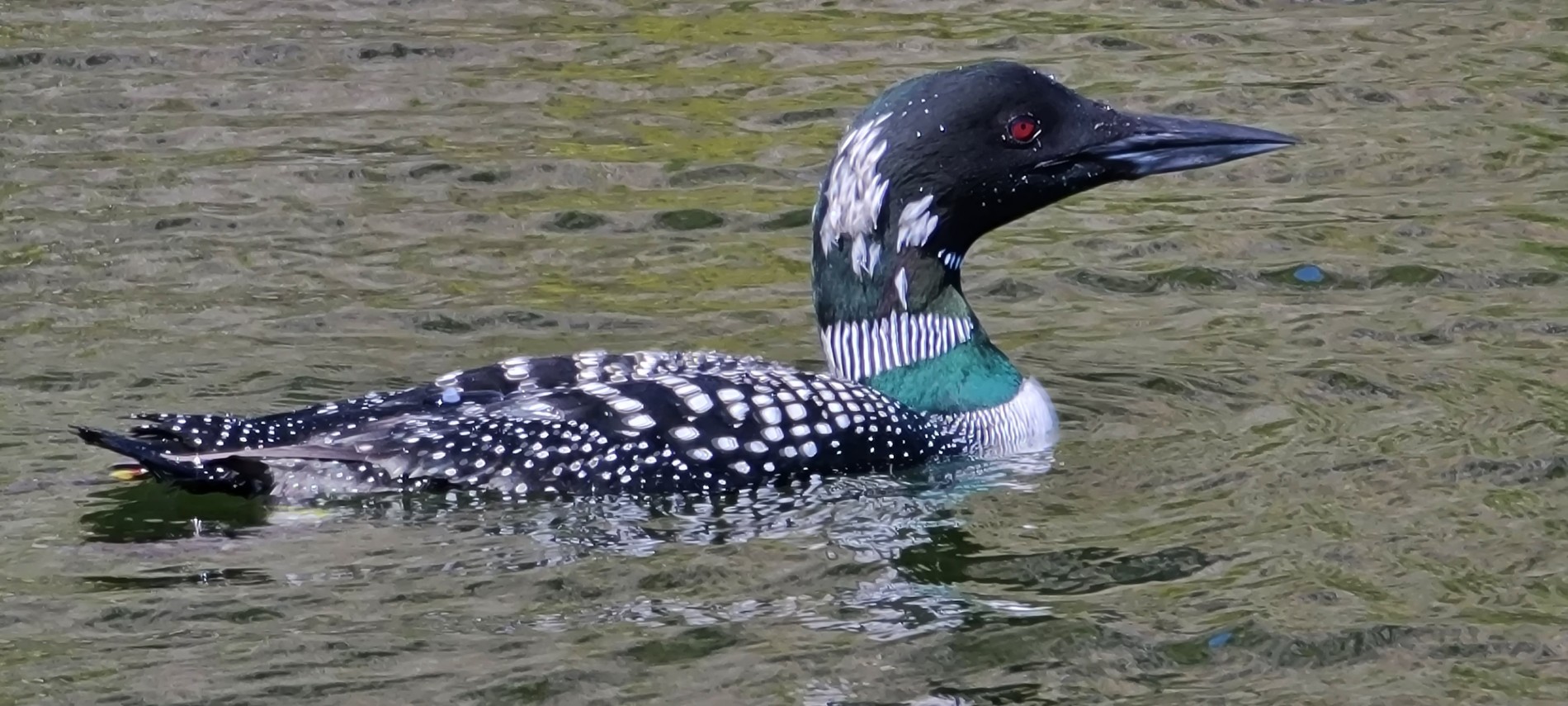
Portrait of Lily still molting into breeding plumage in April 2021. (Billy Helprin photo)

“A loon’s breeding plumage comes in during their third summer, but younger birds in particular are not very likely to get a territory because they have to fight their way in and displace somebody else,” said Helprin. It is estimated to take about six or seven years to become dominant enough to get a territory, and there are not enough for everyone who wants one.”

They’re very territorial birds and will battle violently to defend their existing nesting area or to usurp the current residents, with the victor ultimately claiming at least part of the lake or pond as their own. In fact, many of the sounds we associate with common loons are used during aggressive, territorial encounters. MDI-area loons that don’t win a territory or a partner—the “non-breeders”—have the option of being on the nearby ocean. Many will repeatedly return to the lakes to challenge resident territory holders throughout the summer.

A nest’s location is critical to the loons’ success, and it can often determine whether or not the pairs’ eggs hatch.

Although completely avoiding predators is impossible, a good nest location offers some protection from potential threats. Mammalian predator presence, like that of raccoons, foxes, otters, and mink, encourages loons to choose nest sites with the best protection available. Shrubby vegetation above and around a nest can help block eagles and owls from swooping down and flushing out an incubating loon. Small islands, just like rafts, provide a moat to make predation of eggs less likely, but are no guarantee of protection.

Sometimes, loons just have to go with the best available site despite its drawbacks.

Getting airborne tends to be a bit challenging for these birds as well.

“They are heavy birds with relatively small wings, and that means that they have to run on the water and flap simultaneously for quite a distance to take off,” Helprin said. “Both modes of locomotion are necessary to get enough momentum to get airborne. It’s just like a plane at the airport: the bigger the aircraft, the longer the runway needs to be.”

This means that they should only land on lakes big enough to take off from; otherwise, they will be stuck.
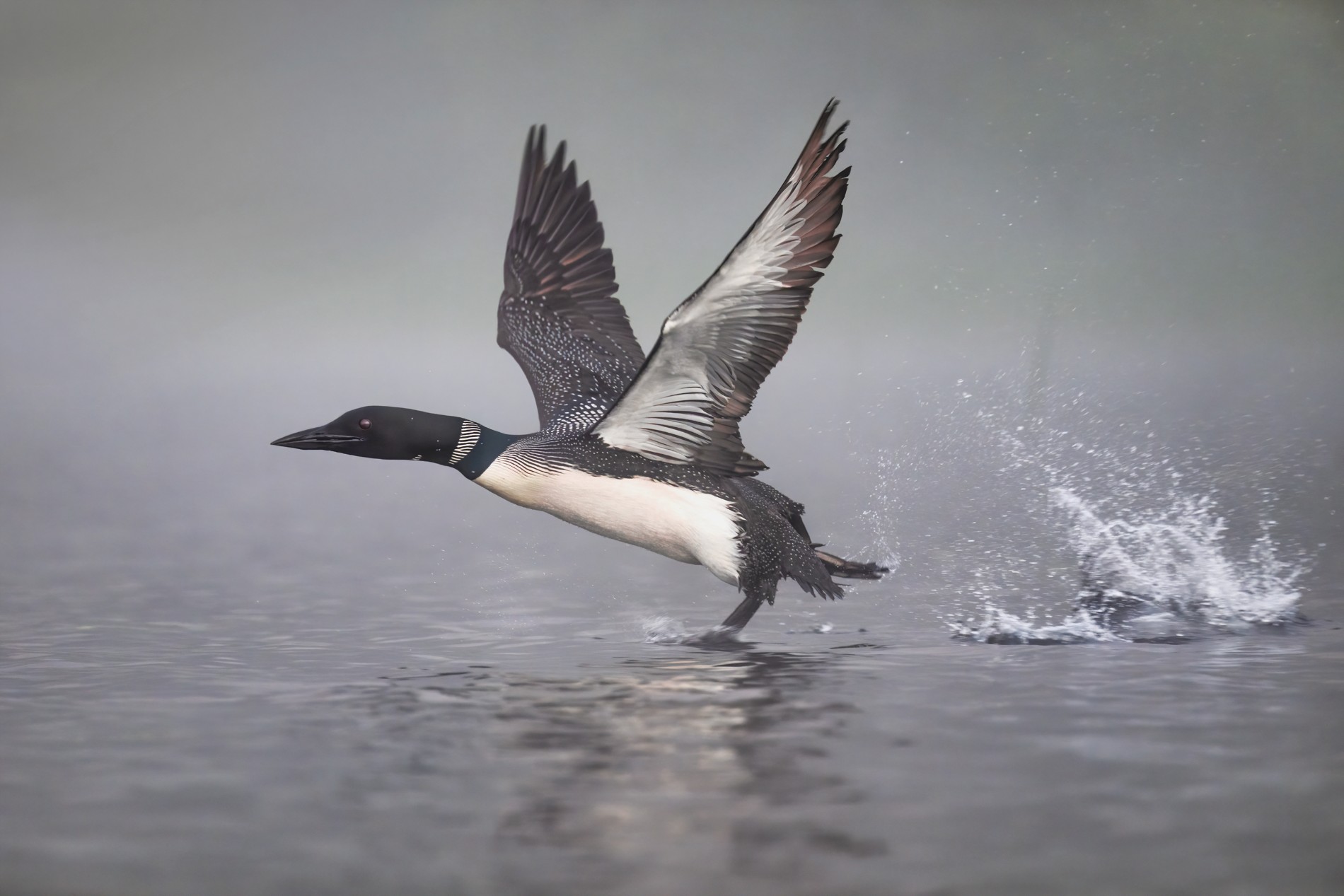
Adult loon running on water and flapping wings to take flight. (Ray Yeager photo)
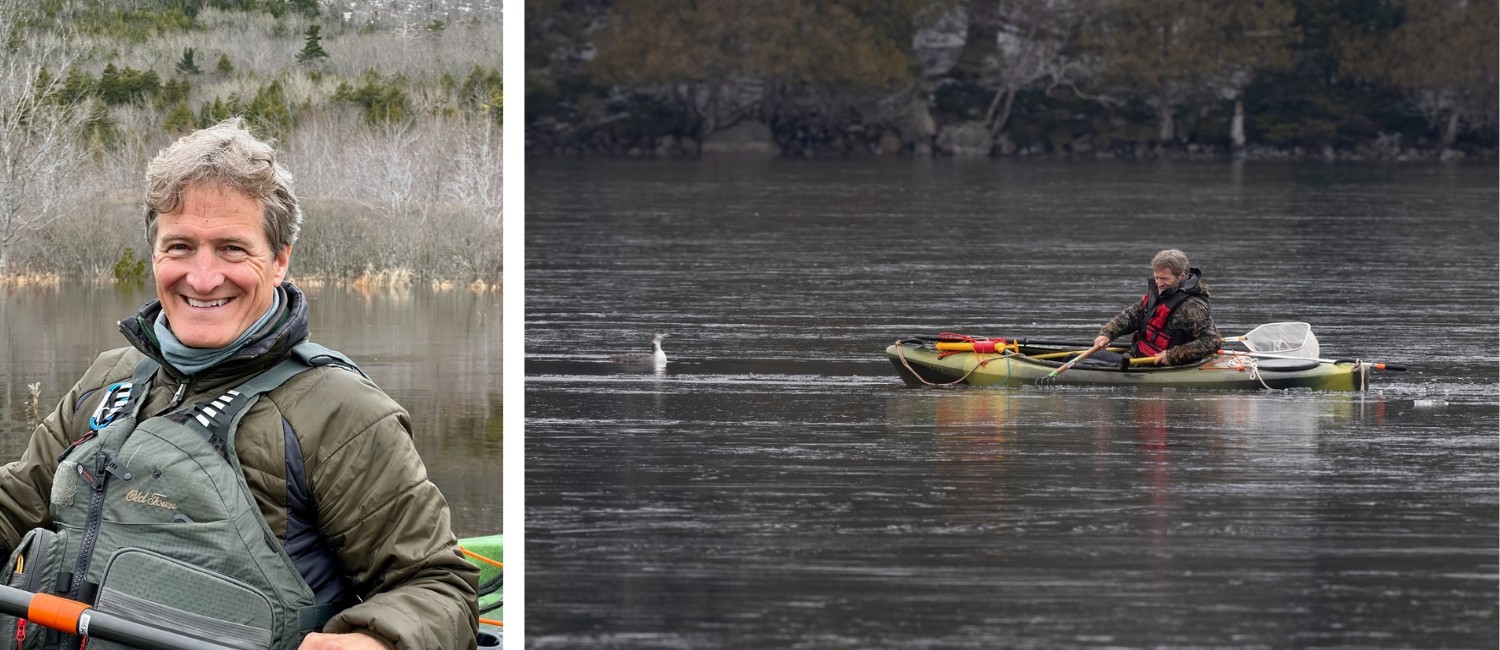
Left: Billy Helprin in kayak on flooded Great Meadow. (Bo Greene photo) Right: Billy Helprin breaks up ice to rescue a loon on Somes Pond. (Photo Courtesy Ray Yeager)

“It’s not just the area of the lake, but the shape, coves, peninsulas, and islands that are important features of territory potential,” said Helprin. Identifying a truly good nesting site isn’t as simple as finding an unoccupied body of water.

Most years, loon pairs nest on Somes Pond, Long Pond, Seal Cove Pond, Upper Hadlock Pond, Little Long Pond, Jordan Pond, and Eagle Lake. “Eagle Lake, as big as it is, 436 acres—that’s one territory,” said Helprin.

There are typically two pairs on Echo Lake—one on the south end and one on the north—and three pairs on 900-acre Long Pond.

Somes Pond is a one-territory water body of 104 acres. Witch Hole Pond, a relatively small 28 acres, is a newer territory where loons are nesting; Round Pond used to host loons, but it’s been about a decade since any loons have nested there.

Each year, if they are able, the most dominant male pairs up with the most dominant female in their freshly acquired or reacquired territory, and they begin the next part of their journey: incubating eggs for about 28 days. If they are lucky and the eggs hatch, then they start the arduous 12-week (or so) journey towards fledging.

Although, as Lily and Herman, and others experience, competition can arrive at any moment.

“A lot of recon happens by “floaters” or unwelcome visitors all summer on certain lakes,” said Helprin. “It’s common to see groups of five, six, or seven loons out in the middle of Echo Lake. When there’s a skirmish, the non-residents are scoping things out to see ‘how strong is this opponent? Can I overcome him or her?’” Males displace males and females displace females, but they all may be involved in above-and-below-water fights.

Once their eggs are laid, both parents share responsibility, Helprin said. “Both the male and female do everything (except lay eggs). …They both incubate. They both feed the chicks. They both have them on their backs early on for protection. Don’t assume that a loon with a chick on its back is a mommy and her little one.”
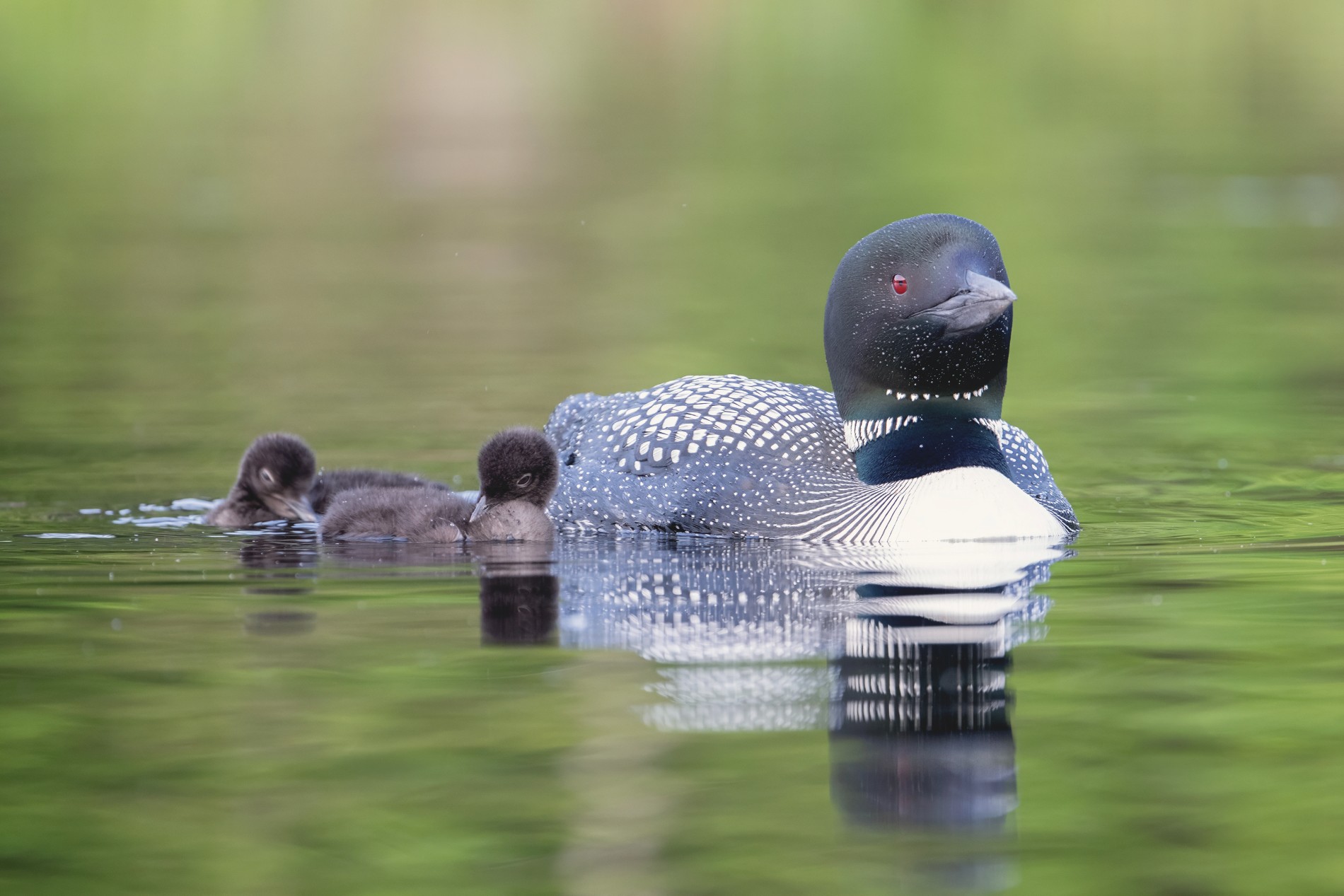
Six-day-old chicks preening alongside their parent on Upper Hadlock Pond in July 2025. (Ray Yeager photo)

If all goes to plan, one to two chicks will hatch about a month after they are laid. Once hatched, the parents will provide protection for the 12 weeks it takes for their chicks to be able to fly away from their natal lake. They do all of this while capturing fish and aquatic invertebrates like crayfish to feed themselves and their offspring.

Last summer, a total of eight chicks hatched from Little Long Pond, Somes Pond, Upper Hadlock Pond, and Echo Lake. Of those, five successfully fledged.

“So that’s five out of eight chicks for survival to fledging time. But it’s 5 out of 12 territorial pairs of potential parents,” said Helprin. “That’s the population metric that’s usually used by loon biologists.

The target is to have about a 50% survival rate for a sustaining population so one chick every other year across all territorial pairs would be a good outcome. A higher percent survival rate would indicate a building population, and less than that is a decline.”

“In the past 10 years, we have had 65 chicks fledged out of 98 eggs hatched, and 65 chicks for 115 ‘territory seasons,’” said Helprin. “That’s really good.” In many other parts of the state and across the northern part of the continent where loons breed, they are not doing as well.

A Tough Loon Life

“The oldest common loons we know of spend their summers at the Seney National Wildlife Refuge in Michigan’s Upper Peninsula. The male, banded as a chick and known as ABJ, was 38 in 2025 and the female “Fe,” banded as an adult, was at least 39. They have produced 32 chicks together and 29 fledged, but they split up in 2022 and have had other mates since.”

“They can live a long time, but a lot of them do not,” said Helprin. “It can be a very tough life for loons, as it is for most animals.”

Predation is a significant threat for both eggs and hatched chicks.

“Oftentimes one or both parents leave chicks by themselves to defend the territory or forage in other lakes or on the ocean if they have a relatively small pond as their territory,” Helprin said. “And there may be eagles watching who take advantage of parents being away.”

Human disturbances and rival loons are other dangers.

On the north end of Echo Lake last year, observers noticed a problem for the banded territorial pair loons. The male’s left leg was entangled in fishing line, affecting his mobility and hunting success. It was hard to tell how the line was attached and exactly where, but he often held his left leg out of the water, dragging it behind him or pulled up by his wing. Despite the male’s encumbrance, the pair managed to hatch one chick.

“He was really handicapped,” said Helprin. “He was able to dive in shallow water, catch crayfish and small fish to feed himself, but he wasn’t able to feed the chick.”

Echo Lake north-end male dragging its leg due to fishing line entanglement. (Ray Yeager photo)

Sanctuary staff and a BRI biologist boated out to try and capture him and remove the line, but he dove out of sight every time they approached. “There was just no way we could get close to him. We just had to wait.”

An intruding male loon took advantage of the original male’s vulnerability, Helprin said. “Another male came in and displaced him and killed the chick. That’s not uncommon, to disrupt the bond of the existing pair.”

The original male loon, unable to take off in his condition, was forced to live in hiding on Echo Lake.

“He had to hide out on the edges and up in the very north cove in the shallows,” Helprin said.

That banded male eventually disappeared from Echo Lake. He was observed making test runs on the water in mid-August and was not seen after days of thorough searching. It’s most likely that he was able to fly off and is spending the winter along the coast—hopefully without the fishing line still attached.

“It will be interesting to see what happens this spring, whether he will return and try to take back the territory,” Helprin said.

Winter Weathering

As the breeding season comes to an end, loons begin to leave their lakes and head to the ocean for the winter—typically one parent goes first, while the other remains to tend to the chick(s) until they’re ready to go. Sometimes parents leave before the chicks and sometimes the youngsters depart first.

While extremely territorial during the breeding season, loons will often congregate on lakes in large groups in the late summer and fall. No longer needing to defend their territories or their chicks, they raft up and socialize before eventually migrating to coastal waters for the winter.

Compared to midwestern loons, who migrate thousands of miles from the interior of the continent to the Gulf of Mexico, Acadia’s loons have a very short migration if they stay along MDI shores.

“These birds are half marine and half aquatic, the ones that are breeding,” said Helprin. “Here (in coastal Maine) we have ocean and lakes right next to each other. That gives us an opportunity to see things that most people observing inland loons wouldn’t see.

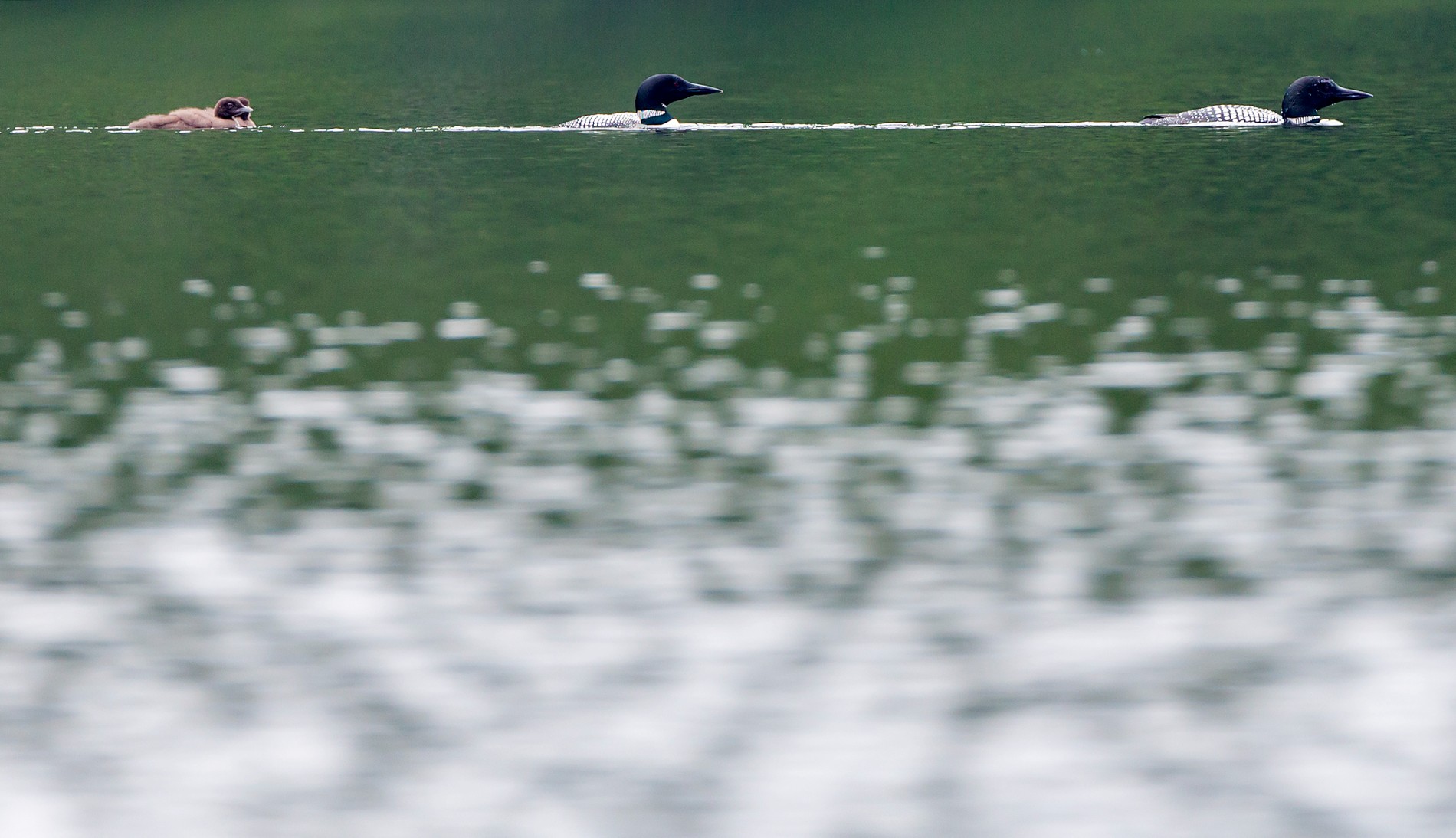
Common loons swim with chicks on Echo Lake. (Photo by Will Newton/Friends of Acadia)

That includes being able to follow fledged Somes Pond juveniles over to Somes Harbor and Somes Sound where, in multiple years, different young birds have hung out with and been fed by the Somes Pond male (his or her father) for many weeks after leaving its natal lake. Two different Somes Pond resident males have done this!”

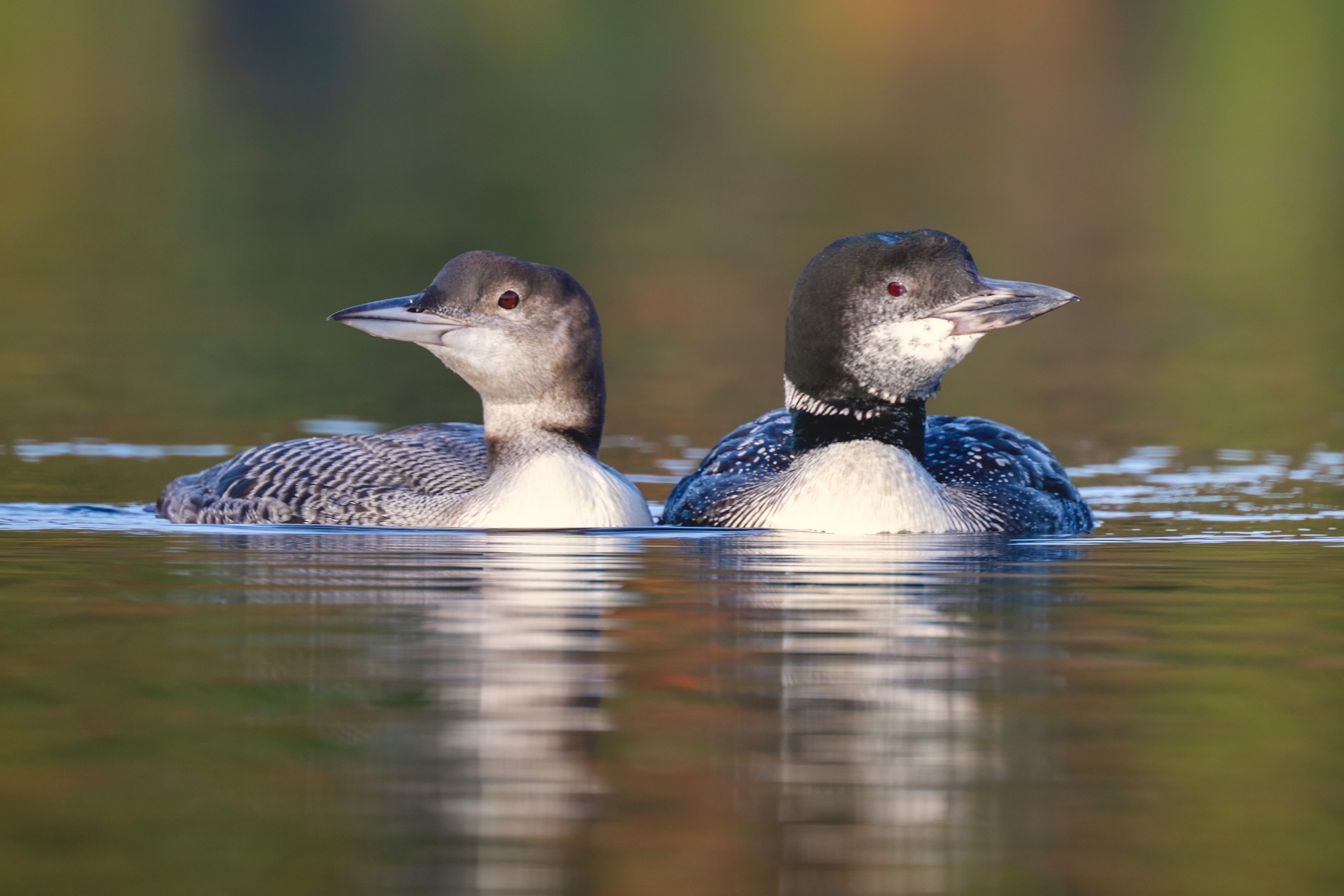
Winter loons may be unrecognizable to the summer visitor. Loon plumage changes from fall to winter to a subdued gray and white. Their red eyes become less vivid, and their bills tend to lighten to gray shades.

When spring comes again, they return to the lakes to defend their territories, mate, and hopefully raise another generation.

Their striking appearance and haunting calls make common loons one of Acadia’s most recognizable birds, but their resilience defines their importance to the park.

Thanks to dedicated monitoring, greater understanding, and mindful lake visitors, these iconic birds have a better chance of thriving in Acadia National Park.


JAZMINE DEBEAUCHAMP is a freelance writer and former Raptor Intern at Acadia National Park.

How You Can Help Protect Loons

Small actions can make a meaningful difference in protecting loons on MDI—and everywhere.

  • View loons from a good distance (at least 100 feet) with binoculars and long camera lenses to reduce stress and the risk of nest abandonment. If a loon (or any animal) changes its behavior, moves away, or vocalizes in your presence, you are likely too close.
  • Keep dogs on leash and away from areas where loons might be nesting—loons view dogs, even tiny ones, as predators. Minimize boat wakes near shorelines and nesting areas to prevent nest disruptions. Maine law requires boaters to operate at “headway speed” within 200 feet of any shoreline, including islands. “Headway speed” means the
    slowest speed at which it is still possible to maintain steering and control of the watercraft.
  • Use alternatives to lead fishing lures and weights. Lead poisoning from ingested tackle is a leading cause of death for adult common loons and use of small-sized lead gear is
    prohibited by Maine law. Learn more at maineaudubon.org/projects/loons/fish-lead-free/ and fishleadfree.org/me/
  • Remove broken or stray fishing line and hooks from the water and shorelines. Dispose of them in the garbage or recycle in dedicated containers. Line entanglement is a significant cause of harm and death for loons and other animals that inhabit lakes.
  • Report MDI observations and share photos of banded loons, predation events, or loons in distress to Billy Helprin at the Somes-Meynell Wildlife Sanctuary (email somesmeynell@gmail.com or call 207-244-4027). More observers contributing information helps us all know more about how our loons are doing. Join loon-watching walks in the summer to learn more.

Browse Loon Count Data
Curious about statewide loon counts over the decades?

Check out Maine Audubon’s interactive Annual Loon Count Results, where you can view data from 1983-2025. Last year’s loon count showed a healthy population in
Maine. Search Acadia’s lakes and a host of sites around Maine. Find it on maineaudubon.org.

For more information on MDI’s loon population, visit the Sanctuary’s website: www.somesmeynell.org/mount-desert-island-loon-monitoring-project