 Join
Join Donate
 Acadia National Park
My Acadia: 75 Years of Visiting Acadia
BY SUZANNE LOEBL
March 25th, 2026
BY SUZANNE LOEBL
March 25th, 2026
In August 1950, Ernest Loebl, my new husband, and I stepped out of a spiffy, black limousine at Acadia National Park’s Blackwoods Campground. A uniformed chauffeur held the car door, then unloaded our luggage: two enormous backpacks.
Some campers doubtlessly were surprised at our glamorous arrival. We were glad when the fancy car disappeared and we blended into the somewhat disheveled looks typical of campers.
Back home in Manhattan, we had planned our ambitious vacation to Maine. We had no car, little cash, and planned to hitchhike whenever possible. We intended to start our trip in Churchill Junction and then canoe down the Allagash Wilderness Waterway to Greenville. From there we would hitchhike to Baxter State Park and climb Mount Katahdin. Then we would hitchhike our way to Bar Harbor and its crown jewel, Acadia National Park.
Not everything worked out as planned. We never got to Churchill Junction; we got to Katahdin, but the famous peak remained shrouded in clouds for five days straight. We landed in Bar Harbor and, for the first night of our stay, luxuriated at a motel on Main Street. Then off we went to camp at Blackwoods.
Being sick of hitchhiking, we called a taxi. A limousine is what came for us, hence our seemingly fancy arrival at the campground.
We felt very grown-up, but we were newlywed graduate chemistry students. Both of us had recently immigrated and met at Columbia University. Bar Harbor was unlike anything I had ever experienced: a high-end, sleepy resort town amid unlimited beauty.
Our week in Acadia was magical. We took a boat trip and admired the Porcupine Islands. We watched the sea crashing into Thunder Hole, carefully studied exquisite tide pools, ate our first lobster, and hiked up Champlain Mountain. It was soon after the 1947 fire, and charred tree trunks still marred the mountain.
Kind motorists helped us crisscross the island. Most commented on the strange couple “who don’t have a car and don’t fish.”
The 500-mile trip back to New York was daunting, but luck was with us. The skies opened 24 hours before we were to leave Maine, and it poured as much as it could. We had befriended the two young men who had pulled into the adjacent campsite.
They lacked any reasonable camping equipment and decided to return to their waterproof abodes in Boston. They offered us a ride, and we returned to Manhattan safely and quickly.
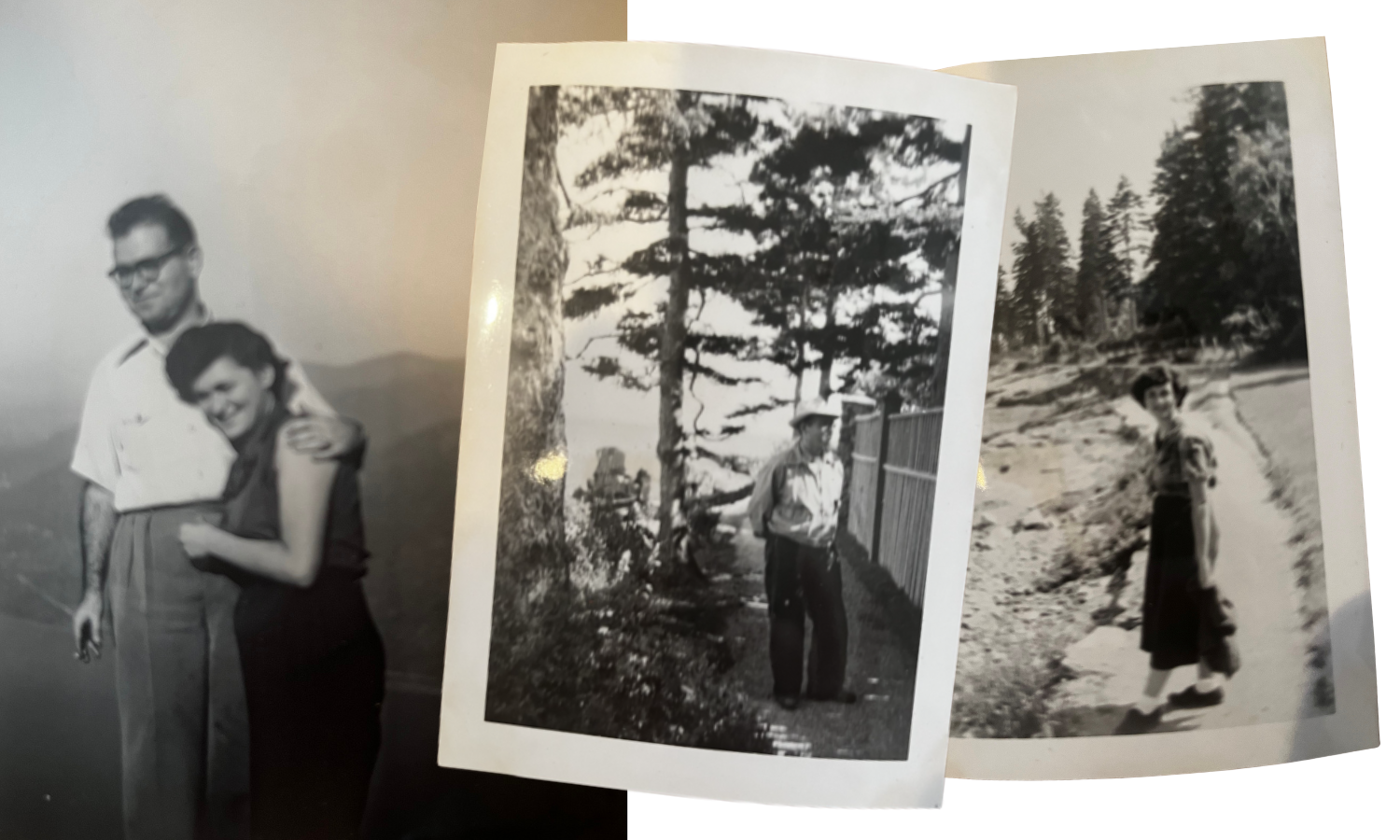
Suzanne and Ernest Loebl in Acadia. (Images courtesy Suzanne Loebl)
Except for a short sojourn in 1961, we did not return to Mount Desert Island for years.
Some people are good at planning their lives; others just amble along. We are the latter and were thus ill-prepared when our phone rang on an icy day in February 1967. My husband’s colleague at the Brooklyn Polytechnic Institute called. He told us that his brother-in-law’s summer landlady wished to sell her small group of summer camps on Echo Lake in Somesville. Would we be interested in buying one of her cottages?
We flew to inspect them. The cabins were shabby, but their lakeshore location and the view of Acadia Mountain were great. We rashly offered to buy one called Judy, fortuitously our daughter’s name. All winter long we worried about our foolishness.
It was the smartest thing we ever did.
By then, I had become a writer, and a summer retreat seemed fine. A piece of every one of my 15 books was written on Mount Desert Island. My output ranged from a 25-page picture book to a pre-internet 1000+ page pharmacology text-reference book for nurses.
A faint smell of pine needles emanates from each publication.
During the last half century, my summer day is carefully divided between writing and enjoying Maine. The latter changed with the decades. For three decades I was the champion swimmer of the Echo Lake colony. Each year I also hiked many of the trails developed by those who had loved these mountains before me: the rusticators and painters who arrived in the mid-1800s, various volunteers, national park rangers, and Friends of Acadia.
Some hikes were exhausting. Some, like the ones up Beech Hill or Flying Mountain, were short, but they still rewarded me with gorgeous views down onto Long Pond or Somes Sound. In between swims, hikes, shopping at Beech Hill Farm, and attending lectures and art openings, I crafted my books. The island’s library system proved essential. I just finished book number 15: “Plunder and Survival: Stories of Loss, Theft, Recovery, and Migration of Nazi Unmoored Art.”
The summer came when I could no longer scale the big rock at the foot of Penobscot, and I gratefully switched to Mr. Rockefeller’s carriage roads. Walking around Eagle Lake, Witch Hole and Jordan Ponds, and along the Amphitheater carriage road became an addiction.
In 2023, my left hip gave out for the second time. My skillful surgeon replaced it again. I became adept at walking with a rollator along paved roads. My conveyance took me along Beech Hill Farm, Oak Hill, and Indian Point Roads, where I feasted on views of Acadia, Saint Sauveur, and even Blue Hill. But I was greedy.
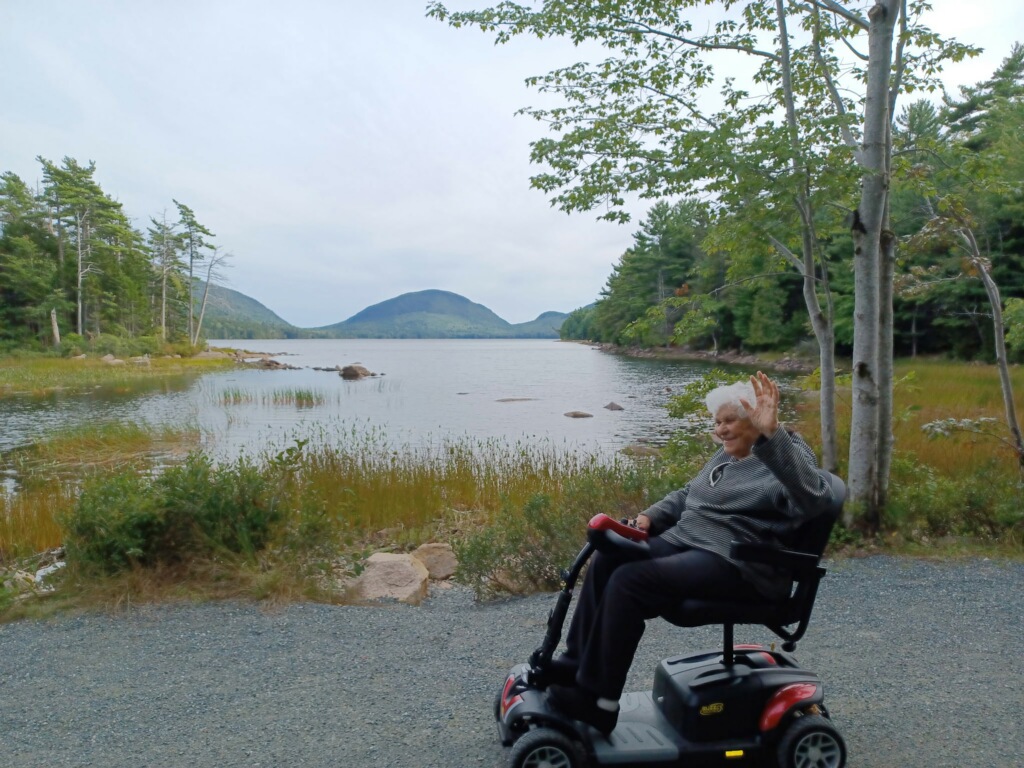
Suzanne Loebl waves to the camera as she drives her scooter on the Eagle Lake carriage road in Acadia National Park. (Photo courtesy Judith Loebl)
My rollator could not negotiate earthen roadways, and I missed being hugged by the assorted micro-environments of Acadia formed by firs, oaks, beeches, birches, and maple trees, as well as the meadows and mountains enclosing Little Long Pond. With my family’s encouragement, I bought an electric scooter.
With some trepidation, I can again experience Mr. Rockefeller’s 45-mile-long carriage road system.
Before returning to Brooklyn last summer, my friend Walter and I walked along Little Long Pond in Seal Harbor. He walked while I rode my scooter. I greeted trees I had not seen for years. I did panic when we encountered horse-drawn carriages or bicycles. But here I was, at 100 years of age, admiring the tops of the tall trees that stretched towards one another, forming a tunnel. I admired small brooks gurgling under the roadway; Little Long Pond, glistening in the distance; and the mountains of Mount Desert Island framing it all.
My body may be arthritic, but my heart is young.
SUZANNE LOEBL is the author of 15 books, including “America’s Medicis: The Rockefellers and Their Astonishing Cultural Legacy.” Based on her extensive research in the Rockefeller family archives, Loebl paints a vivid picture of the family’s many cultural contributions beyond John D. Rockefeller Jr.’s work in Acadia.
** Individuals with mobility challenges may request special use permits to utilize Other Power-Driven Mobility Devices (OPDMD) within Acadia, including tracked chairs, scooters, non-traditional wheelchairs, and micro-mobility devices. Learn more on the park’s website.
We each have a unique and rich connection to Acadia.
Whether we came for a single memorable visit or return time and again. What’s your My Acadia story? Share it with us by emailing editor@friendsofacadia.org. (Send a photo or two, too!)