 Join
Join Donate
 Acadia National Park
Managing Fire in Acadia
Acadia’s fire crews provide wildland fire management in the park and partner with local towns and national park sites to help fight fires nation-wide.
BY TREVOR GRANDIN
December 2nd, 2025
Acadia’s fire crews provide wildland fire management in the park and partner with local towns and national park sites to help fight fires nation-wide.
BY TREVOR GRANDIN
December 2nd, 2025

Fire Management Officer Matthew Carroll poses for a portrait with his pulaski, a tool named after U.S. Forest Service ranger Edward “Ed” Pulaski, during a prescribed burn and training in Wells, Maine earlier this season. (Rhiannon Johnston/Friends of Acadia)
On October 26, 1947, the voice of Maine State Forest Commissioner Raymond E. Rendall crackled over the air on WLBZ. He called for volunteers from around Maine to help fight the fire on Mount Desert Island, which had been burning for more than a week. After nine continuous days, those fighting the blaze in Bar Harbor were exhausted.
“Every fire line must be patrolled or under watch day and night,” Rendall said. “We can and must not slip up on this extremely important job.”
Firefighters from across Maine heeded Rendall’s call, and help poured onto the island.
It was the collaboration of firefighters and townspeople from throughout Maine that ultimately subdued the blaze, which burned 17,188 acres on Mount Desert Island, with more than 10,000 acres in Acadia National Park. After the blaze died down, the lasting effects of those partnerships remained.
Today, Acadia is part of the New England Fire Management Zone—a region that spans six states from Connecticut to Maine. The zone’s fire crew is stationed here in Acadia National Park. Although crew size fluctuates by time of year—growing during peak fire season and dry spells and shrinking in the rainy season—a year-round crew is regularly on hand to provide aid to Acadia and the 22 other national park sites within the zone.
Matthew Carroll leads the crew as the zone’s fire management officer. Although he might be fresh on the job, having joined the crew earlier this year, he’s far from a new face in Acadia. Carroll was the assistant fire management officer in the park from 2017 to 2020, and his roots on MDI stretch even farther.
“I’ve been living in Bar Harbor for 10 years now. I went to College of the Atlantic before that. I met my wife here,” Carroll said. “This is my home.”
Carroll’s familiarity with Acadia gives him a head start on the community-building process, and that’s integral in a state like Maine, where many volunteer and municipal fire teams rely on each other for assistance. The crew has mutual aid agreements with fire departments across the island and throughout the state, pledging their help whenever needed. That relationship flows both ways, with the New England crew able to call on surrounding departments for assistance, be that extra personnel or equipment.
“It really is because we rely on our partners,” Carroll said. “If I go out on a fire and another one starts, I need someone else to be able to go and provide leadership there.”
During Acadia’s rainy season, New England’s fire crew is scattered throughout the United States, fighting fires in hotspot regions like Alaska and the Pacific Northwest. They also deploy to named wildfires, like the Dragon Bravo Fire that burned nearly 150,000 acres of the Grand Canyon’s north rim this summer, making it one of the most destructive fires in the history of Grand Canyon National Park.
It’s through this out-of-state deployment that the crew can maintain their qualifications, get valuable experience, and create relationships with other skilled fire teams. Engine Captain Bryan Daigle has been with the New England crew for 18 years and said that it’s important for their crew to go out west to stay good at their jobs. “When we make those decisions to go out west, we don’t make them lightly,” Daigle said.
That experience comes in handy when predicting the likelihood of a fire. Wildfire behavior is determined by an alignment of three factors, Carroll said: fuel, weather, and topography. First, a wildfire needs an abundance of fuel. While some might peer into Acadia’s forests and bristle at the thought of its fallen trees and dead vegetation contributing to the next great fire, fuel is only one part of a larger equation.
Second, the weather needs to be right. Wildfires are born from situations of low humidity and high winds, but Maine’s frequent rains and high relative humidity make their spread difficult. Even a short rain shower could set back the creation of burnable fuel, soaking vegetation that was once primed to burn.
Finally, a fire’s location helps determine how it behaves, with blazes moving quicker up steep slopes and slower along rockier surfaces. These three factors, when in alignment, create dangerous situations – and that’s why coordination and partnerships are so important to fire management.
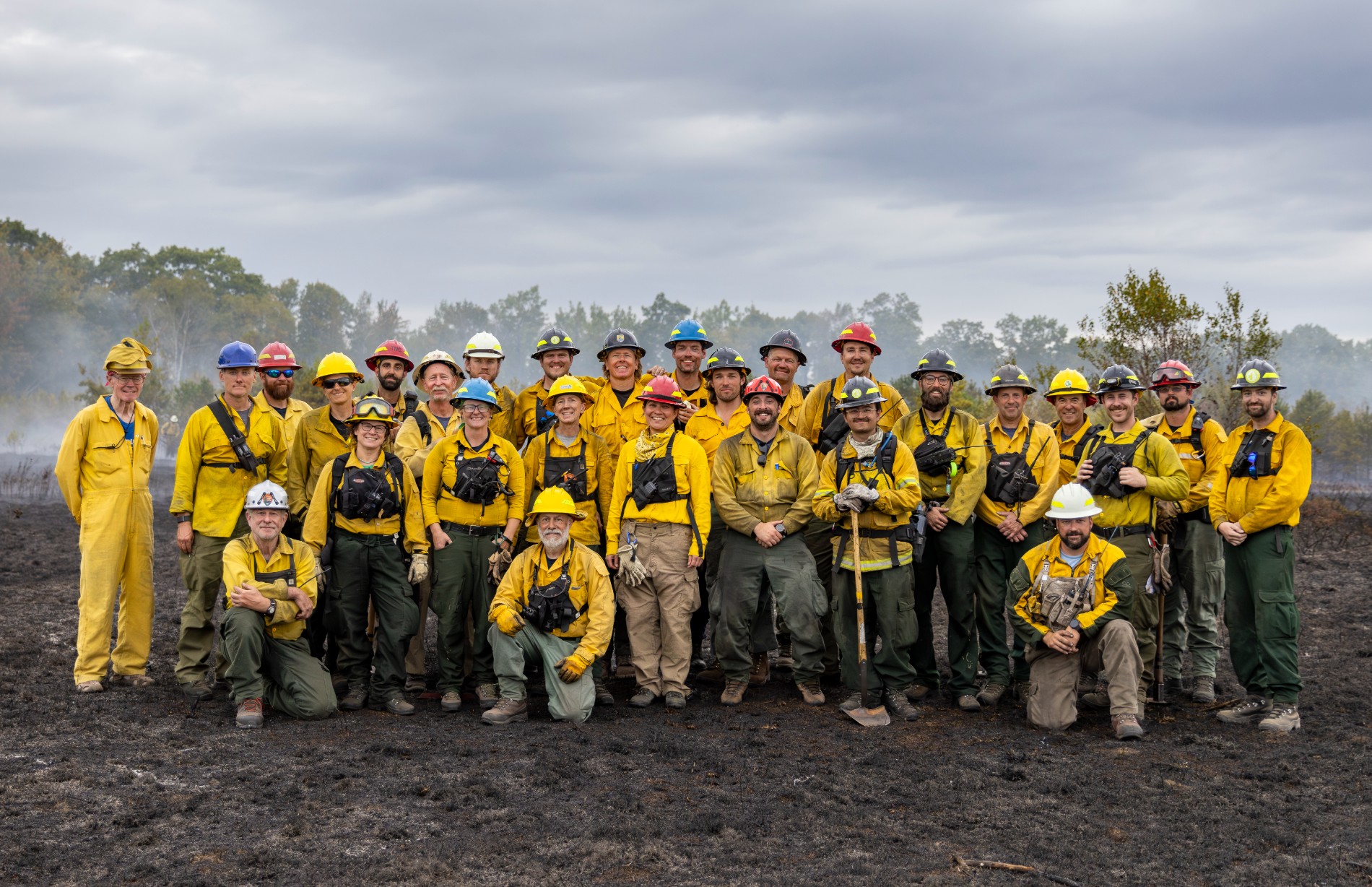
Participants in the 2025 Maine TREX Prescribed Fire Training Exchange pose for a group portrait after completing a prescribed burn on the Wells Barrens Preserve in Wells, Maine. The training included participants from the Acadia National Park Fire Management Team Members as well as more than a dozen states and
Tribal Nations from the US and Canada. (Rhiannon Johnston/Friends of Acadia)
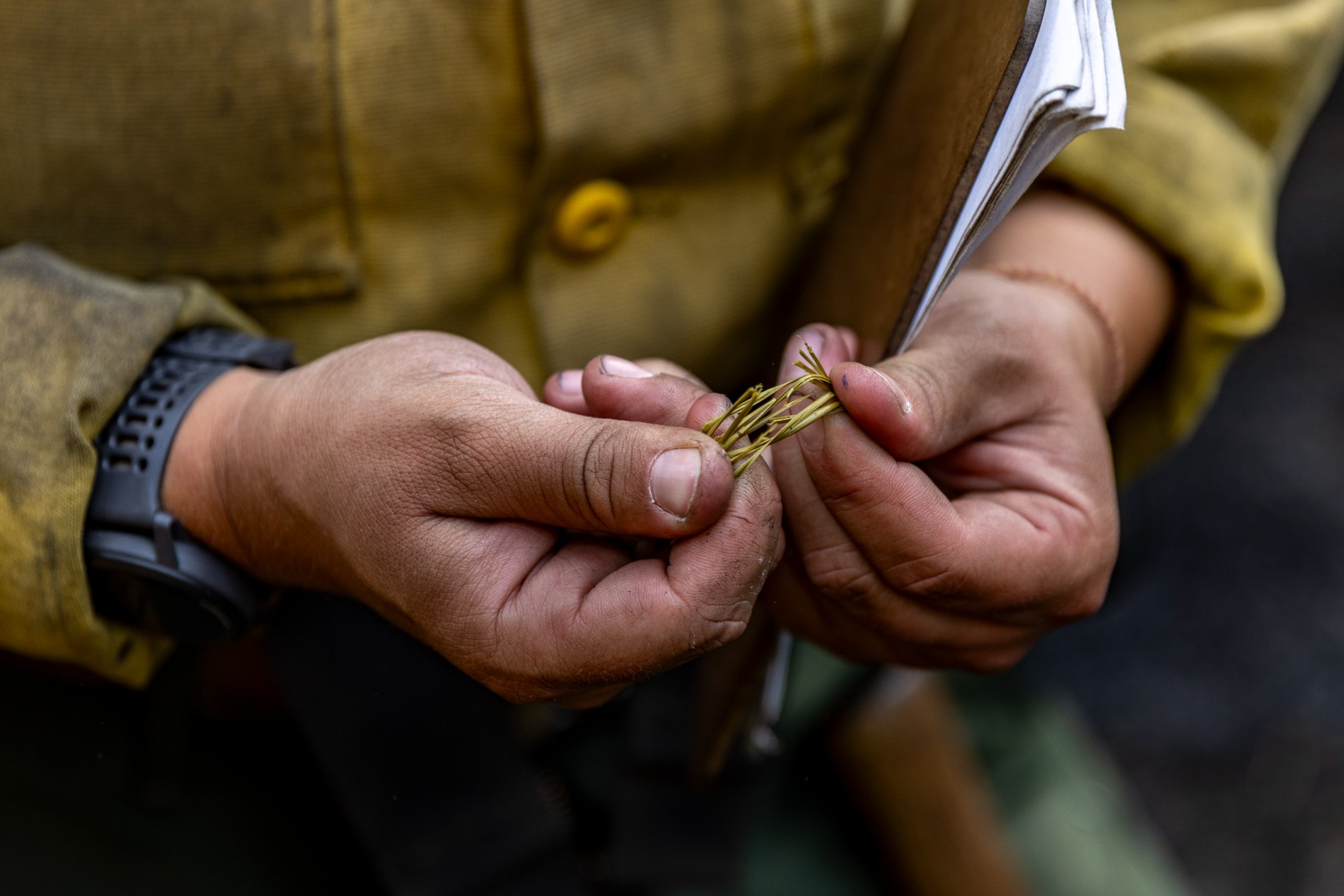
Firefighter A.J. Balduman-Gerrity examines pitch pine needles during a training in Wells, Maine. In fire ecology, the phenomenon where needles
and leaves “freeze” after a fire is described as a fire pattern indicator. This indicates the direction of the fire, as the frozen foliage can be swept by the wind
to reflect a certain direction and it is fixed by desiccation, revealing the wind’s path at the time of the fire passage. This characteristic is part of a broader understanding
of how fire affects plants, their response to fire intensity, and ecosystem dynamics. (Rhoannon Johnston/Friends of Acadia)
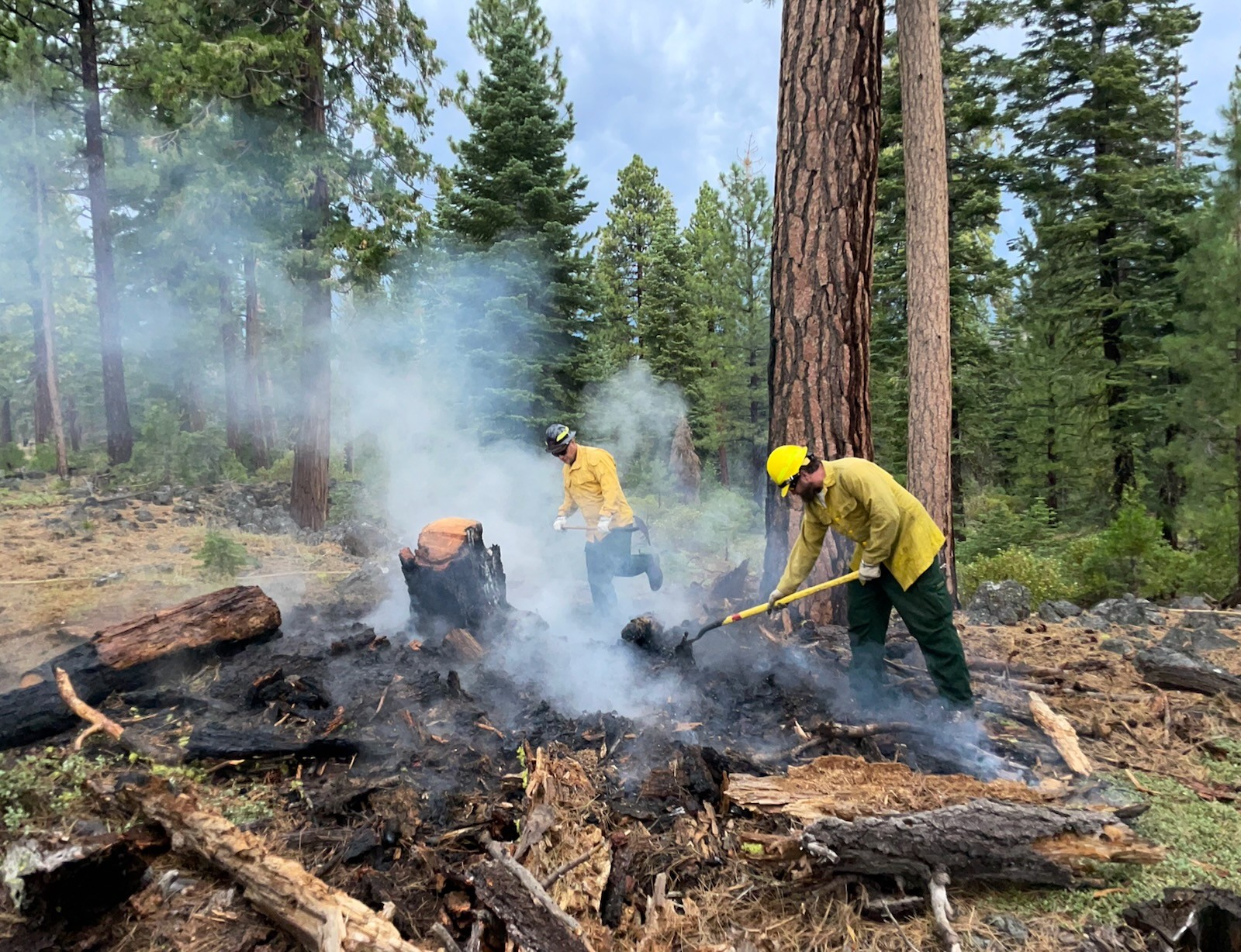
Wildland firefighters Erik Ahlquist, a Maine forest
ranger, and Matt Grant (right), part of the Acadia National Park trail crew, provide initial attack efforts to a tree that was struck by lightning in Hat Creek Wilderness in northern California in late July 2025. (Courtesy Marty Huysman)
When the crew arrived at a call this summer, the result of a lightning strike near Aunt Betty Pond, the smell of smoke was already in the air.
Responding at night and unable to see the fire through the trees, they started the gridding process, where firefighters line up and sweep a given area for signs of fire. After it was found smoldering under the duff (the layer of decaying leaves, needles, twigs, and branches on a forest floor), the crew made quick work removing fuel from the equation, cutting down hazardous trees and digging out organic material nearest to the embers.
“We just remove the fuel, let it burn out to the edges, and then we do what we call ‘mop-up,'” Carroll said. Mop-up looks exactly like it sounds, with crews crawling around searching for stray embers that may continue to smolder under the organic layer. After this manual process, around 2,000 gallons of water are dumped on the site for good measure, putting out any sparks that may be unreachable.
When Acadia’s crew isn’t putting out fires, they’re completing projects in the field, tending to the park, and proactively lowering the risk of spread in the event of a blaze. This includes limbing and cutting down trees, removing excess vegetation, and balancing sun exposure to prevent dry conditions around park structures. These defensible spaces lower the risk of a fire spreading and give the crew easily accessible staging areas should a fire start.
Prescribed fires are also performed in Acadia to reduce “fuel load;’ i.e., areas where dense shrubs or trees are at heightened fire risk, and to protect cultural landscapes by perpetuating open fields. A prescribed fire at the lower field at Jordan Pond House last spring is a good example. Careful planning goes into those fires, and a specific set of conditions must be met before the fire is ignited. Once burning, the fire is carefully monitored.
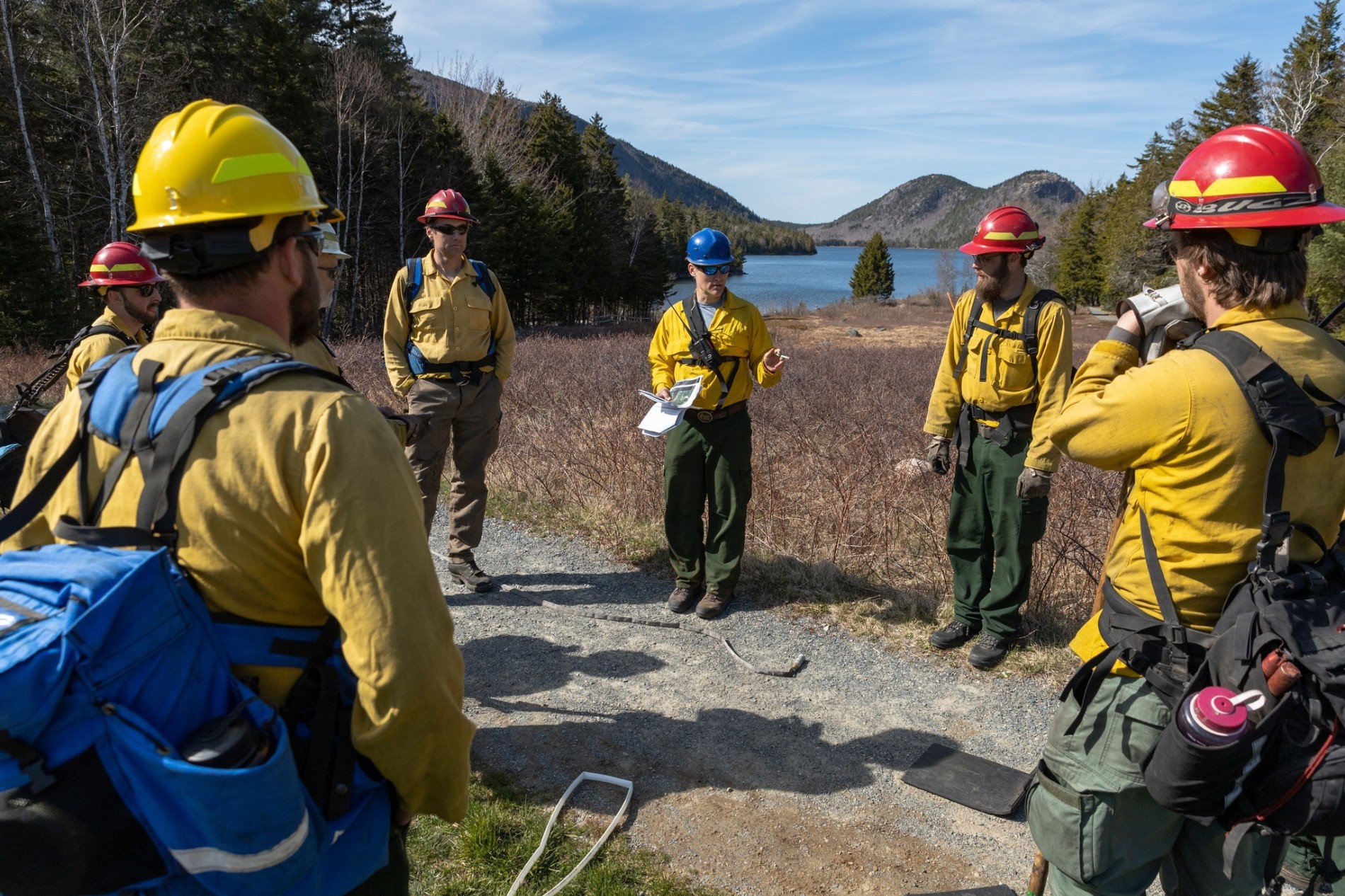
The fire crew gathers during a prescribed burn in Acadia National Park. (Brady Richards/NPS)

A prescribed burn of around a one-acre plot of land behind Jordan Pond House in April 2024. The intention behind the fire was to perpetuate native blueberry plant growth and to restore the cultural landscape. (Brady Richards/NPS)
Fire plays a vital role in nature. It clears out mature growth, creating space for sun-loving plants that provide food for wildlife and regenerating forests as a whole. Pitch pine trees, which are native to Maine, require fire for successful reproduction. Their cones are serotinous, meaning the heat from a fire is required to melt the waxy resin that holds the seeds in the cone, allowing them to be released. Young seedlings are sensitive to shade and need open, sunny conditions to grow, which fire also provides.
Though fears of another great fire follow close behind every dry summer, western eruption, or blanket of smoke thrown over the state, Maine is better prepared for the threat of wildfire than it was in 1947.
Firefighting looks different now – from forecasting improvements to advancements in technology – but two things have stayed the same: the importance of strong relationships and a willingness to help.
For Daigle, that’s what’s most rewarding: putting in the work and taking steps to prevent the next great fire. “I like to help,” he said, “and
that’s my way of trying to help.”
TREVOR GRANDIN is a freelance writer and former Cathy and Jim Gero Acadia Early-Career fellow at Schoodic Institute.
Following the fire of 1947, Acadia’s forests regrew naturally. Seeds, carried by the wind, settled into burned areas. Some deciduous trees regenerated by stump sprouts or suckers—shoots that grow from the roots or the base of a tree’s trunk. But the forest we see today is different than the forest that grew before the fire. While spruce and fir trees reigned before the fire, birch and aspen were the first to pop up afterward. Sun-loving and fast growing, these deciduous trees continue to grow and shade out the forest floor, providing a nursery for the shade-loving spruce and fir that may eventually reclaim the territory.
The fire of 1947 increased diversity in the composition and age of the park’s forests. It even enhanced the scenery: today, instead of one uniform evergreen forest, we are treated to a brilliant mix of red, yellow, and orange supplied by the new diverse deciduous forests.
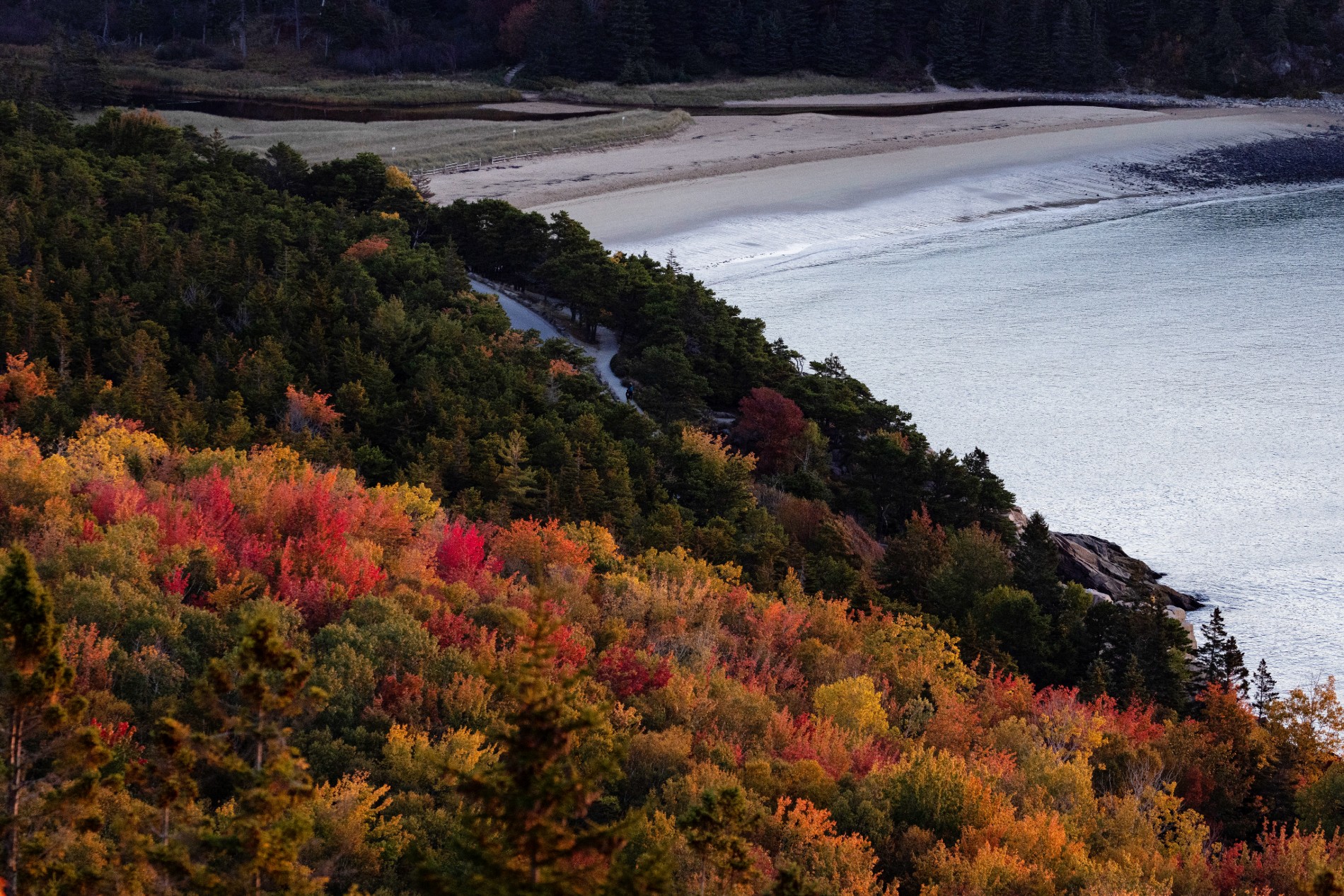
Morning light shines on fall foliage as seen from the Gorham Mountain Trail, Sunday, October 9, 2022, in Acadia National Park. (Photo by Ashley L. Conti/Friends of Acadia)
Oberlin College & Conservatory student Matthew Thomas Brown wrote a “symphonic poem” inspired by his 2023 visit to Acadia National Park, where he learned about the fire of 1947.
“’All safe. Home gone.’ progresses from a lamentation of the landscape lost to a rehashing of the nightmare and the emergence of a new vision,” Brown writes on his website. “The final melody… is my recollection and exaltation of the pristine view from the top of Sargent Mountain.”
The title is an abbreviated message the American Red Cross used in the wake of the fire to quickly catalog the condition and needs of those affected.
Learn more and hear the Oberlin Orchestra’s performance: mtbrownmusic.com/allsafe
This story was originally published in the fall 2025 issue of Acadia magazine.
Acadia magazine is published three times a year and features stories of Acadia National Park and the local community, from behind-the-scenes work to the impact of donor dollars. To receive Acadia magazine, become a member/donor!