 Join
Join Donate
 Acadia National Park
Step by Step:
Trail Work on the Bubbles Divide
Melding history, natural resources, and a magic touch on Acadia’s trails
August 10th, 2025
Melding history, natural resources, and a magic touch on Acadia’s trails
August 10th, 2025
BY SHANNON BRYAN
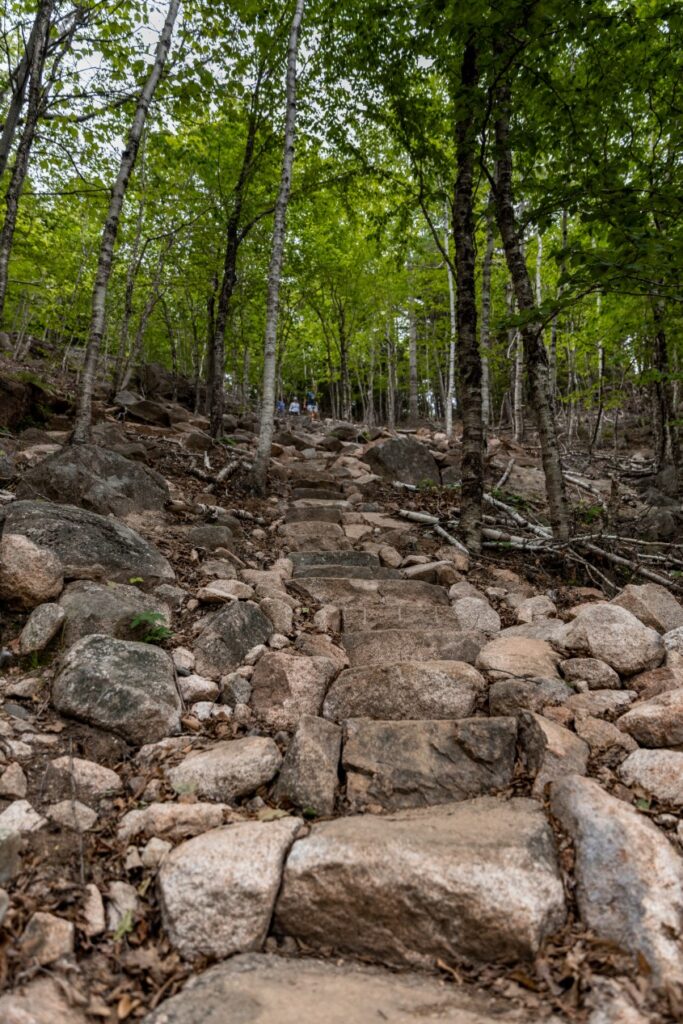
More than 300 granite steps have been set into place along a 0.3-mile section of the Bubbles Divide Trail.(Rhiannon Johnston/Friends of Acadia)
The Bubbles Divide Trail just got a facelift.
More than 300 granite steps have been set into place along the 0.3-mile section of trail between the Jordan Pond Path and the Bubbles Trail intersection. There are new “check steps,” too—wooden frames filled with crushed stone and covered in dirt that function like a French drain, deterring erosion.
But even the upgrades have a historic look and feel. Those granite blocks that form the staircase were sourced from close-by quarries right on the Bubbles—the same quarries from which granite was pulled back in the early 1900s. The width and depth of each step mirror the width and depth of the steps laid on this pair of mountains more than 100 years ago.
“We want to match what was there, as far as the look of the trail. We want to keep the same historical and cultural standards,” said Dave Schlag, trail crew foreman at Acadia National Park. “Why was the trail here in the beginning, and why are we rebuilding it? We want to honor those parts of it.”
Thanks to the trail crews’ final touches, from transplanted mosses and plants on a rehabbed trailside to scattered leaves and pine needles on freshly laid steps, even just-completed trail work looks like it’s been that way for a century.
That’s part of the magic—and hard work—of Acadia’s trail crew.
There hadn’t been much trail work done on the Bubbles Divide since the early 1900s. Some work was done in the 1980s and ‘90s, Schlag said, but it had largely been untouched.
“It’s a talus slope running from the north end of Jordan Pond up the divide between North and South Bubble. It’s just pure rock through there,” he said. The terrain made it a safety challenge—both for hiker injuries and search-and-rescue carry-outs. At the bottom, the trail was largely dirt surface.
“Being between two mountains, all the water runs through and comes right down the trail,” said Schlag. “It had become the classic gouge where everything funnels through.”
Over time, the soil eroded, and the trail level dropped. In some areas, water pooled and stretches of mud lingered. In response, hikers often abandoned the muddy trail and took wide alternate paths through the trees.
“People are bugging out everywhere because they don’t want to be in the mud. They start taking their own route,” Schlag said. “Whatever way they deem safe and stable, they’re going to go, which creates this huge series of social paths.”
That’s not great for the trail or for the hikers. It’s also not great for natural resources, Schlag noted. Wider areas of plants get trampled; hikers wander into bat habitat.
Bubbles Divide needed a rethink.
But first things first. As with any trail project in the park, well before a shovel is wielded or a single slab of granite is moved (often years before), Acadia’s trail crew goes in to assess.
“We’ll look at the conditions of the trail at different parts of the trail,” Schlag said. “We look at any damage in the area, whether it’s to the trail itself or to the surrounding areas, whether that’s storm damage, erosion, or visitor damage.”
“We look at whether it’s people not using the trail how it’s supposed to be used, maybe because the trail is so muddy that nobody wants to step in this section, so they go around,” he added.
“Or whether the stairs are too small, and they can’t accommodate people coming from different directions, so people make their own trail.”
On Bubbles Divide, Schlag said, “We had to define the corridor, make it much more clear from point A to point B.”
The particulars on how that should be done required a great deal more planning, conversation, and collaboration.

Large blocks of granite are cut and moved into place this summer on Bubbles Divide Trail. (Rhiannon Johnston/Friends of Acadia)
Trail work in Acadia involves an interdivisional team that includes staff well-versed in the park’s wildlife, resource management, and cultural history. Together, they consider historic and environmental factors. Is the trail near water? Is it in a bat area where bats are raising young?
“During certain times, you can’t work on the south face of different slopes and talus fields because of the bats and their mating seasons,” said Schlag.
Bats roost and hibernate in rock crevices, particularly Acadia’s sunny south-facing talus slopes. In the summer months, they pup in the small nooks of partially detached bark on birch trees.
“That might dictate that we can only work there for six weeks and then go work somewhere else.”
Before work on Bubbles Divide began, wildlife managers gave Schlag a map showing where all the bat nesting sites are.
“Most of the nesting sites were up on the cliffs, and we were working down lower,” Schlag said.
Likewise paramount to the trail crew: staying true to the historic look and feel of a trail.
“Back in the day, when they were building the trails—whether it was the village improvement associations, the Civilian Conservation Corps—we try to match those building specifications as far as the size of the rocks we’re using. If they’re building 26-inch steps, we’ll try to do the same thing,” said Schlag. “Matching those specs is a big deal for us.”
Since early trail builders had varying approaches and styles, Acadia’s trail crew endeavors to match them—from where the granite is sourced to how slabs are stacked into stairs. They pay attention to how the stones were cut, too. Are there drill scars? Were the workers using hand chisels and hand bits or were they just using the natural material?
“If you look at the Emery Path on Dorr Mountain, for example, every step is eight inches, eight inches, eight inches,” said Schlag. “That took a lot of planning and a lot of attention to detail.”
But over on Beech Mountain’s Valley Trail, “they’re way more rustic. There are no drill scars on anything because they were just grabbing rocks and sliding them together to build staircases and walls. It’s a four-inch rise to a 12-inch rise and then back to a seven-inch rise.”
When possible, the trail crew sources stone from the same exact quarry or gravel pit the original stones came from—a surefire way to adhere to historic materials.
On the Bubbles Divide Trail, drills left visible scars as the large, bulbous granite was cut on site for the new stairs. But that didn’t fit with the historic aesthetic of those trails. So, the trail crew went back with hand chisels and hammers to chisel all the drill scars off.
That’s a great deal of extra effort, but it’s a testament to the trail crew’s dedication to historic accuracy.

Granite steps follow the natural flow of the gorge on the Gorge Trail towards Dorr Mountain. Acadia’s trail crew works hard to maintain the historic look and feel of each trail and its unique styles. (Photo by Ashley L. Conti/Friends of Acadia)
Acadia’s trails see more hikers nowadays than they did a hundred years ago.
Finding a balance between the trail’s history and how a trail is used today is an ongoing aspect of trail work in Acadia.
“We want the park to stay the living history that it is, but also accommodate today’s visitation,” Schlag said. “Are we going to build 26-inch steps or are we going to build four-foot-wide steps, which will change the look of the trail?”
Conversations with Acadia’s cultural resources manager helped Schlag settle on a mindful plan.
“We decided the best thing for that area was a stone staircase to the top, mostly following the existing corridor,” said Schlag.
Work on the Bubbles Divide Trail began last year, with crews working as long as the freezing ground allowed, right through December. This June, the trail closed again so they could finish up the final 75-or-so yards.
All told, the crew put in roughly 320 steps and 1,000 to 1,500 feet of retaining wall on both sides, which helps stabilize the steps and clearly define the staircase (and keep people on the trail). Check steps were installed near the bottom, where there wasn’t much rock and where erosion was having its way with the soil.
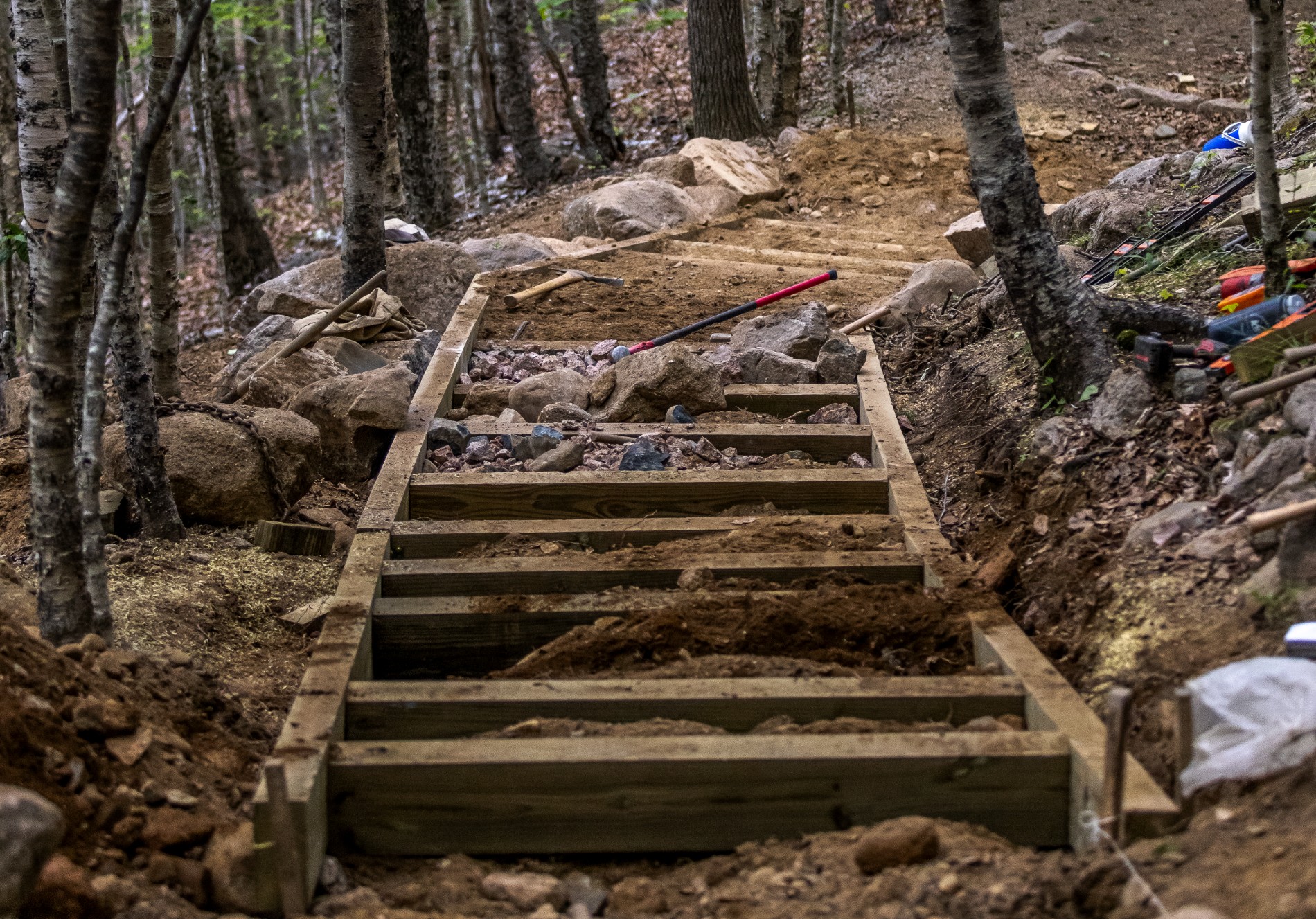
New wooden check steps on the Bubbles Divide Trail. (Rhiannon Johnston/Friends of Acadia)
When trail work involves removing soil or vegetation, the trail crew saves that material to repurpose it later. “We’ll cut out the sod, the native grasses, the dirt, we may transplant small trees, shrubs, and moss, and we’ll stage all that material,” said Schlag. When the trail work is complete, they’ll replant.
Those plants help maintain the natural “been-here-for-awhile” look. The vegetation also serves an important role in keeping that woodwork or stone in place and helping with erosion control. “The roots will take back hold and grow back in and hold everything in place,” Schlag said. “A living berm almost.”
Sometimes that work is covered with erosion matting for the first year or two as the vegetation retakes root. The matting is made of biodegradable material that eventually rots away.
And if gravel or stone was sourced from nearby, they’ll transplant mosses and other vegetation to cover any visible
disturbance there, too.
The final touch?
“We call it the naturalization or seamless blending,” said Schlag. A couple of crew members call it “the magic fairy dust.”
The trail crew gathers up leaves, twigs, and pine needles and scatters them over the newly finished portions of trail.
True, nature will do its own sprinkling in fairly short order, but this extra touch means a hiker on the trail the very next day can walk along, largely unaware of the work that has just been done and instead focus on the marvels of stacked granite slabs and forest canopy.
While hikers familiar with this trail will certainly see the difference, newcomers are likely to believe it’s looked this way
for a century.
“When you can match the building materials and naturalize it, it’s amazing when you can come back in a week and be like, ‘this looks like it’s been here for 100 years,’” said Schlag. “That’s one of the things that I think is so magical.”
SHANNON BRYAN is Friends of Acadia’s Content and Website Manager.