 Join
Join Donate
 Acadia National Park
Great Strides in the Great Meadow Wetland
A reimagined Hemlock Path and a new culvert coming this year are big steps forward for this complex rehabilitation project.
BY CLAIRE KEELEY
March 27th, 2026
A reimagined Hemlock Path and a new culvert coming this year are big steps forward for this complex rehabilitation project.
BY CLAIRE KEELEY
March 27th, 2026
Adjacent to Sieur de Monts Spring lies the 100-acre Great Meadow Wetland, a glacially carved U-shaped valley cradled by the granite rock faces of Kebo, Champlain, and Dorr Mountains. Here rainfall and snowmelt collect from hundreds of trickling streams, flowing north toward Frenchman Bay as part of a larger network of wetlands, tributaries, and ponds in the Cromwell Brook watershed.
The largest freshwater wetland in Acadia, Great Meadow supports several different interconnected wetland ecosystems.
Birch trees shade the Hemlock Path, putting on spectacular displays of autumn colors. Ferns emerge from water-saturated soils beneath the Jesup Path, and sedges, rushes, and tall grasses flourish on the marshy banks of the meandering waterways. These habitats provide food, shelter, and hunting grounds for hundreds of insects, birds, and mammals, including wood warblers, herons, owls, hares, meadow voles, and beaver.
In the late 19th century, this landscape attracted George B. Dorr, one of the area’s leading early preservationists. Around 1900, Dorr, a summer resident turned year-rounder, began purchasing land around Great Meadow, including Sieur de Monts Spring.
Recognizing the importance of protecting Mount Desert Island’s beauty and diversity from encroaching development, he donated the natural spring and additional parcels of land to the National Park Service, helping to establish Sieur de Monts National Monument in 1916. The monument soon reached National Park status and was renamed Lafayette National Park in 1919 before being renamed again as Acadia National Park in 1929. Dorr served as the park’s first superintendent, holding the position until his death in 1944 at age 90.
During his tenure, Dorr focused much of his time on Great Meadow and greatly modified it, adding greenhouses, trails, and roads to improve public access. These changes inadvertently altered the wetland’s natural water flow, and now, a century later, the impacts of those modifications are evident.
“George Dorr was really fascinated and amazed by the beauty of Acadia, especially the area around Sieur de Monts and the Great Meadow, and he wanted to share it with others,” explained Lauren Gibson, Friends of Acadia’s Wild Acadia coordinator. “To make it accessible and bring people there meant building roads and a trail system through the wetland into Sieur de Monts; some of that infrastructure still exists today, impeding the natural hydrology and the health of the wetland environment.”
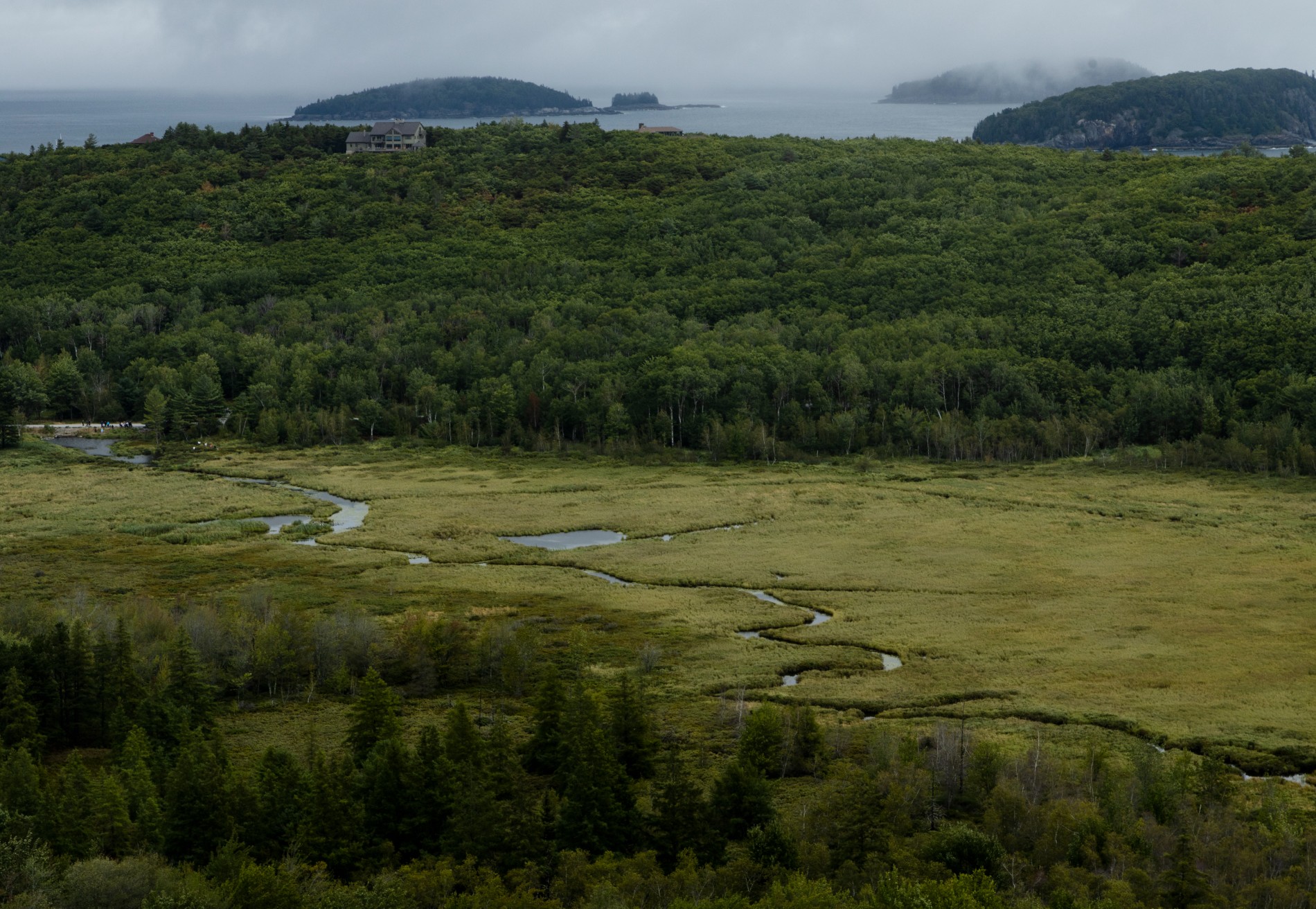
The previous day’s rain saturates the Great Meadow Wetland, viewed from the Emery Path on Dorr Mountain. (Photo by Lily LaRegina/Friends of Acadia)
Long before George Dorr, Great Meadow was part of the ancestral homeland of the Wabanaki people, who had deep, enduring relationships with this landscape since time immemorial.
As the historic infrastructure fractures the meadow now, the creation of federally managed lands limited Indigenous access to traditional territories, fracturing their relationship with the land and interrupting the transmission of place-based knowledge and cultural practices. Today, Acadia National Park and Wabanaki partners are working together to restore and strengthen these relationships through a growing model of co-stewardship. By integrating Indigenous knowledge with Western science, these partnerships are reshaping how Great Meadow is understood, studied, and stewarded.
It’s been an all-hands-on-deck endeavor in recent years to address the deteriorating health of Great Meadow. Park staff, Wabanaki communities, and partner organizations—including Friends of Acadia and Schoodic Institute collaborate closely to address issues ranging from invasive plant management and disruptions in water flow to identifying solutions to undersized culverts and wetland-dividing roads and ditches.
The bisecting trails and abandoned roads that remain on the landscape inhibit the wetland’s natural water flow, resulting in drought-like conditions during dry periods and flooding events during periods of heavy snow or rain that can impact adjacent habitats and submerge park infrastructure.
In addition, an undersized culvert has long been a culprit for the wetland’s poor hydrology; it struggles to keep up during heavy rain events and is frequently clogged by fallen tree branches, leaves, and other organic debris. Compounding these issues are a multitude of environmental stressors, including more frequent and intense storms and heavy rains in winter instead of snow.
Great Meadow is Acadia’s largest freshwater wetland complex, but it isn’t currently functioning like a healthy wetland.
With the soil at times hidden under floodwater and at other times dry and cracked, it doesn’t look like one, either.
“It’s one of the most complex rehabilitation projects in Acadia National Park,” Gibson said.
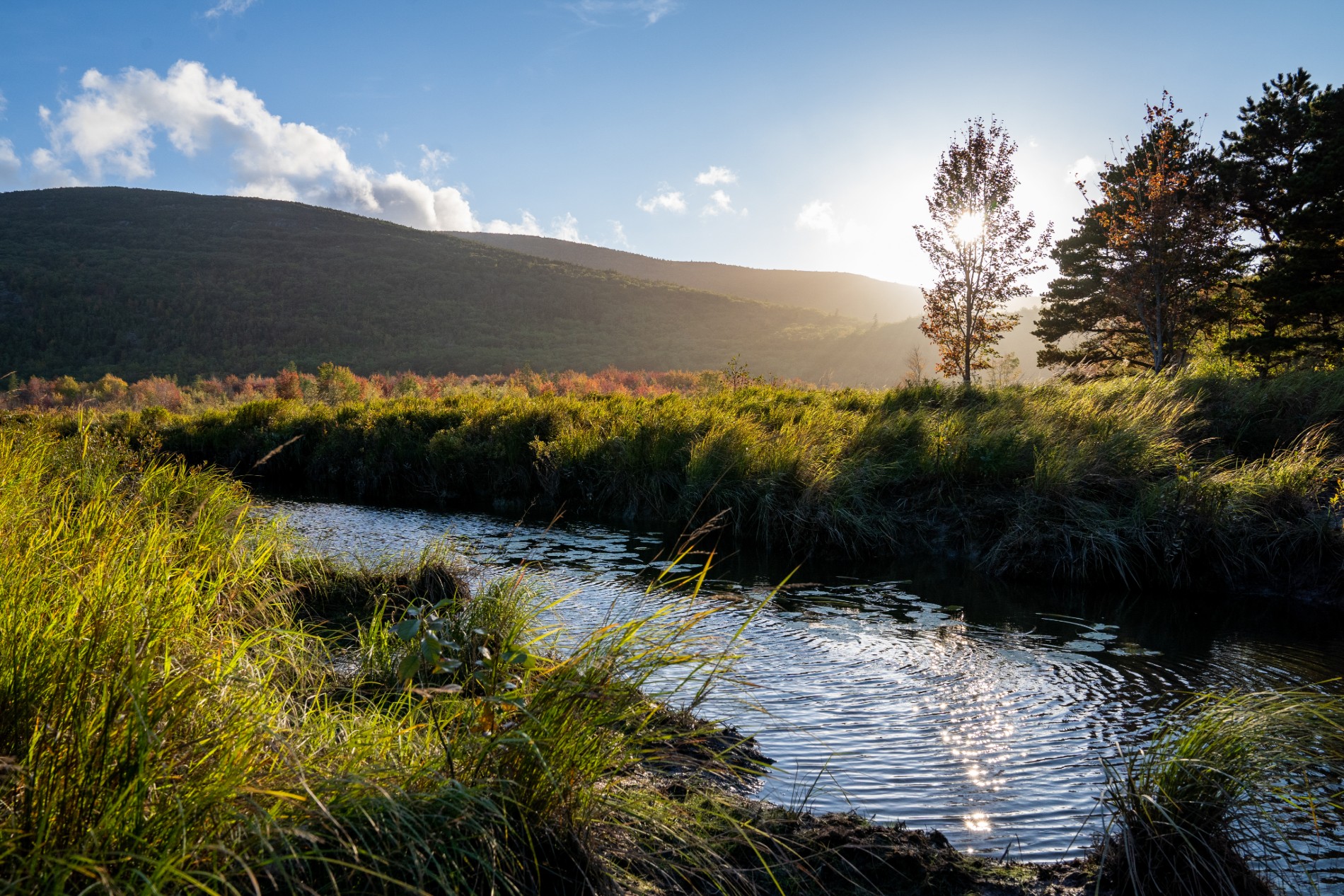
Fall colors are illuminated by the evening in the Great Meadow Wetland. (Emma Forthofer/Friends of Acadia)
Acadia’s well-traveled Hemlock Path was initially built as a road by Dorr to improve access to the area. Leading from Sieur de Monts Spring and through the Great Meadow, the raised gravel road was eventually abandoned in 1939 in favor of the circular drive that exists today. This road-turned-trail barricaded the natural flow of water as it bisected the wetland. “The trail was elevated,” Gibson explained, “and so it served to separate the wetland into two parts.”
With the goal of improving the natural hydrology, or flow of water, of the meadow, Acadia National Park’s trail crew, led by Trail Crew Supervisor Chris Barter, worked throughout last summer to revamp Hemlock Path in water-friendly ways.
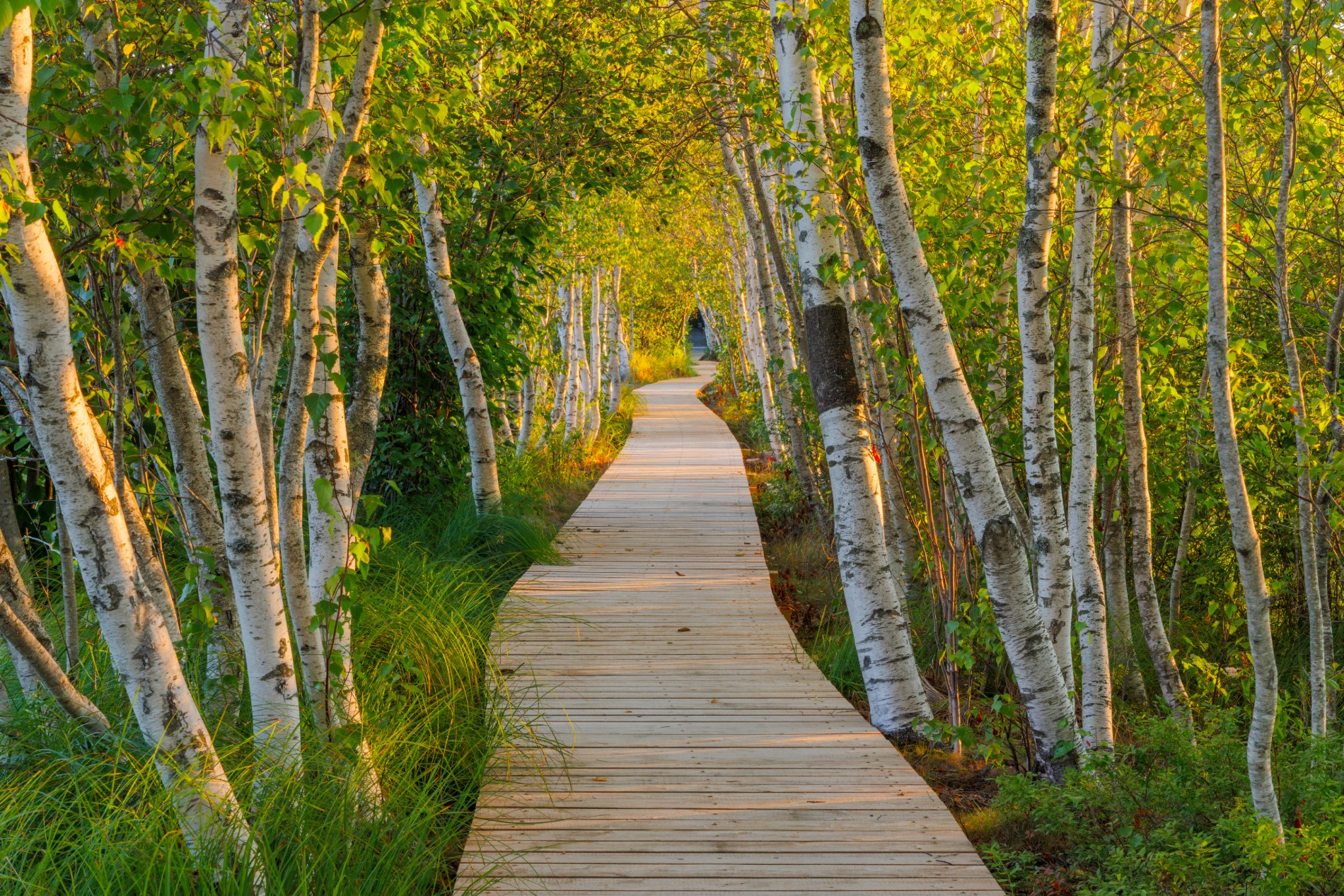
The new Hemlock Path: A dedicated group of volunteers, including Francis Hopcroft, Mark Munsell, Gary Stellpflug, Terese Miller, and Bill Shaw, worked this summer to construct a new 500-foot-long raised boardwalk along the Hemlock Path. The new design allows water to flow freely beneath the path, improving the hydrology of the wetland. “The boardwalk enhances the visitor experience on multiple levels,” said Dianna Sproul, Acadia National Park’s volunteer coordinator. “We are so grateful for all the tremendous volunteers who support and help make Acadia such a special place.” (Photo by
Assisted by a dedicated group of community volunteers who spent hundreds of hours on the project, the trail crew reimagined Hemlock Path as a raised boardwalk, similar to the nearby Jesup Path, with numerous channels running underneath, known as “purges.”
The purges allow water to readily pass below—and wildlife as well—removing the hydrological obstacles that arose in the path’s initial state. The new boardwalk design simultaneously improves visitor access, keeping the trail dry and navigable after large rainfall events, and improving accessibility for a wider number of park visitors.
“The Hemlock Path boardwalk is an astounding accomplishment by our incredibly skilled Trails Volunteers,” said Dianna Sproul, Acadia National Park’s volunteer coordinator. “It is well built, creating an accessible trail surface that protects the resources around it, but it also is a beautiful piece of artwork in and of itself.”
“The formation of the park relied on individuals within the community coming together and making a difference,” Barter added, as his staff and volunteer crew worked hard on the Hemlock Path in the heat of last summer. “The same can be said about the teams and our work in the Great Meadow.”
“The formation of the park relied on individuals within the community coming together and making a difference. The same can be said about the teams and our work in the Great Meadow.”
Dianna Sproul, Acadia National Park volunteer coordinator
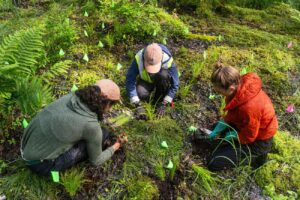
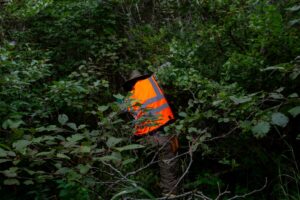
While the trail crew was hard at work on Hemlock Path, a specialized crew worked nearby to remove invasive plants.
The work is interconnected. The dramatic swings between flooding events and dry spells favor disturbance-tolerant plants, many of which are non-native invasives.
“The dynamic hydrology is a problem,” Gibson explained. “It’s stressing out a lot of the native vegetation. Our goal is to improve the hydrology by facilitating fewer extreme drought or flood conditions, which we’re hoping will improve the health of the meadow and increase diversity of both plants and wildlife, like birds.”
Part of a years-long effort to address invasive plants in Acadia, Great Meadow is a focus area for a collaborative Invasive Plant Management Team comprised of staff from Acadia National Park and Schoodic Institute, with support from Friends of Acadia.
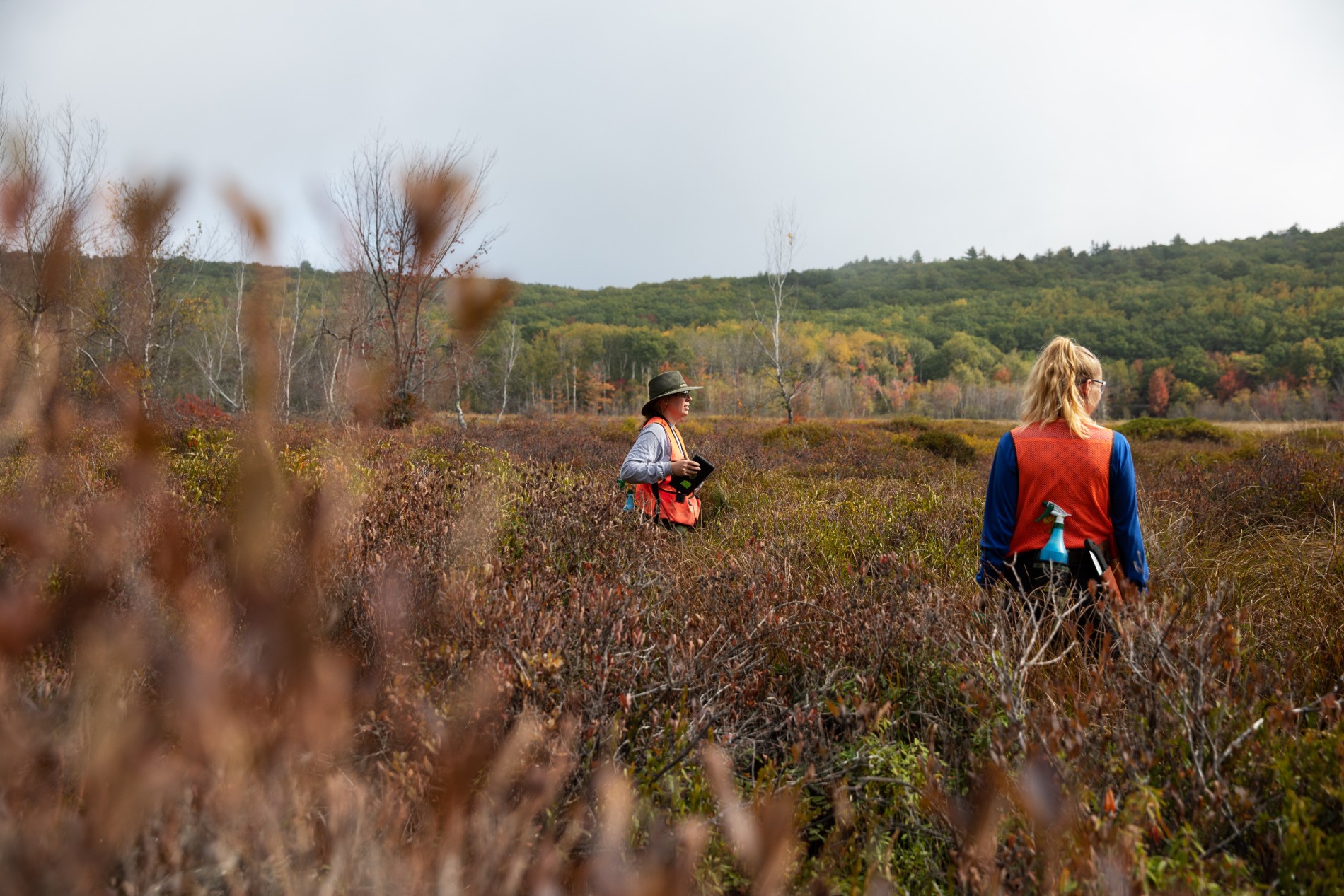
Members of the Acadia National Park Invasive Plant Management Team Emma Lanning, biological science technician and Gondica Stryker, American Conservation Experience assistant to AYCC remove glossy buckthorn from Great Meadow in 2023. (Photo by Julia Walker Thomas/Friends of Acadia)
Schoodic Institute restoration technicians, alongside Acadia’s Vegetation Program Manager Jesse Wheeler, work to remove invasive plant species that are altering the function of the Great Meadow.
One plant of particular interest is glossy buckthorn (Frangula alnus). Glossy buckthorn can take hold quickly in an area—and stress native plants. It tolerates a wide range of conditions and keeps its leaves on longer into the season, often “shading out” lower-growing native plants and creating inhospitable conditions for them to thrive.
Giving glossy buckthorn a new kind of treatment, the team established a series of experimental vegetation plots and is testing how some specific native plants that also keep their leaves longer might compete with glossy buckthorn and, ultimately, help keep it from taking over.
Last year, the team continued to monitor and identify resilient plants that may be instrumental in maintaining habitats. The team also looked to the past, uncovering the meadow’s vegetative history well below ground.
Last summer, in collaboration with Wabanaki partners, University of Maine palynologist Andrea Nurse collected soil cores to explore how the landscape has evolved over time.
By studying pollen, macrofossils, environmental DNA, and radiocarbon samples, scientists will reconstruct what the Great Meadow looked like thousands of years ago. This data will allow the team to understand which native plants—and culturally significant plants, traditionally used for food or medicine—thrived here in the past, informing conversations about restoration work and Indigenous food sovereignty into the future.
While the research is one small piece of the puzzle, this collaborative work is instrumental in restoring the health of Great Meadow.
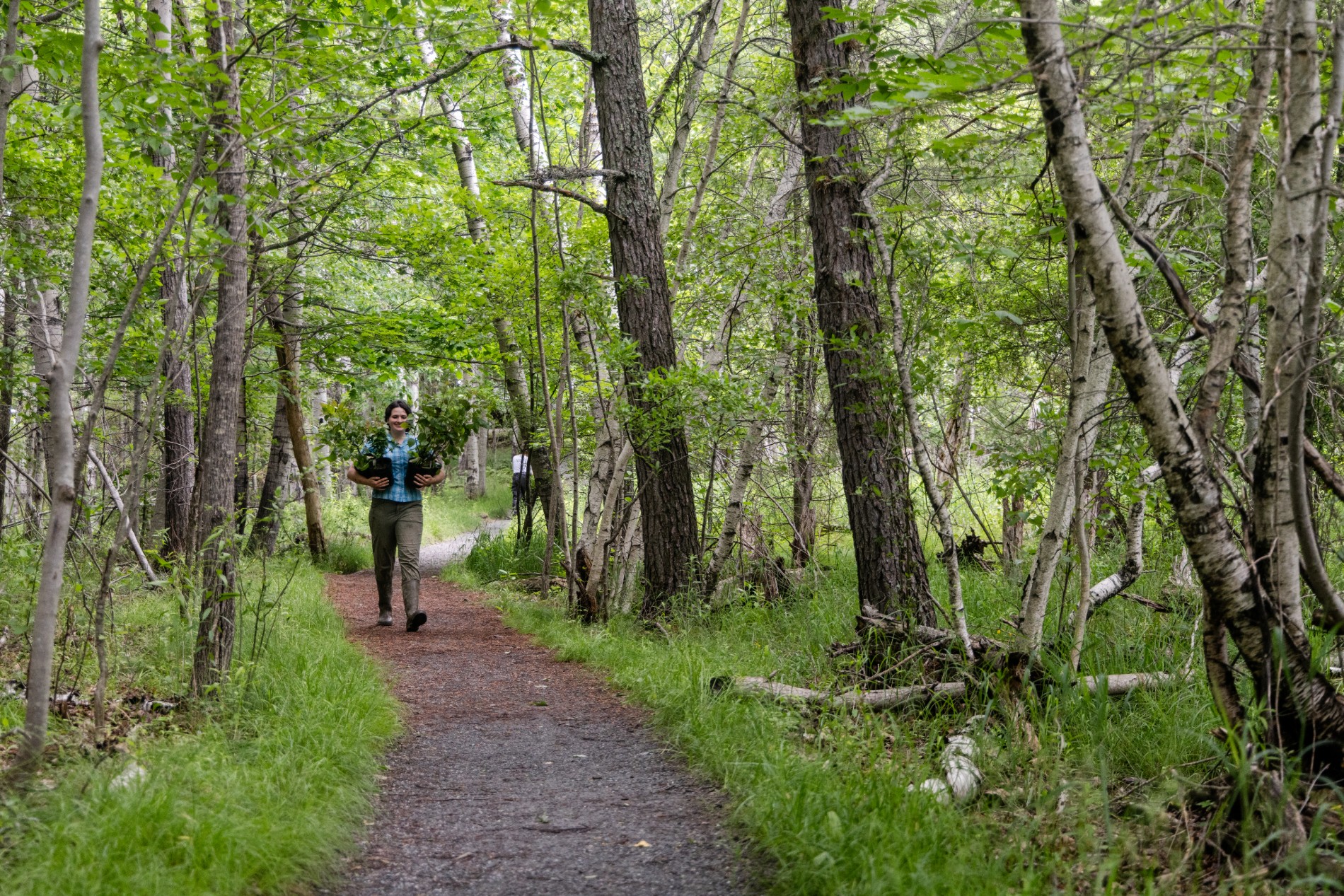
Elena Sparrow of the Wabanaki Youth in Science (WaYS) program, carries native plant species to one of the plant restoration areas of the Great Meadow Wetland. (Photo by Sam Mallon/Friends of Acadia)
Another critical piece to restoring the natural water flow in Great Meadow is scheduled to take place this year: replacing the undersized culvert.
Considered relatively small, the three-foot corrugated metal tube will be replaced with a wider, 12-foot concrete culvert that gives broader berth to both water and wildlife. In times of heavy rain, there will be room to accommodate an immediate influx of moving water.
And where wildlife like beavers, porcupines, and foxes are currently compelled to walk across the road above to reach the other side of the wetland, they’ll have room to waddle and scamper through the new passage. The culvert’s corrugated metal bottom will be replaced with a streambed-like design that improves conditions for fish and amphibians to pass through as well.
“This replacement will make a huge difference in helping to moderate water in the wetland,” Gibson said. “We’re hoping that the culvert replacement, in addition to the other restoration work, will eliminate those really high-water highs and those really low lows and reduce the flashiness of the system.”
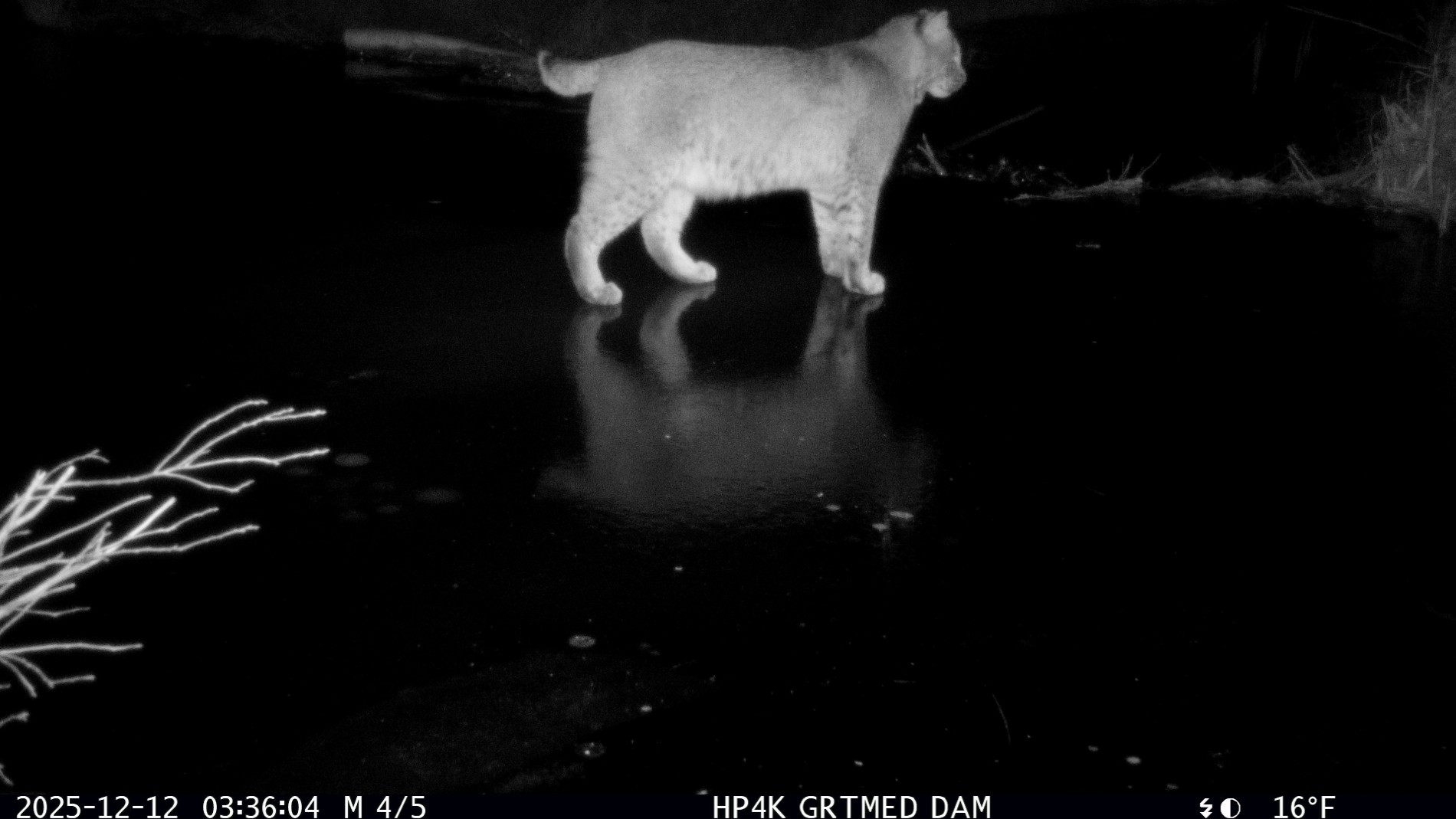
A game camera in the Great Meadow Wetland captures a passing bobcat. (NPS photo)
Building on this progress, a $308,000 grant from the Maine Natural Resource Conservation Program, awarded to Friends of Acadia this winter, will expand restoration efforts to watershed areas above and below Great Meadow. Above the wetland, the Abbe Stream is currently confined to a maze of human-made underground channels. It will be returned to a more natural streambed and reconnected with Cromwell Brook.
This work will improve hydrology, enhance habitat for plants and wildlife, and restore connectivity for fish and other aquatic organisms.
Below the wetland, this new funding will extend the restoration work downstream of the culvert to the park boundary, helping restore Cromwell Brook’s floodplain and native vegetation.
“It’s extraordinarily exciting to see how much progress is being made,” Gibson said. “In the last 100 years, we’ve learned so much more about how important wetlands are to wildlife, to water quality, and in mitigating flooding. Each one of these projects is helping us restore Great Meadow to a more natural, healthy state.”
CLAIRE KEELEY is a former Digital Content Creator at Friends of Acadia.