Small Mammals on the Mountains


Dr. Brittany Slabach and students from College of the Atlantic are studying the small mammals on Acadia’s summits and their roles in the ecosystem and vegetation restoration.

BY CLAIRE KEELEY

What if you were told that on Acadia National Park’s summits, nestled among the rock faces and patches of three-toothed cinquefoil, there lies a chain of grocery stores?

Not just one store, but multiple, where consumers are provided with resources that help them restock and refuel after long days of traversing the park’s rugged landscapes.

It would seem hard to believe, yet visitors come from near and far to experience what each store has to offer. Squirreling throughout the aisles, those who visit search for fibrous meals or stash highly sought-after items in their pouches for later. Some may even be observed stuffing their cheeks with free samples before scurrying out of sight.

Each hub functions as a cornerstone for the community that it serves. By supplying locally sourced items, these stores have the potential to boost the community’s productivity, resilience, and overall health. And it is all happening right under our noses…and our feet.

This is the secret, bustling world of the small furry creatures hidden within the vegetation restoration plots located on the summits of some of Acadia’s tallest mountains. Acadia’s summit vegetation restoration efforts date back as early as 2015, but recently park management has accelerated that work with the help of Schoodic Institute and Friends of Acadia.

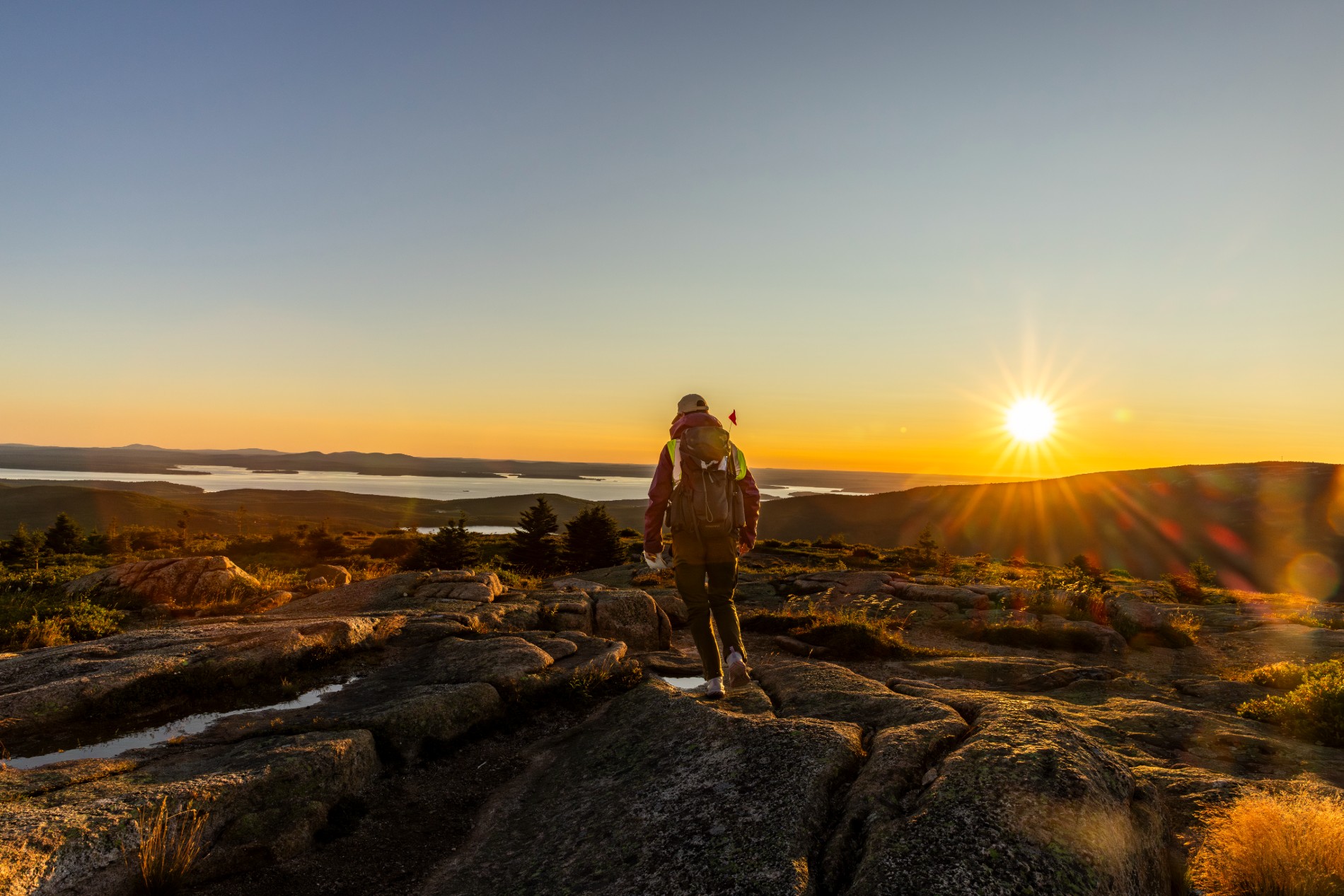
As the sun rises over the summit of Sargent Mountain, College of the Atlantic Shaw Fellow Colleen Nelsen begins checking traps set the night before as part of Dr. Brittany Slabach’s small mammal research project. (Rhiannon Johnston/Friends of Acadia)

These efforts are helping to restore low-lying vegetation in areas damaged by inadvertent trampling, social path usage, and more frequent weather events.

Throughout the summer, park staff and volunteers haul soil to the tops of Acadia’s peaks, and each October a selection of test plots are planted with native seeds. The hope is that reestablishing native plants on Acadia’s summits will benefit entire ecosystems.

“I refer to [the restoration plots] as grocery stores,” explains Dr. Brittany Slabach, professor of terrestrial biology at College of the Atlantic, “because once they put the seeds out in October, mammals, birds—all kinds of things—come up and eat them.”

Though the plots can serve as a buffet for many organisms, small mammals caught Slabach’s eye and became the focus of her 2023 Second Century Stewardship research, a fellowship led by Schoodic Institute aimed at advancing conservation science within Acadia National Park.

Small mammals are regarded as good indicators of ecological health. Aside from the surplus of ecological benefits they provide, such as soil aeration and seed dispersal, “one of the best things about small mammals is that everything eats them,” Slabach said.

As a result, these tiny creatures have a significant ecological impact despite their size. With this in mind, Slabach set off to understand how restoring Acadia’s peaks might impact these small mammal communities.

UNCHARTED TERRITORY

In 2023 Slabach received a call from Bik Wheeler, Acadia National Park’s Wildlife Biologist, notifying her that restoration efforts would begin later that season on Sargent Mountain.

Slabach and her team of undergraduate researchers jumped at the chance to “understand the potential indirect effects of restoration on other aspects of community ecology” in real time. They first needed baseline data—beginning with a simple question: which small mammal species are up there?

“No one had ever done a live capture on Acadia’s summits before to see what was there,” explained Slabach. During that initial field season, the team became the first to live trap a small mammal on Acadia’s summits, using Sherman traps baited with peanut butter, birdseed, and mealworms and insulated with Poly-fil, a synthetic bedding.

“It was just a Peromyscus,” Slabach said, reflecting on her team’s first-ever capture. Peromyscus, a genus of rodents, are highly adaptable generalists, allowing them to thrive just about anywhere and everywhere—including in Slabach’s traps. The next capture was another mouse, and then another. But that itself was interesting. To the naked eye, it seemed like each trap was capturing the same species, but on a genetic level, a different story was being told.

“With Peromyscus, they phenotypically converge,” Slabach explained, a phenomenon that occurs when lineages of organisms evolve to be more similar in traits than their ancestors.
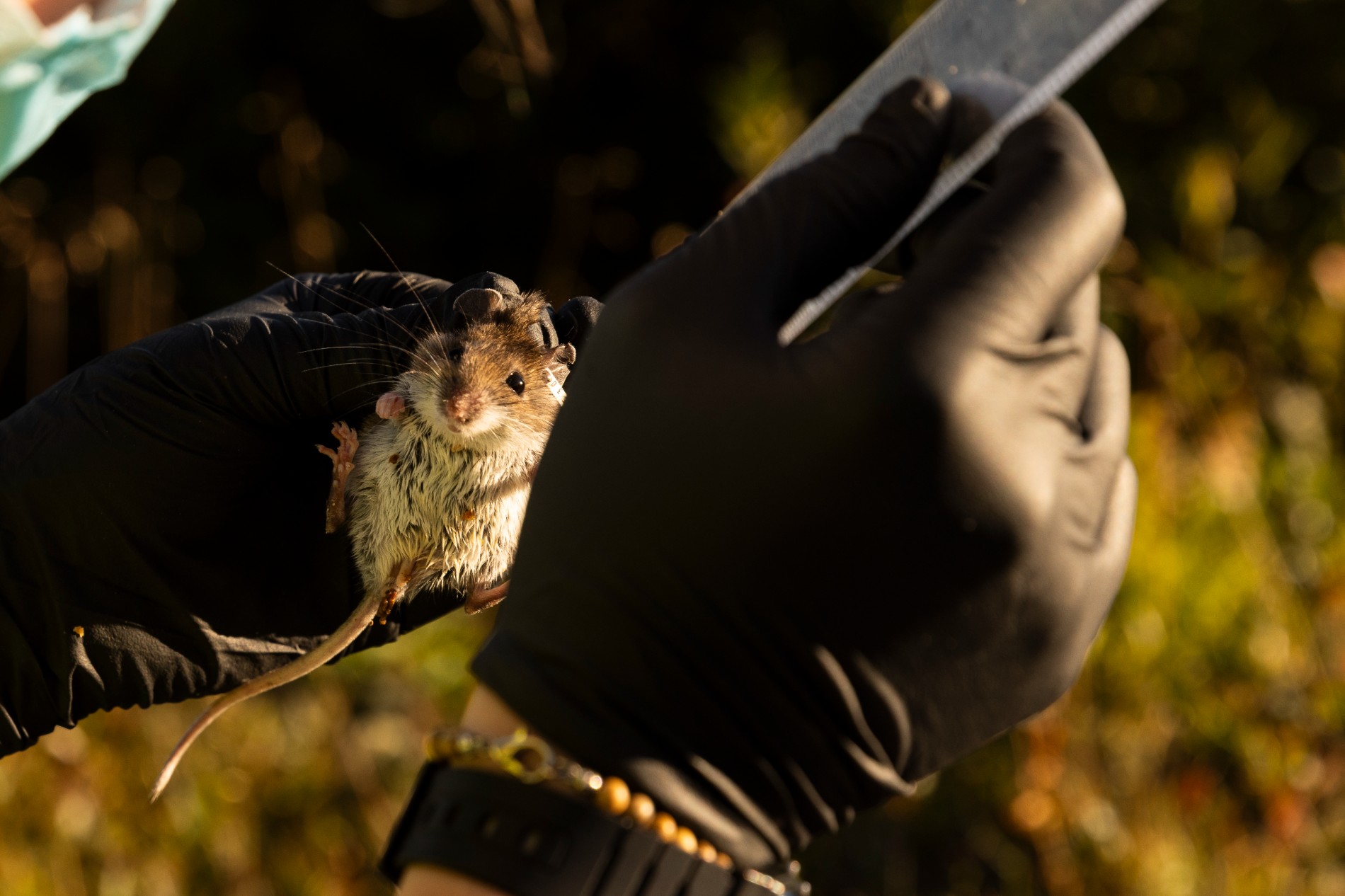
College of the Atlantic Shaw Fellow Z Packard measures the ear of a deer mouse. (Rhiannon Johnston/Friends of Acadia)

On Acadia’s summits, Peromyscus leucopus (white-footed mice) and Peromyscus maniculatus (Eastern deer mice) have developed similar physical traits across evolutionary time. The only way to tell the species apart is through genetic testing. Slabach’s team collected small ear tissue samples, a standard field technique for small mammal research, to confirm which of the two Peromyscus species they had captured.

Early in the team’s research, it felt like Peromyscus were the only small mammals on the summit. But then one day they opened a trap to find something that changed their perception of what called the mountaintops home.

“I don’t think we’ve ever been so excited,” shared Slabach, reliving the moment. “We [trapped] this big, beautiful male meadow vole … It was finally something different, but it made us think, why are you here?”

To Slabach’s surprise, her team discovered a resident population of Eastern meadow voles (Microtus pennsylvanicus). Known for living in meadows, lowland fields, and grassy marshes, it seemed out of place on the rugged, subalpine peak of Acadia’s second tallest mountain.

“[The summits are] not what we refer to as ‘traditional’ meadow vole habitat. It is not like a meadow, but in many ways, it is,” according to Slabach, referring to the habitat as an “elevation meadow.”

“The grassy moss [on Sargent] is really great [habitat] for meadow voles to tunnel down into,” moving efficiently across the landscape and evading predators.

In stark contrast with the generalist Peromyscus, meadow voles are specialists, occupying very specific niches in their surrounding environment. “One of the things I am really curious about is the relationship between when you have a generalist that can do really well in all kinds of environments and you have a more specialist species … what are the competitive interactions there?

Slabach’s team trapped 33 Peromyscus and two Eastern meadow voles in their first field season, giving researchers a first look at what was living on Sargent before restoration work began. “If we are thinking about changing climates and resilience, we want to understand this from a community [ecology] aspect. To me, it is important to know what is there,” explained Slabach, and even the smallest pieces of information can be vital. “It might just be a bunch of deer mice, and that is okay, but that tells us something, right?”
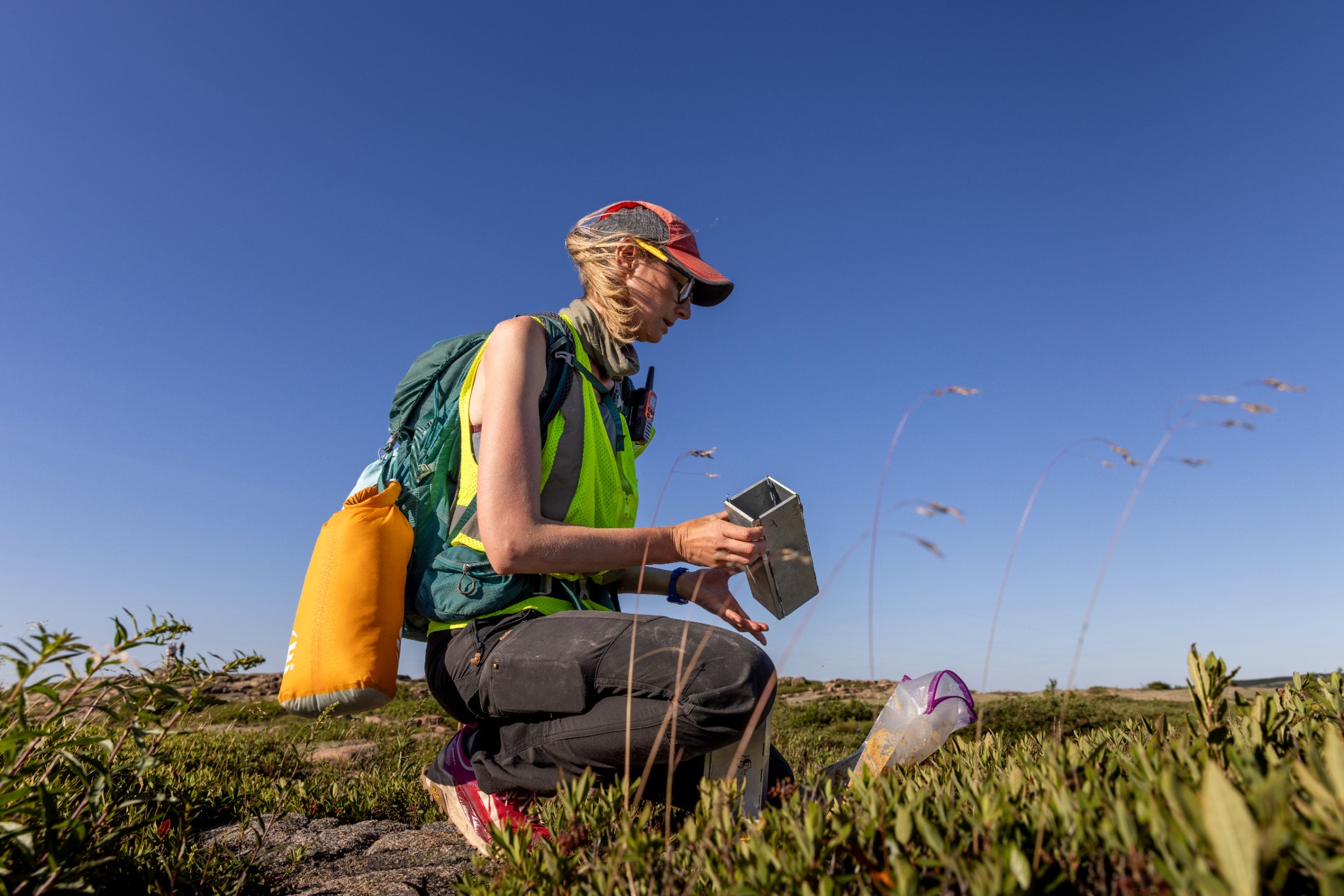
Dr. Slabach sets small metal box traps filled with balled-up oats and peanut butter on the summit of Sargent Mountain. (Rhiannon Johnston/Friends of Acadia)

BROADENING HORIZONS

With Sargent Mountain, pre-restoration, serving as a baseline, Slabach and her team decided to expand their research to new summits to contextualize their findings, adding Cadillac and Pemetic Mountains to the mix for the 2024 season.

“Cadillac has had some restoration on it; Sargent is [currently] getting restored, and Pemetic has not been restored,” explained Slabach. Adding Pemetic gave the research team an unrestored peak to compare to, providing their expanding field research with a control group. “Is Sargent an outlier? Are the restored mountains outliers?” questioned Slabach, “Or are we seeing the same thing across Acadia’s summits?”

Simultaneously, the team launched a secondary focus to observe if restoration plots influenced overall movement of small mammals through the usage of tiny tracking collars. This allowed Slabach to track home ranges, observe competitive interactions, and observe movements in and around each restoration plot. By the end of their second field season in 2024, Slabach’s team captured 94 unique individuals, representing Peromyscus and two other species: Eastern meadow voles and Northern short-tailed shrews. (Though not harmful to humans, the Northern short-tailed shrew, Blarina brevicauda, is notably one of only a handful of mammals in the world known to be venomous.)

Slabach’s team found that Peromyscus populations nearly doubled on restored summits from 2023 to 2024. In addition, although species diversity was low overall, it appeared to be higher on the restored summits.

Now, the research is in its third field season, and Slabach’s team has hit their stride.

Hiking a cumulative 250+ miles in the 2025 field season alone, Slabach and her team continue to assess the distribution, biodiversity, and population size of small mammals on Sargent and Cadillac Mountain. In addition, they have added two unrestored peaks, Parkman Mountain and Bald Peak, in lieu of Pemetic Mountain.

The team has also begun to collect data on vegetation types at each capture site to further understand the influence of vegetation on capture rate. The team hopes to create a statistical model that can provide the capture probability at a specific trapping site based on the vegetation type nearby, as well as the capture probability based on species. This could help explain why the team sees some species more often on some summits versus others.

Through each passing year, Slabach and her team have built upon their knowledge of the small mammal communities, unlocking new pieces of an even larger, complex puzzle.

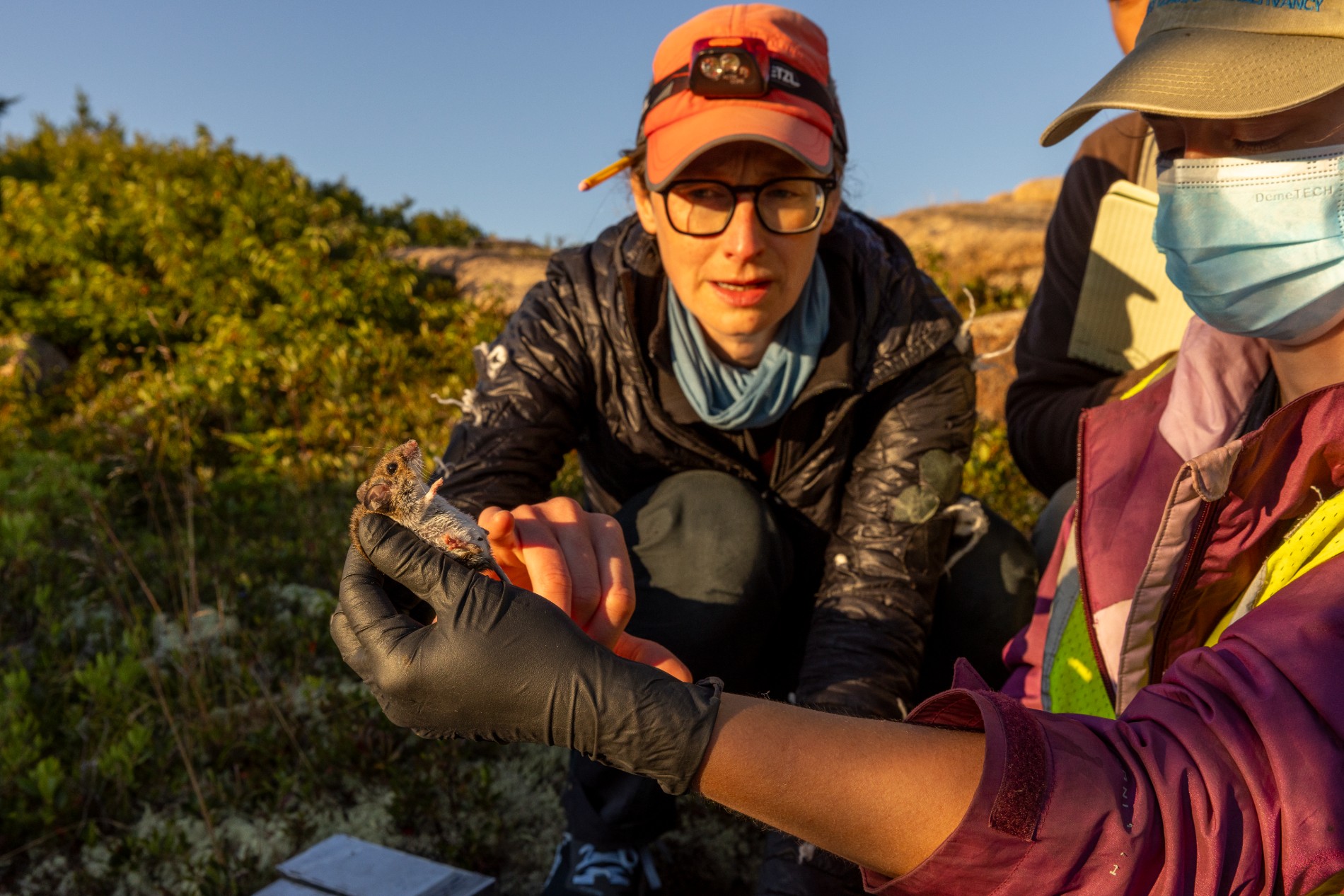
Dr. Brittany Slabach points out which part of a deer mouse College of the Atlantic Shaw Fellow Colleen Nelsen (right) should measure to collect accurate data as part of Slabach’s small mammal research project. (Rhiannon Johnston/Friends of Acadia)

SMALL BUT MIGHTY

Since the project’s inception, Acadia’s summits have turned into outdoor classrooms for Slabach’s undergraduate students who help with Slabach’s research.

“I have a pretty good crew,” Slabach shared. A smile spread across her face as she observed this year’s College of the Atlantic Shaw Fellow undergraduate researchers Z Packard, small mammal lead, and Colleen Nelsen, vegetation lead, “running the show” as they conducted research in the field.

“The work is hard.” explained Slabach. “I get why people have not done [live captures]. It is lots of early mornings and late nights.”

However, a multitude of rewarding opportunities stem from it, such as Slabach observing her two mentees growing into budding field ecologists right before her eyes. It has also deepened Slabach’s understanding of the park.

“None of Acadia’s summits are the same,” Slabach shared, “and that, in many ways, is what makes them wonderful.”

Results from the 2025 season are currently being analyzed, but previous results suggest that restoration efforts may be influencing small mammal assemblages on Acadia’s mountaintops. Slabach has begun to identify emerging trends from baseline biodiversity data that indicate species richness and abundance appear to be higher on restored summits.

For Slabach and her team, each result leads to new, interesting questions: “You’ve got all these seeds you put out, and most of these small mammals are seed predators, known as granivores. In some ways, this might be a benefit if they are helping disperse [the seeds],” Slabach said, “but if the goal is to re-vegetate something and small mammals are eating the seeds, then it may be influencing your goal.”

Each new question, Slabach said, eyes lighting up, “makes me want to trap on more summits.”


CLAIRE KEELEY is Friends of Acadia’s 2025 Digital Content Creator.