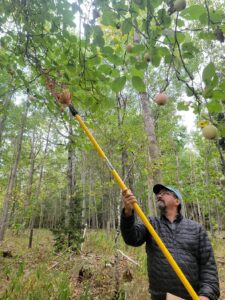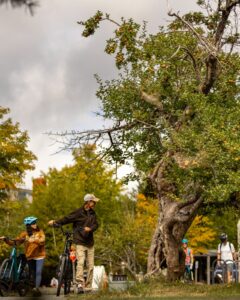
Historic apple trees stand outside the Jordan Pond House near Jordan Pond. The Jordan family planted a small orchard here in 1847 when they built the original Jordan Pond House, making the trees left on the property nearly 170 years old. (Rhiannon Johnston/Friends of Acadia)
Late September, the Jordan Pond House is crowded. People wait for the Island Explorer bus while others drive in circles trying to find a parking space. Groups of hikers gather at trailheads, families wait for tables in the restaurant, and tourists browse the gift shop and hustle to and from the restrooms.
In the lawn surrounded by this busy scene stand two large apple trees, largely unnoticed by the crowds, perhaps perceived as just another tree in a park that is mostly forest. But unlike most of Acadia’s trees, which have been here for thousands of years, apples are recent arrivals, here for only a few hundred years. But just like the rest of Acadia’s trees, apples are remarkable.
Their story is intertwined with the human story of relationships with trees, land, and one another. They are the most obvious reminder that , as it says on a park wayside at Frazer Point, there have been footsteps before you.
The apple’s story starts in the mountains of Central Asia. There grew a tree so full of life that every single one of its seeds had a unique genetic inheritance. Arranged in a five-pointed star and embedded within a megafauna-friendly fleshy fruit, the seeds that sprouted would not “come true” and have the same characteristics as their parent. Instead, seeds yield pomes of their own size, shape, color, and flavor.
Like humans, every single apple tree is one of a kind. An apple can, however, make more of its kind if a twig grafts to the trunk of a different apple tree, drawing nutrients and water from an established rootstock while the fused twig exercises its own DNA to make fruit. This was a miraculous composite, fostered into being some four thousand years ago by people living in the Tian Shan mountains of western Asia-around the same time Wabanaki people, having found rich beds of shellfish, decided to stay for a while at Frazer Point, now part of Acadia National Park.
There may not have been apple trees here then, but there were spruce and fir and birch, chokecherries and blueberries, huckleberries and acorn-bearing oaks, enhanced and facilitated through burning and other methods.
The apple trees came later, grown from seeds and scions carried by waves of colonists across an ocean. Those who arrived after Wabanaki communities had been decimated by war and disease perceived not a cultivated garden but a forest primeval. Cutting down the forest became the actual and metaphorical task of the settler, and apple trees, like sawmills, were among the many marks of possession.
Apples rooted in their new ground, but they did not take over, did not become “invasive.” The apple’s easy adaptation to local soils and climate, their seeming naturalness in the new land, their tendency to go wild (but not too wild), became a metaphor for Americans themselves.
Across Acadia, people planted apples on their claims. Apples were a sweet and symbolic sustenance at first, and then a cultural phenomenon. New apple varieties proliferated as 19th-century farmers identified promising seedlings, gave them names, and then gave them away, said historian and College of the Atlantic professor Todd Little-Siebold. “More than one thousand named apple varieties were being grown in the state of Maine alone, with tens of thousands across the United States,” he said.
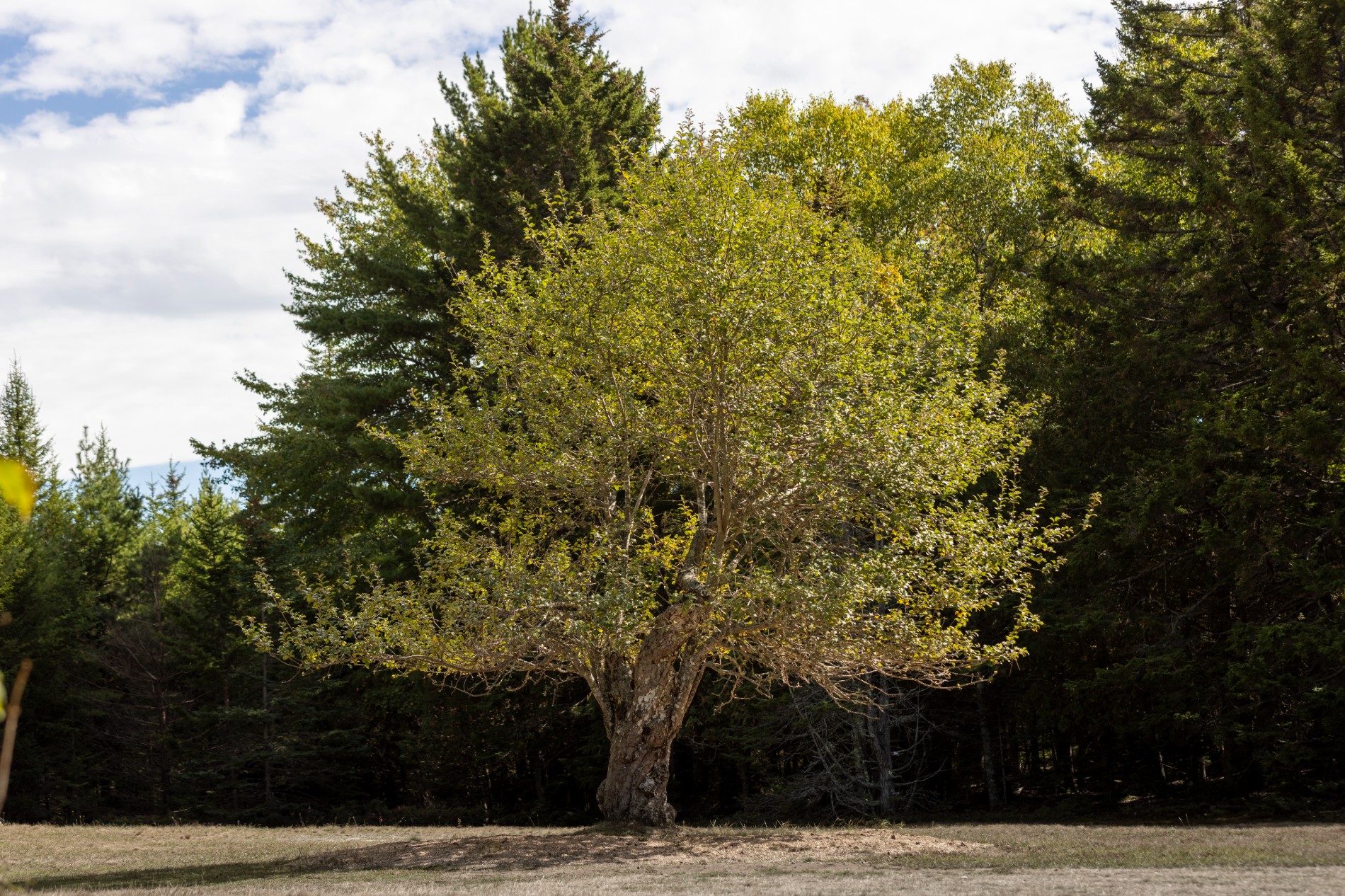
Historic apple tree in the lawn of the Carroll Homestead. (Rhiannon Johnston/Friends of Acadia)
Some apples were for eating fresh, others for cooking or storing, and still others for cider, despite efforts of the temperance movement. Sustained by tourists and summer communities, orchards at Beech Hill and the foothills of Cadillac Mountain grew Pewaukees, Baldwins, Fameuses, Wolf Rivers, and Kings. Farmers began showing their apples at agricultural fairs. Exhibitors at the Eden Fair displayed over sixty varieties, and several were unique to Mount Desert Island.
Those apples probably extended the economic viability of farms by a couple generations, said Little-Siebold, who is still searching for the golden-hued Jacobs Sweet apple reportedly planted by the Carrolls at their “mountain house.” But most residents could not survive on fruit alone.
“This is a crazy place to farm,” said Little-Siebold. As with land and lumber and economic opportunity, apple supplies shifted south and west. In addition, farmers’ preferences for what to grow changed to satisfy market demand in Europe, as well as at home. Apples had become an industry. In 1917, Mount Desert Nurseries had 14 different varieties for sale, but the market demanded large quantities of “first class fruit,” apples uniformly perfect in size, shape, and color. The industrialization of apples contributed to the decline of local farms as well as a loss of diversity – and memory.
Yet reminders of Acadia’s agricultural past are everywhere, in the apple trees that today grow along roadsides, in old fields, and outside former homes, estates, and tea houses.
Outside the Jordan Pond House in the fall of 2024, Todd Little-Siebold walked around the trees, looking for graft lines, inspecting their bark riddled with sapsucker holes.
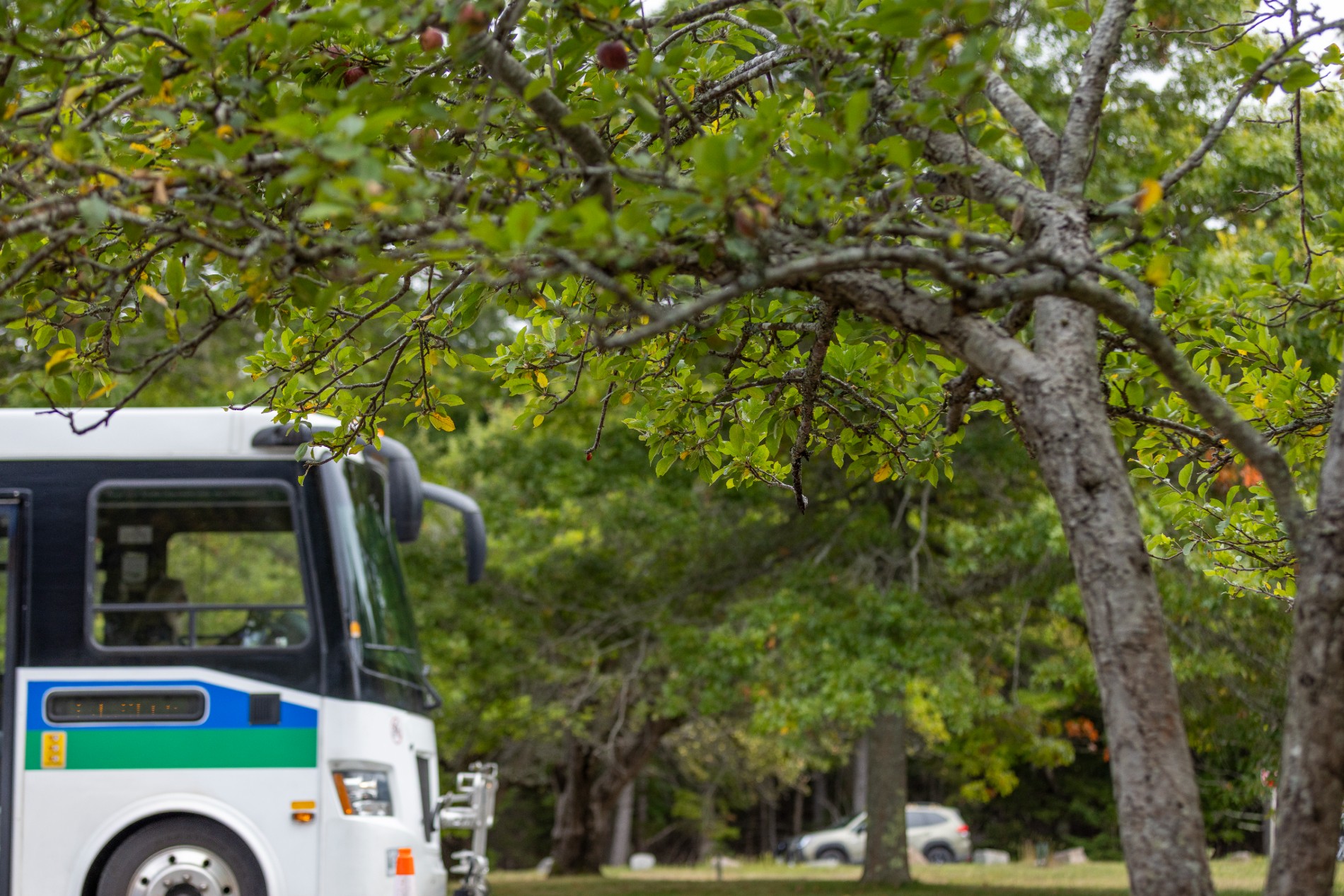
Historic apple trees stand outside the Jordan Pond House near Jordan Pond. The Jordan family planted a small orchard here in 1847 when they built the original Jordan Pond House, making the trees left on the property nearly 170 years old. (Rhiannon Johnston/Friends of Acadia)
Cultivated trees tend to have a Y or V shape from heavy pruning, as horizontal branches make more fruit. One tree was sprouting branches from the base of the old rootstock, and one larger branch bore different apples than the rest of the tree.
“These trees were planted before the Civil War,” he said. “There are very few trees that old on this island. They are probably one of the most significant elements of the past agricultural landscape that survives in the park.”
“The story of apples and the story of the park are both about abandonment,” he continued. “Why is it that the park can become a park? Why was there nobody here? Acadia is presented as sort of like a human-free environment. And it is not that. There have been people here for a long time.”
Conservation of lands that became Acadia National Park preserved apples associated with cultural landscapes like Jordan Pond House, Carroll Homestead, and Frazer Point. Conservation also preserved fragments of ancient forest and allowed forest that had been cleared for farms or cut for lumber to grow back. The old apple trees sent forth their thousands of seeds into the spreading woods, where they sprouted in sunlit clearings and roadsides, exercising their unique DNA, continuing a legacy of relations between people and land, perhaps to become heirlooms in their own right.
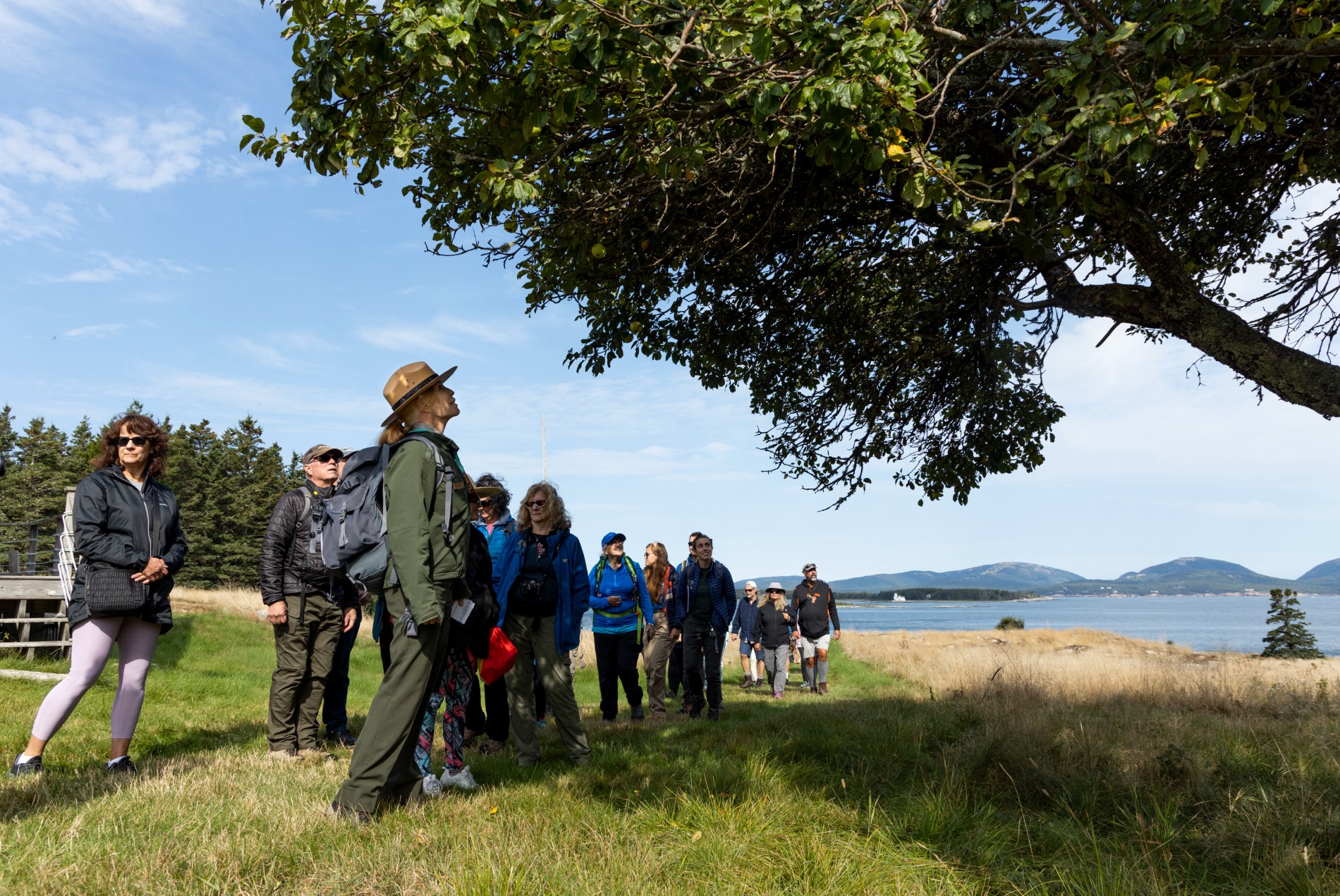
Meribeth Kambitsch, Acadia National Park interpretive ranger and language interpreter, stops with visitors under an heirloom apple tree on Baker Island. (Photo by Lily LaRegina/Friends of Acadia)
Little-Siebold has been collaborating with fellow heirloom apple expert John Bunker, of Maine Organic Farmers and Gardeners Association and Fedco Trees, to locate old orchards, identify and document fruit varieties, and connect the history of apples to the history of the region and state. He has also been collecting DNA samples from trees in Acadia to learn what variety (and era) they may have descended from.
He reached up into branches drooping with fruit, pulled down a yellow apple from the branch retained by the old rootstock.
“This apple is the only one of its kind in the universe,” he said, holding up the fruit. “Do the math. I’m holding this little apple, and there may be 10 seeds in here, 10 new unique apples … and on this little tree, there may be 400 or 500 little pieces of fruit. Times 10 means 4,000 to 5,000 potential apples on each tree. There are 20 trees in this corner of Acadia National Park. Every year they produce fruit, a new 5,000 next year, and then a new 5,000 the year after.”
According to Little-Siebold, Maine may have one of the highest levels of apple diversity in North America. The National Park Service recognizes that apples are part of Acadia’s ecology and culture.
There beside the Jordan Pond House, old-growth trees dropped their ancient, edible fruit onto the lawn. For Little-Siebold and others seeking to protect the trees of Acadia, the apples are a windfall of biological diversity—and human history.
CATHERINE SCHMITT is a Science Communication Specialist at Schoodic Institute.
EDITOR’S NOTE: This article was excerpted with permission from Catherine Schmitt’s upcoming book, “Trees of Acadia: The Past, Present, and Future of Park Forests,” which will be published in Spring 2026 and is now available for pre-order at bookshop.org.
 Join
Join Donate
 Acadia National Park