 Join
Join Donate
 Acadia National Park
People Powered
Volunteerism Sparked the Flame of Friends of Acadia – and Keeps It Alight for 40 Years and Counting
BY ELIZA WORRICK
September 10th, 2026
Volunteerism Sparked the Flame of Friends of Acadia – and Keeps It Alight for 40 Years and Counting
BY ELIZA WORRICK
September 10th, 2026
When chatting with longtime Friends of Acadia stewardship volunteer David Opdyke over a cup of coffee, two subjects made his eyes light up and a smile spread across his face: his grandsons and the Jordan Pond bogwalk.
“I’m partial to raking ditches,” Opdyke said when asked about his favorite volunteer tasks, “but I like the special projects. Bogwalks are my pride and joy.”
When Opdyke’s grandsons come up from New Jersey for a visit, he’ll take them through the park to see, touch, and stand on projects he had a direct hand in creating. Strolling along the Jordan Pond bogwalk with them, he says, “You see that? Your grandfather built that.”
“We’re passing on to the next generation a love of the park and the area, which makes me feel good. It’s not just the old geezers.”
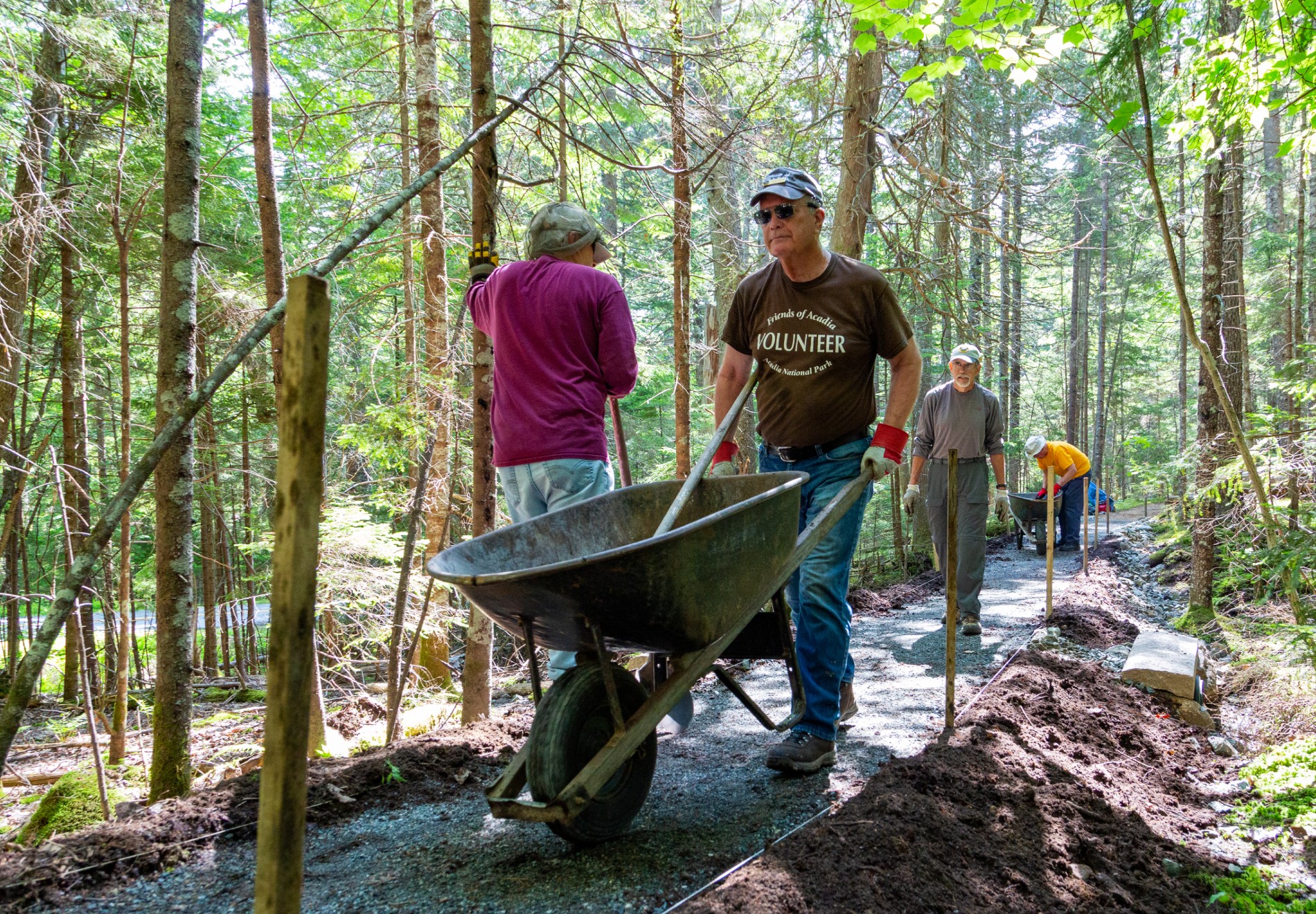
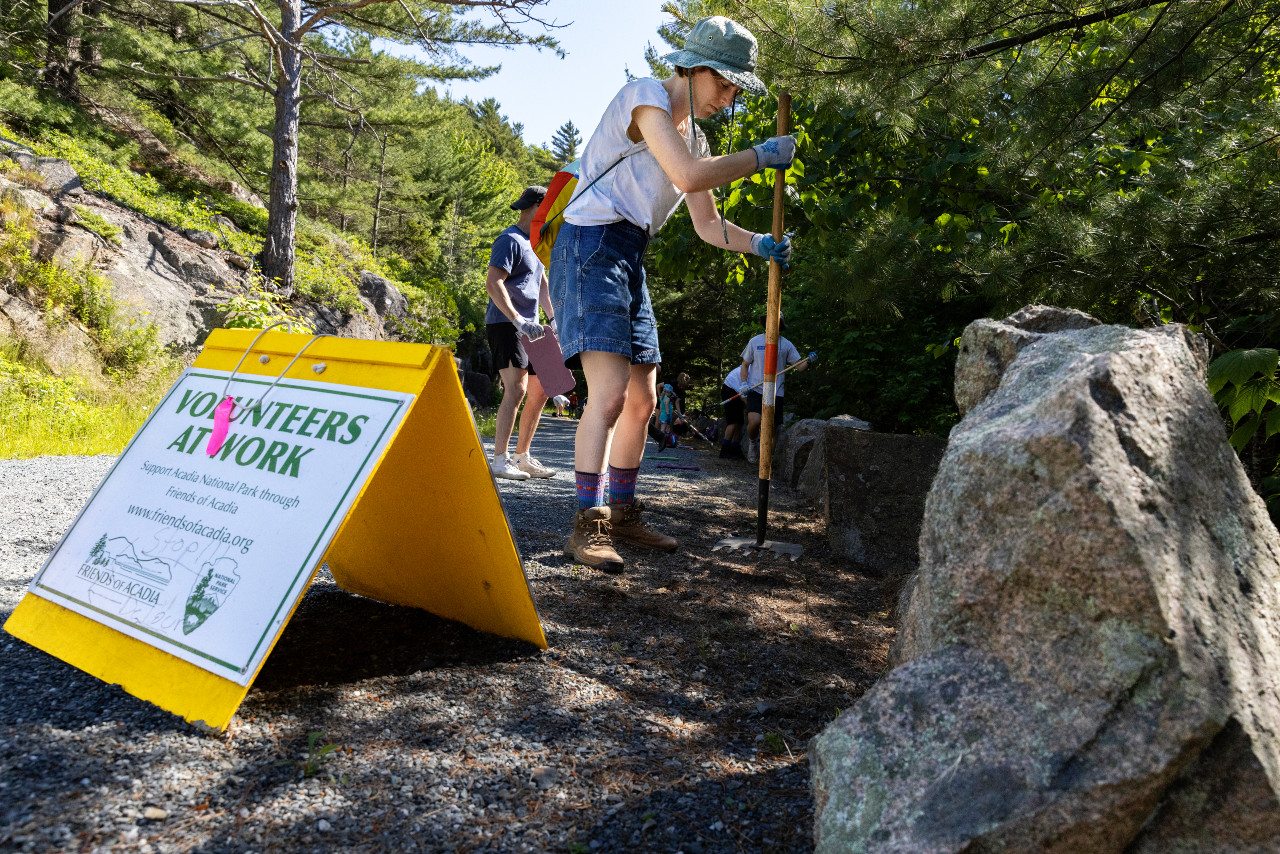
Park volunteers Roger Thompson, Gerry Fournier, and Volunteer Crew Leader David Opdyke work to re-vegetate and add gravel to the Seaside Path. (Nathaniel X. Boechat/Friends of Acadia)
Loving Acadia National Park is easy—everyone reading this story feels it deeply. What becomes more challenging is translating that love into something tangible. Friends of Acadia was founded on that very alchemy.
In 1982, the Downeast Outing Club was created by a group of local outdoor enthusiasts and fans of Acadia National Park.
By the 1980s, Acadia’s trails and carriage roads were showing serious signs of neglect. This compelled some members of the Downeast Outing Club to mobilize and approach Acadia’s Trails Foreman, Gary Stellpflug, to offer their volunteer services as a group.
Stellpflug took them up on their offer, and before long, this crew was out cutting back vegetation, removing debris from trails, and eventually tackling larger projects like helping Stellpflug rebuild a bridge on the Hunters Brook Trail.
In March of 1985, Acadia’s Chief of Park Operations, Joe Abrell, announced in the Bar Harbor Times that there would be no funds available for trail maintenance due to federal budget cuts. That summer, the concept of creating a “Friends” organization for Acadia gained real traction thanks to Downeast Outing Club member Marianne Edwards and Acadia’s Deputy Chief of Interpretation, Lois Winter.
Friends of Acadia formed in 1986, and the park’s neglected carriage roads became the organization’s first fundraising priority.
To further codify and strengthen the relationship between Acadia National Park and Friends of Acadia, the Trails Committee was founded in 1990 with members from both organizations. This group decided which projects to take on and what they would need in terms of human power and tools. That same year, Friends of Acadia published its first official call for volunteers in the Bar Harbor Times, with several opportunities for trail and carriage road work. They likewise began purchasing tools, gloves, and water bottles for volunteers to use and donated a shed to store everything in at park headquarters.
As interest and participation in volunteering grew, the park created a volunteer coordinator staff position in 1993, a role that still exists today. Four years later, the park came to Friends of Acadia with a proposition: Friends of Acadia should hire their own volunteer coordinator to supervise volunteers and free up park personnel.
Chris Corwin was hired as the first trail crew leader (today’s stewardship crew leader) in 1997. Mike Alley stepped into the role in 1998 and, together with the park’s Volunteer Coordinator Jonathan Gormley, continued to shape what is known today as the Drop-in Stewardship Volunteer Program. Over the years, this program has become the most tangible expression of not only love for the park, but the relationship and trust between Friends of Acadia volunteers and Acadia National Park staff.
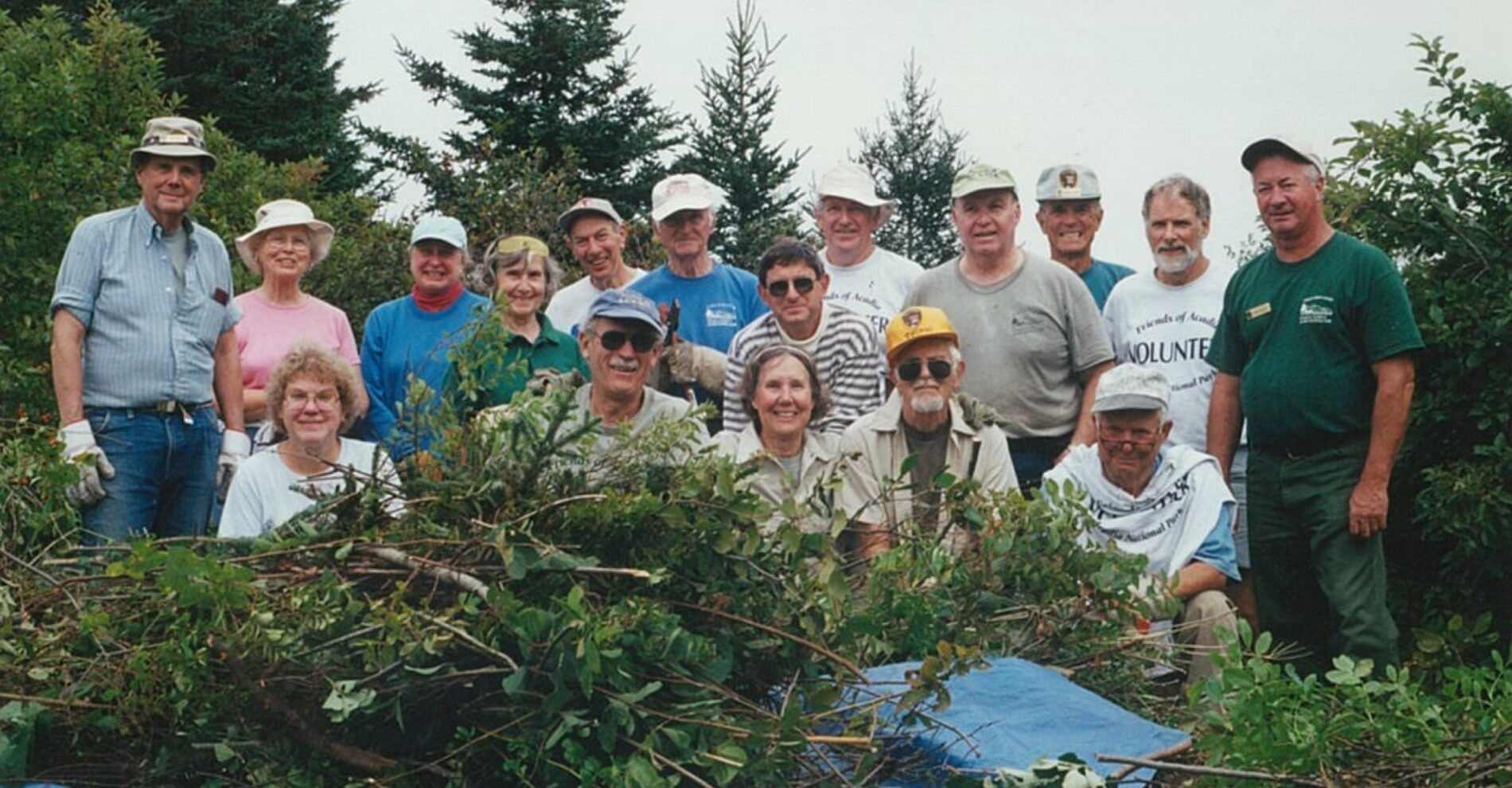
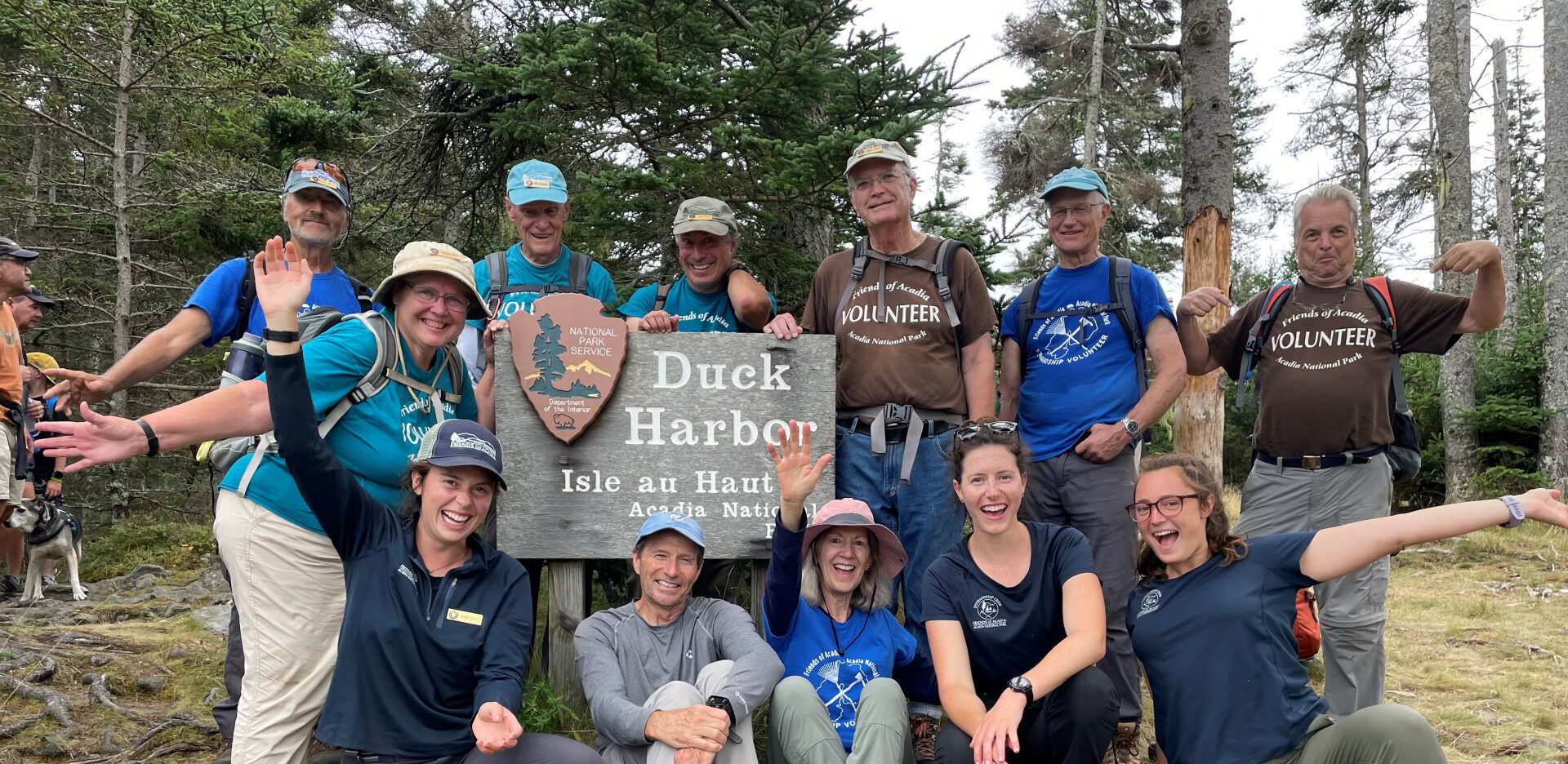
Stewardship volunteers pose for a photo. Front row: Marcia Fisher, Del, Dee Solomon, George Feltus, Bill Bell. Back row: Don Curley, Pat Bell, Marcia Pashkis, Anna Buck, Al Paschkis, George Buck, Richland Landesman, Rodney Fox, Bob Sanderson, Howard Solomon, Tom Frank, Mike Alley(Friends of Acadia)
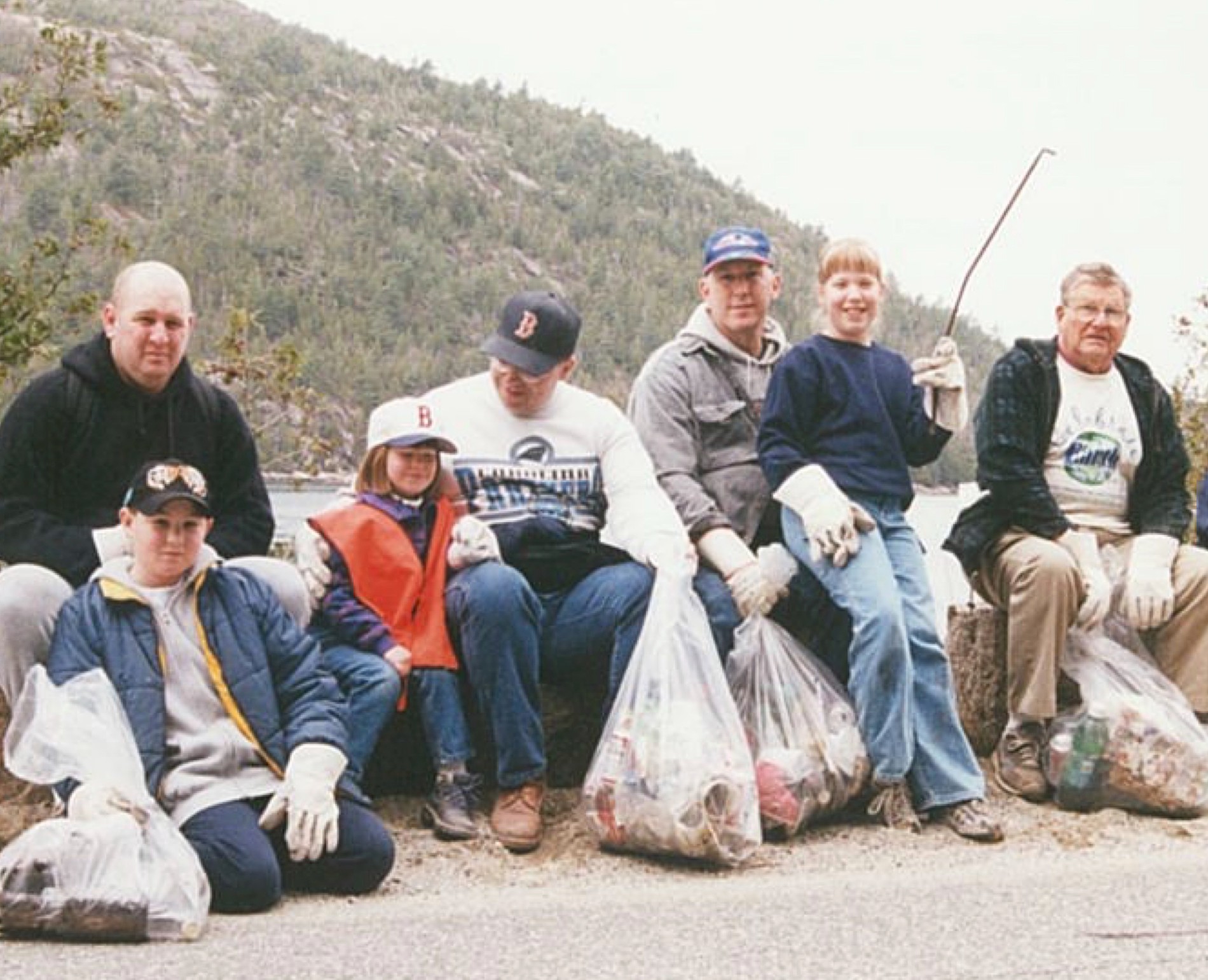
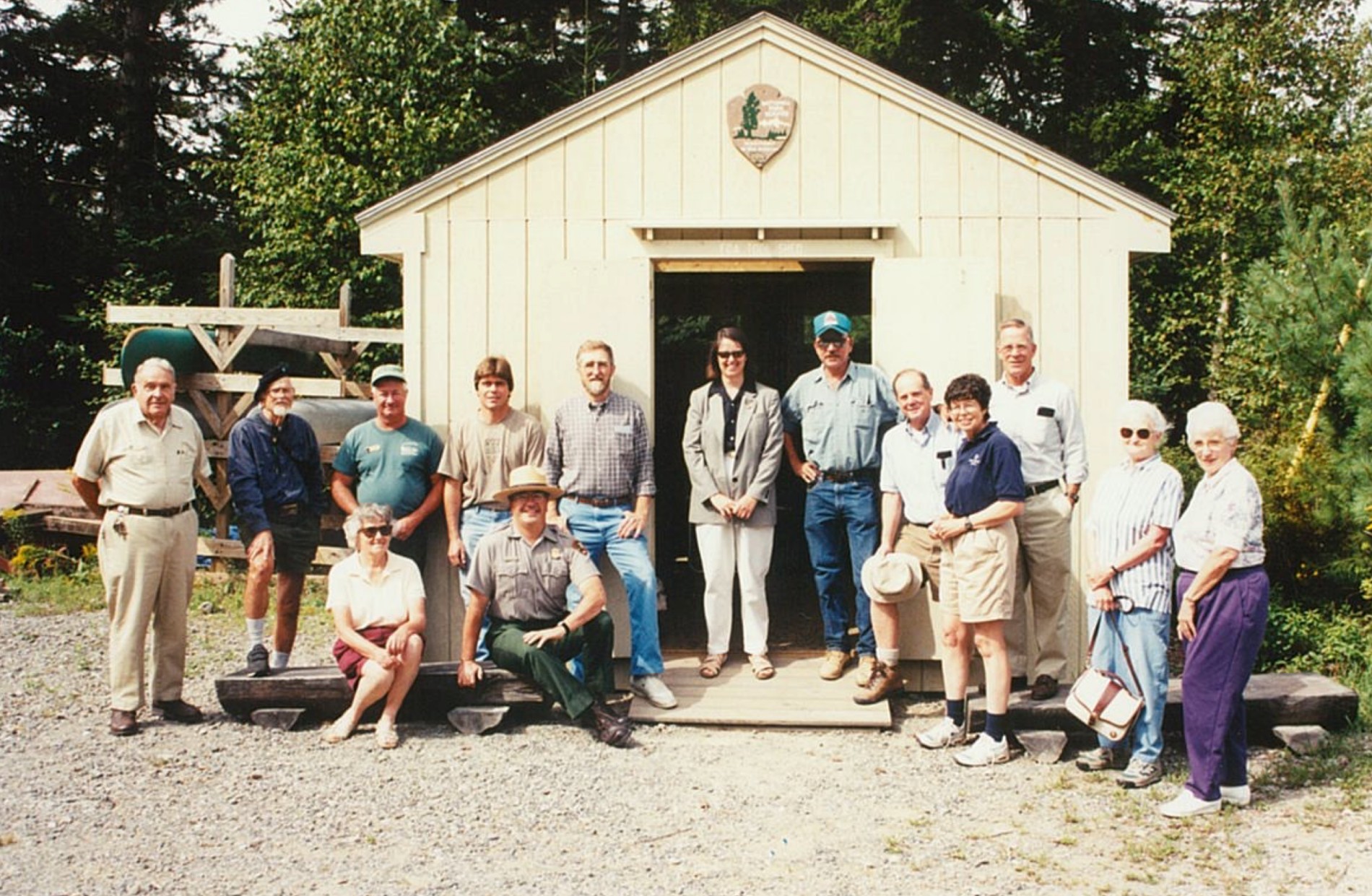
Group photo outside of the volunteer shed in Acadia National Park.
Back in the coffee shop with David Opdyke, the subject of his start with the Drop-in Program came up. In 2011, after retiring from a long career in banking, Opdyke was ready for a change and had no intention of sitting around doing nothing.
“I had my fill of studies and planning and accounting for things; I wanted to do something I could see and that made a difference.”
Opdyke got to chatting with his neighbor, who happened to be Jonathan Gormley, and learned about the Drop-in Program. Opdyke could join other volunteers for a few hours on Tuesdays, Thursdays, and Saturdays to do things like cut back vegetation from trails, clear drainage features, and weed carriage roads. “He said, ‘Just show up,’ which I did in June 2011, and I’ve been doing it ever since.”
“I think the base importance of volunteer programs for me is community,” said former Stewardship Manager Nikki Burtis. Burtis held this position for five years. Working in concert with Acadia’s current Volunteer Coordinator Dianna Sproul, Burtis
witnessed firsthand how this program impacts volunteers like Opdyke. “We’re all friends of Acadia, and that allows folks that maybe have just moved to the area, or just retired, or have just gone through some sort of life change, to find like-minded individuals and community there.”
Opdyke isn’t the only volunteer who found volunteering in the park after a major life change.
“Acadia is kind of a calling,” said Brian Sale, Friends of Acadia’s new stewardship manager. After retiring from the United States Air Force, Sale was living in Colorado and decided to take his first ever trip to Maine in May of 2024. “I spent one day in Acadia, and when I walked down to Schoodic Point, I said, ‘Yep, this is where I want to be.’”
Stewardship and conservation initiatives were things he’d long had an affinity for, so when he got back to Colorado and began plotting his move to Maine, he was thrilled to learn of Friends of Acadia’s Stewardship Program.
“By September of 2024, I had moved here and started volunteering with the Drop-in Program, and I’ve been doing that ever since.”
It wasn’t long before Sale transitioned from being a repeat volunteer to becoming a Volunteer Crew Leader (VCL). Typically, VCLs are drop-in volunteers who show up regularly and demonstrate the potential to lead untrained volunteers. Like the Drop-in Program, the VCLs have grown and changed significantly over the years.
“My first training was half an hour with one of the assistant stewards over a beer,” said Opdyke, who has been a VCL for most of his 15-year volunteer career. “In the last five or six years, we’ve gotten really organized.”
The pandemic helped usher in some big changes to the program, including the creation of a 70+ page handbook to document the roles, responsibilities, and expectations of a VCL. It also includes instructions, work outlines, safety protocols, and necessary tools for each project that the VCL might encounter. VCLs are expected to read this handbook annually as it gets updated each winter.
“They have to do a driving test at the beginning of each season and keep current with their CPR and first aid,” explained Acadia’s Volunteer Coordinator Dianna Sproul. “It’s a serious responsibility that people are taking on to be VCLs,” she continued. “Just as impressive as the work is the commitment and the responsibility and all the steps they’ve taken for training to be capable of managing these volunteer groups.”
Opdyke isn’t shy about acknowledging this responsibility.
“I love doing it. I take it seriously, and it’s been extremely rewarding,” he said. “What I find really valuable is that it’s one thing
to teach VCLs how to use equipment and things like that, but we teach leadership. These are life skills, so to be part of an organization like that, it makes me really proud—I’m happy to be contributing to it.”
Recently retired Acadia Trail Crew Supervisor Chris Barter knows firsthand how much of a difference volunteer stewardship work makes, and how much it enables park staff to do more.
“When I started here in 1989 … we spent the entire season brushing trails, putting down paint blazes, and maybe cleaning a few water bars (drainage channels cut diagonally across trails to divert surface water),” he said. “Now all of that is done by volunteers. And they honestly do it better than we did because this is what they love to do. They do it every week, and they just do a beautiful job of
taking out the vegetation that needs to be taken out—and not a twig more—for the trail to be usable.”
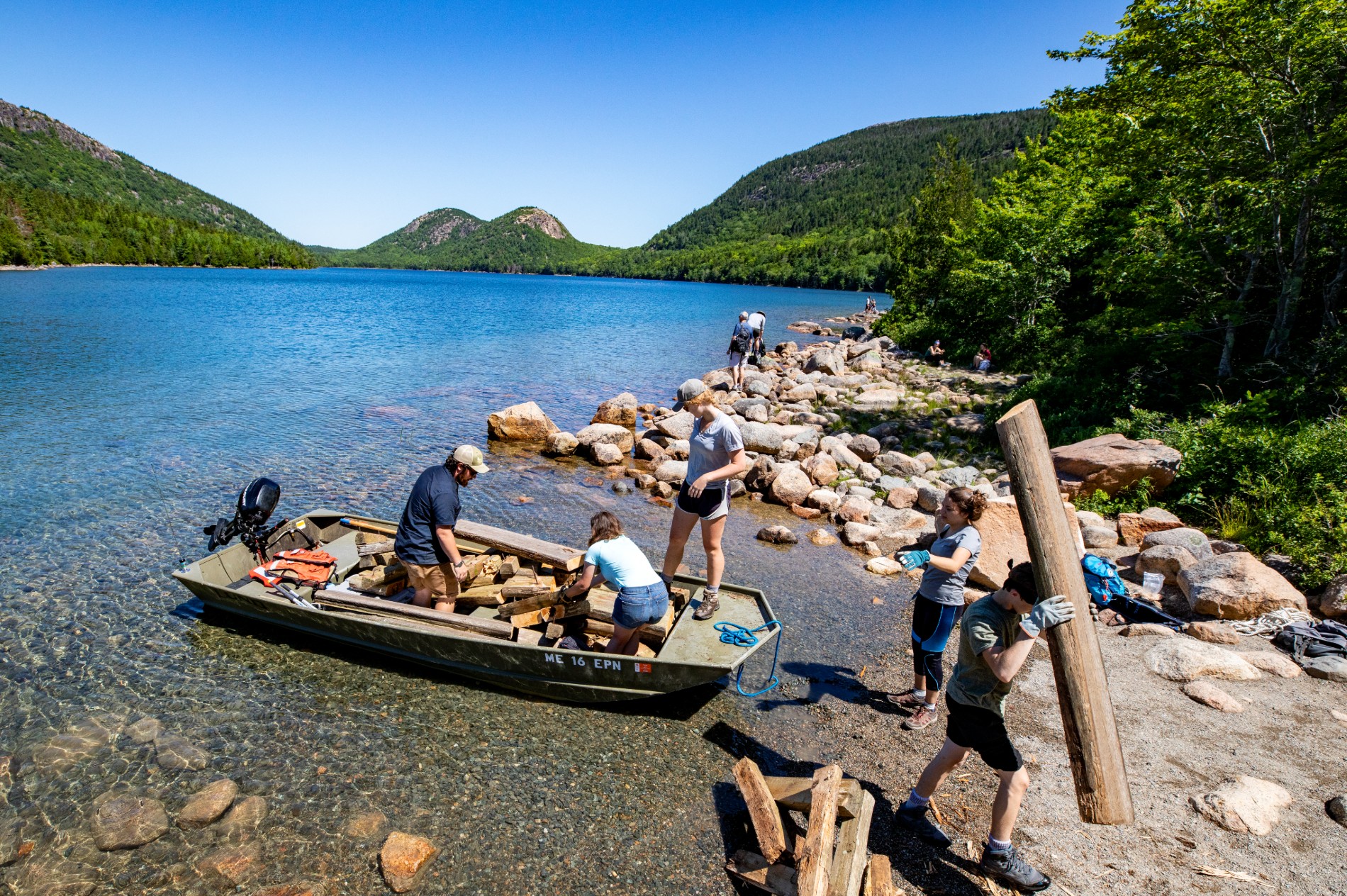
Friends of Acadia Stewardship Crew leads volunteers in the construction of a new bog walk on the Jordan Pond Path in 2018. (Will Newton/Friends of Acadia)
Two of Friends of Acadia’s largest events are centered around volunteer work, acting as bookends for the park’s seasonal operations.
Earth Day Roadside Cleanup, held for 25 years on the last Saturday in April, tasks volunteers with bagging up trash left behind after the winter along the roads of Mount Desert Island and Trenton. Take Pride in Acadia Day, typically held on the first Saturday of November nearly annually since 1991, is an opportunity for volunteers to help park staff “put the carriage roads to bed” by removing leaves from carriage roads and adjacent drainage ditches, which helps deter winter erosion. Both events usually yield hundreds of volunteers and have become a way for fans of the park to express their love in a tangible way.
“Trail work is not always visible, but you can see leaves getting removed, and you can see trash getting collected,” said Burtis. “So, there’s a really poignant visual—you can see things happening.”
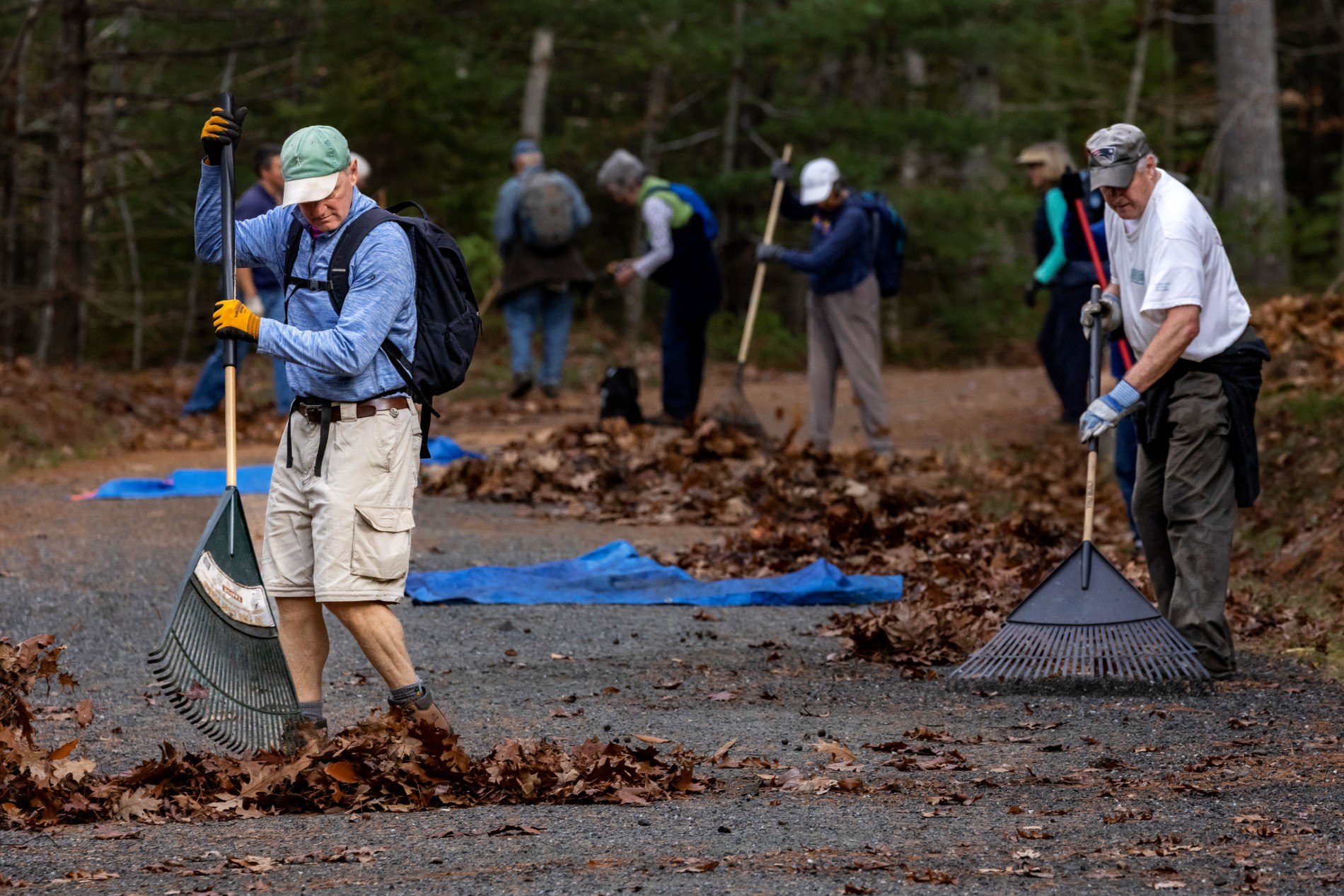
Volunteers from the Downaast Outing Club rake leaves during the annual Friends of Acadia’s Take Pride in Acadia Day. (Ashley L. Conti/Friends of Acadia)
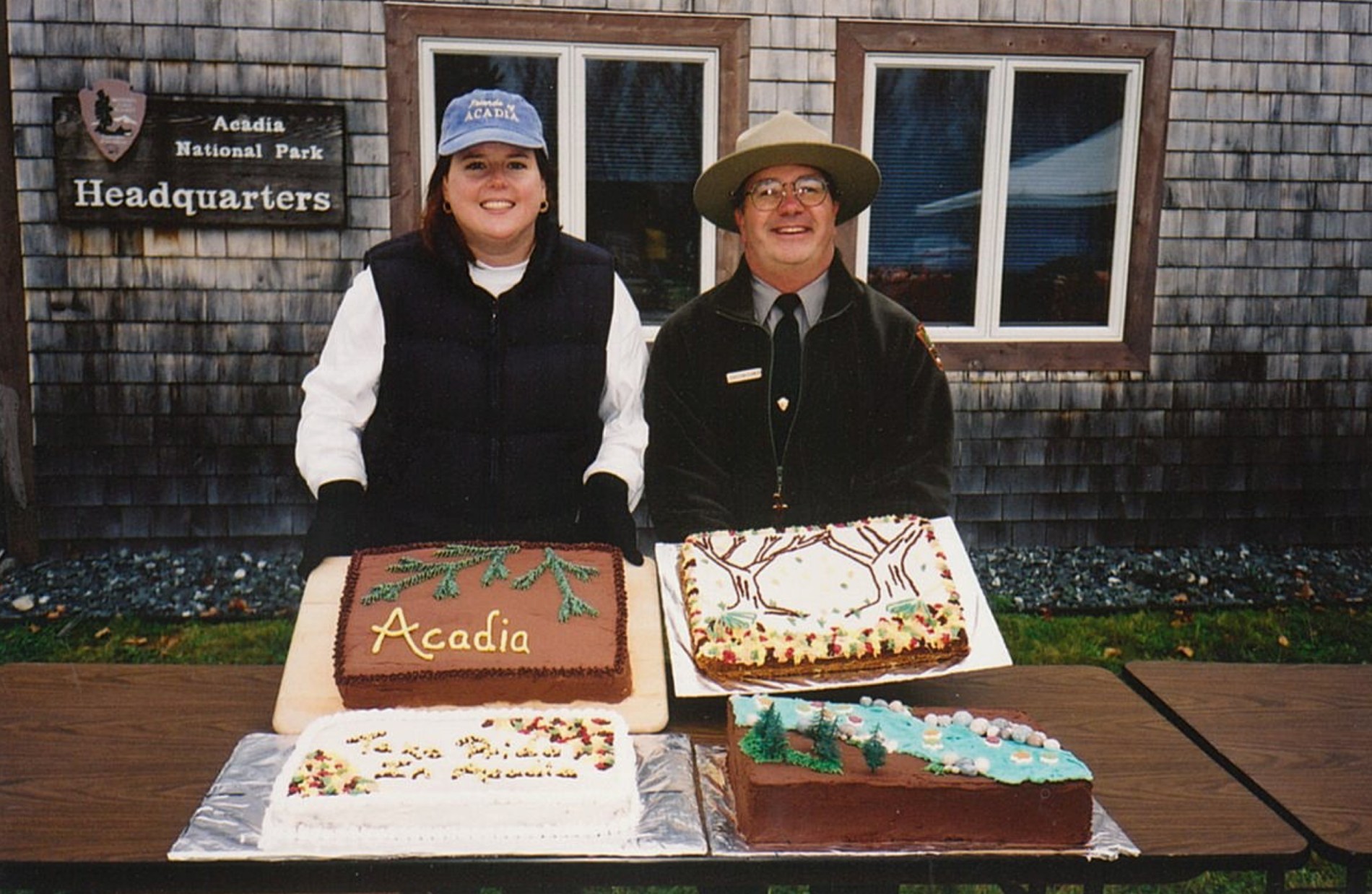
Take Pride in Acadia Day 2000. Terry Begley and Jonathan Gormley stand with celebratory cakes during Take Pride in Acadia Day in 2000. (Volunteer Archives/Friends of Acadia)
A memorable project for former Trails Supervisor Chris Barter is the rehabilitation of the Schooner Head Path, which begins at the site of Old Farm near Compass Harbor and eventually ends at the Schooner Head Overlook. Before work began towards the end of 2007, Barter recalls the trail being “in just terrible shape” and needed some serious TLC.
“We knew right away that this would also be a good project to work with our Friends of Acadia volunteers, having worked with them on a project of this scale at Jordan Pond,” said Barter. “There was going to be a lot of gravel surface and a lot of ditching that needed to be dug by hand and a lot of revegetation that needed to be put down with care along the sides and covering over the scars from construction.”
He knew these were jobs that the Drop-In Stewardship volunteers excelled in.
“I was the supervisor for that project, so I worked directly with them a lot on what parts of the trail they could do,” said Barter.
Friends of Acadia’s Stewardship Crew Manager Mike Alley and Volunteer Crew Leader Cliff Olson brought Drop-in crews out twice a week to work alongside Barter’s team.
“I’d have a section staked out for them, and a lot of times they actually did the excavation themselves by hand, where you have to take away the topsoil so you don’t have mud underneath,” Barter said. “They would cut back to the edges of the trail, dig the ditching, and then they would bring in the gravel and build the surface of the trail. Sometimes it was on the old trail and it was easy, and sometimes it was on new places we had to build from scratch and it was more involved, and they just worked right with us for the whole season.”
Trust in the capabilities of the volunteer crews was foundational to this project’s success.
“Really anything that those guys could do, I just took right off the list for our crews so that we were able to concentrate on building the stone walls and setting the culverts and cutting the trees and bringing in the blown ledge,” said Barter.
That season they were also joined by an Acadia Youth Conservation Corps crew. “It was just a really cool project with all of these different groups coming together to make it happen,” Barter said.
A little more than a decade later, in 2022, a huge washout storm left a massive mark on Acadia. “We lost miles of carriage road,” Barter said. “We lost any place where a ditch could run over onto the surface—it was a huge deal. Some of the worst damage that we saw on the trail system was to the Schooner Head Path because it’s all gravel and it’s all graded and there aren’t checks and steps.”
While this relatively smooth surface is built to allow wheelchairs and other accessibility devices onto the path, “there’s nothing to hold the gravel from washing out if your drainages fail,” Barter explained.
It wasn’t long before a mix of park staff and volunteer crews were back out on the Schooner Head Path to give it some love. “The first group that I had working in there was an Appalachian Mountain Club group and they redid about half of it,” said Barter.
The drop-in volunteers took over from there.
“Over the next couple seasons, they just picked away at about a mile and a half of trail, just moving along, resurfacing, and building it back better,” said Barter.
The silver lining of the storm damage was that it provided crews with the opportunity to improve upon the work done in 2007 and 2008.
“We laid it out with a lot of extra drainage, what we would call grade dips,” explained Barter, “which are just these little subtle depressions built into the surface so that as water is running down a slope, it runs off to the side instead of continuing. And I’m happy to report that all of that work they did has been through many big storms in the last five years and there’s not a speck out of place, it looks beautiful.”
Jordan Pond Path is of the busiest trails in the park. Rebuilding the bogwalk on the trail’s woodsy west side was a unique rehabilitation project.
“It was a huge undertaking—more than 4,000 feet,” said Acadia’s Volunteer Coordinator Dianna Sproul. “That’s an extreme amount of work across multiple years…and it was a huge accomplishment with a lot of effort and so much coordination.”
Longtime stewardship volunteer and Volunteer Crew Leader David Opdyke remembers the project well.
“We started roughly in the middle of [the work in progress],” he said. “There were chainsaws, impact drills, and sledgehammers. And there was a lot of thinking, checking for perfection, making sure things are level, that kind of stuff.”
New volunteers were paired up with more experienced folks like Opdyke as they began ripping up the old bogwalk and preparing it for removal. “There were many very dedicated leaders who were sticklers for perfection besides me,” Opdyke recalls.
Sproul and former Trails Supervisor Chris Barter acknowledge the amount of work that went into the removal process alone.
“There’s a lot of labor and extra pieces just to get the material in and the material out, let alone building it,” said Sproul.
With a clean slate in front of them, Opdyke and the other volunteers could begin building the new bogwalk. “We started laying out stakes, then figuring out the grades and what the heights were supposed to be.”
After the pandemic threw a wrench into things, the park allowed a group of experienced volunteers to continue working on the bog walk in 2021.
“We set our own times [beyond the Drop-In Program hours],” Opdyke explained. “So we essentially doubled the work. They’d usually have eight of us and instead of getting four cribs built and two of them planked, we could get 10 cribs built and about six of them planked. So, instead of taking seven years, we took five.”
An important aspect of this work was the level of trust between volunteers and park staff.
“I think the trust of what we could do grew exponentially because there are very strict specifications for building cribs,” said Opdyke. He recalled a time where former Trails Foreman Gary Stellpflug visited the volunteer crew and shared how impressed he was with their work. “He said, ‘You guys know what you’re doing, just make sure it’s sound.’”
An especially unique feature of the Jordan Pond bog walk is the number and size of the pull-off stations scattered along the trail.
“Because the trail is so ridiculously busy, you need spaces and places for people to pass each other,” said Sproul. “So there are these byways that are grander than we have in a lot of other sections in the park with bogwalk.”
Barter also acknowledged the significance of these pull-off stations, saying “This solution that was implemented by volunteers really takes into account all of the priorities, many of which are related to our core mission about the best way to preserve the natural environment by keeping people on a trail without having to do massive amounts of construction.”
“It was really gratifying when people came by and thanked us,” Opdyke recalled. “They’re always enthusiastic. We’re very happy with that, to the point where once it was done, people like me insisted on being repair crews every spring to make sure we kept it that way.”