 Join
Join Donate
 Acadia National Park
The Multi-Year Effort to Restore Acadia’s Carriage Roads
Today’s historic carriage roads are a testament to the power of community support, public-private partnerships, and a multi-year restoration effort.
BY SHANNON BRYAN
September 11th, 2026
Today’s historic carriage roads are a testament to the power of community support, public-private partnerships, and a multi-year restoration effort.
BY SHANNON BRYAN
September 11th, 2026
On any given summer day, the Eagle Lake Carriage Road is lively with parkgoers.
Cyclists pedal the lakeside stretches, gravel crunching under their bikes’ tires. Walkers saunter along, marveling at how the sun twinkles through the tree cover. Friends pose for big-smiled selfies with the mountains across the lake, and families escort the youngest among them in strollers or bike trailers.
The MDI Wheelers ride here, too. Volunteers pedaling specialized two-person trikes bring people with mobility limitations onto the carriage roads to immerse themselves in remarkable views.
Five years ago, the Eagle Lake loop was the final seven miles of Acadia National Park’s carriage road network to be reconstructed as part of a multi-year effort to restore all 45 miles of the park’s historic carriage road system. The road surface and subsurface—that sensibly engineered layering of stone—was rehabilitated along with drainage features, stone walls, and rock slopes. This section reopened in 2021, capping a significant restoration effort that began nearly 30 years earlier.
You’d be hard-pressed to imagine it today, but a generation ago, with limited funds and staff, Acadia’s carriage road system faced significant maintenance hurdles. Like many national parks, Acadia suffered from a lack of federal funding during the later decades of the 20th century. Much of that shortfall hit the budgets for infrastructure and maintenance.
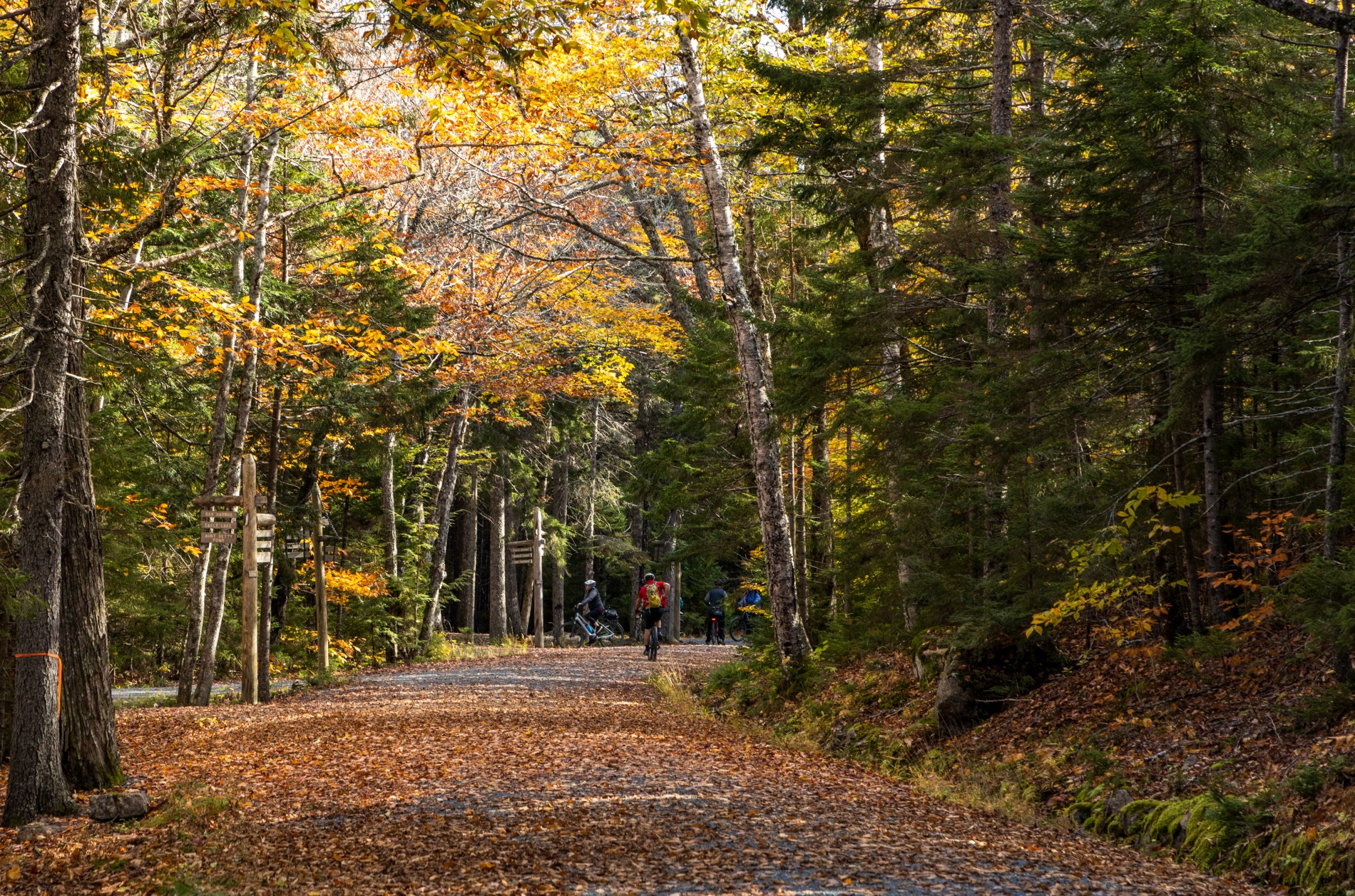
Visitors bike the carriage roads near Jordan Pond. (Photo by Lily LaRegina/Friends of Acadia)
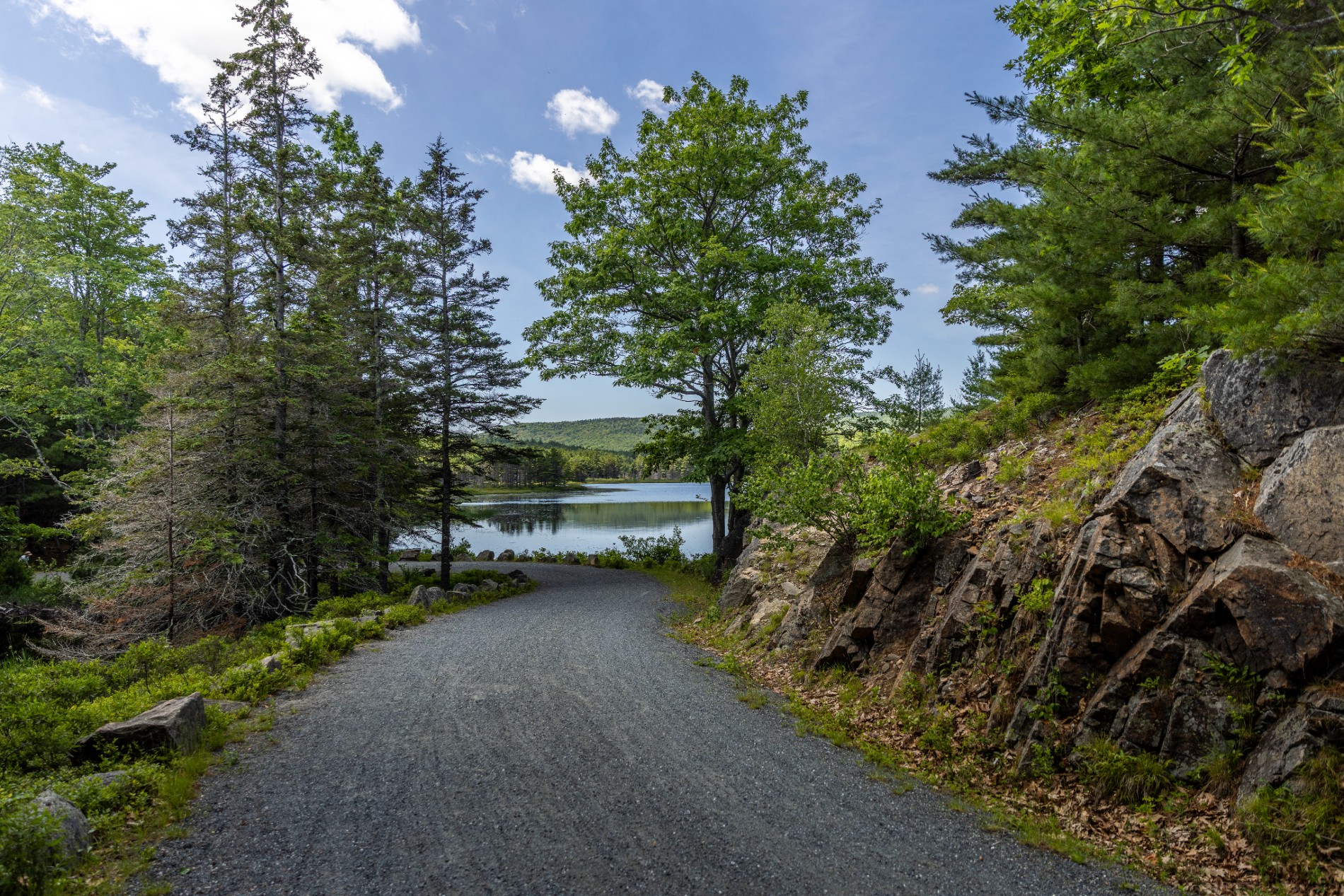
Vista views from the Witch Hole Pond Carriage Roads, overlooking part of Witch Hole Pond. (Rhiannon Johnston/Friends of Acadia)
Built between 1913 and 1940, Acadia’s carriage road system was financed and constructed by John D. Rockefeller Jr. for use by horse-drawn carriages.
Generally 14 to 16 feet wide, the carriage roads were excavated more deeply than typical gravel roads to create a durable foundation.
“The carriage roads are a road style that is built of various layers of stone,” said Keith Johnston, Acadia’s chief of facility maintenance and operations. “The base is large stones, anything from the size of a desk to soccer-ball-sized stones. The layers of stone get smaller and smaller as you build the road base up, so you’ve got a good porous understructure where water can move through it.”
Rather than lying flat, the roads were built with a “crown”—a six- to eight-inch rise at the center—to direct water toward the edges and improve drainage.
Following the natural contours of the land, the roads offered travelers sweeping views from carefully curated scenic vistas designed in collaboration with renowned landscape architect Beatrix Farrand. Locally quarried pink granite coping stones served as guardrails.
The carriage roads also featured numerous stonework structures, including culverts and retaining walls, 16 unique stone-faced bridges (a 17th bridge is on a carriage road just outside park boundaries), and two gatehouses.
In 1960, Rockefeller donated 45 miles of carriage roads to the park. But over the next few decades, the park didn’t have the resources to care for them.
When now-retired Roads Foreman Merle Cousins first arrived in Acadia in 1972, the carriage roads were in bad shape.
“They were in such poor condition; they were rutted and there were washouts and rockslides,” he said. Vegetation stretched wildly into the carriage roads and crowded out Rockefeller’s diligently curated vistas.
“Of the 16 bridges on Acadia’s carriage roads, at least seven [were so overgrown] you couldn’t even see the bridge until you were on it and saw the water.”
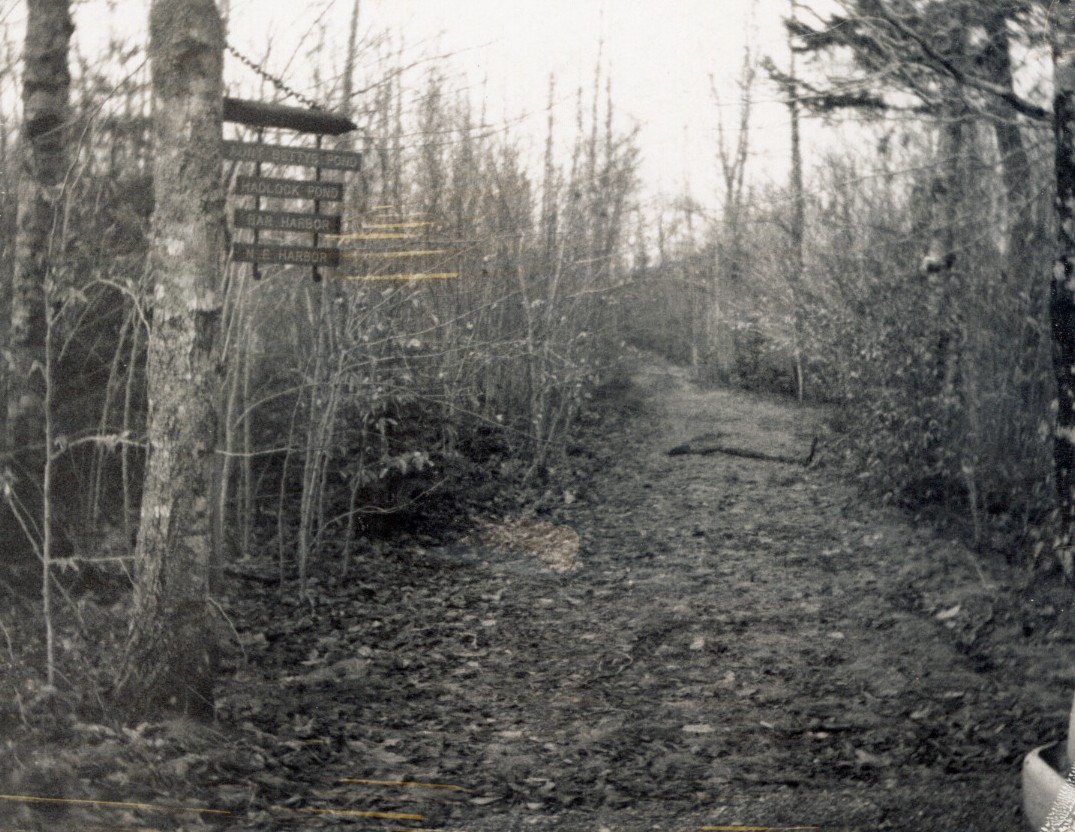
Undated NPS photo shows the condition of the carriage road before rehabilitation (NPS photo)
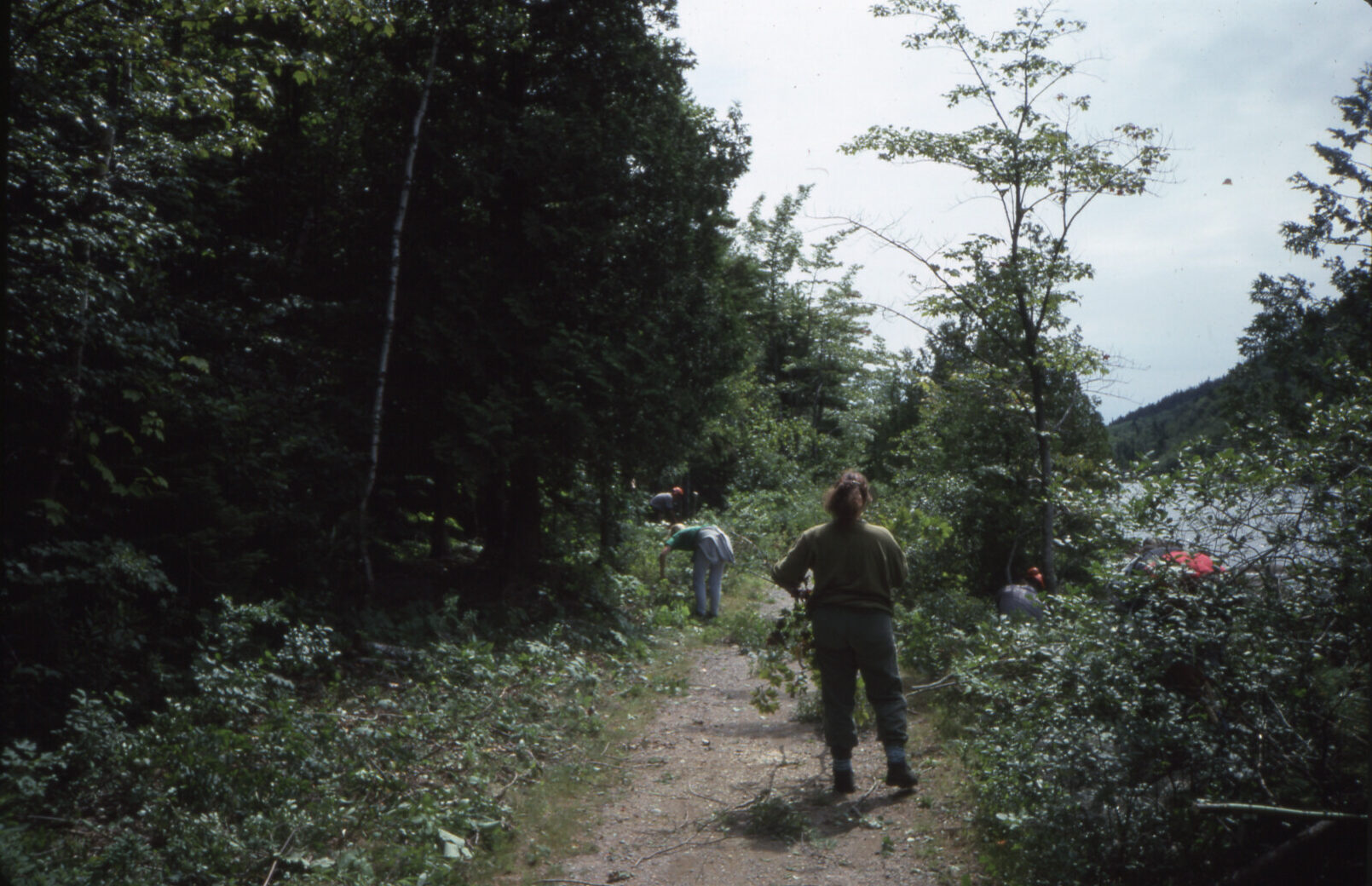
An archival photos of the carriage roads shows overgrowth crowding the road. (NPS archives)
The overrun vegetation blocked the sunlight, “so the roads never dried,” Cousins said. “The roads were wet and damp, and horses and carriages would leave ruts and cracks.”
Coping stones had tumbled by the dozens down hillsides. On Eagle Lake, Cousins said, they found 30-40 coping stones that had rolled down to the water’s edge.
It’s a testament to the carriage roads’ original design and construction that they endured for as long as they did without regular attention. But even the best engineering struggles to stand up under decades of visitor use, heavy rains, drainage-clogging debris, and creeping roots.
By the 1990s, the carriage roads were in dire need of a major overhaul. But such a monumental project on a historic and complex system would cost millions of dollars the park did not have.
Founded just a few years earlier in 1986, Friends of Acadia offered to be part of the solution.
Friends of Acadia board members Frederic “Rick” Bourke and David Rockefeller, son of John D. Rockefeller Jr., joined forces to fund a pilot restoration of more than a mile of carriage road in the valley known as the Amphitheater to test the feasibility of a larger rehabilitation and determine the cost per mile.
“At that time, I was working for the park’s roads division, and they asked me to be inspector for this section of test work,” Cousins said. “I did that all summer, making sure that one-mile section was up to standard, from the road to the culvert sizes and the stone wall rehab.”
It was. And by its completion, it was clear there was great interest in rehabilitating the entire 45-mile system.
Armed with data from that test mile, Friends of Acadia, the National Park Service, and members of Maine’s congressional delegation came to an agreement: the federal government would provide $4 million in funding to restore the carriage roads, and Friends of Acadia would raise $4 million (the equivalent of $9.7 million today) to create an endowment aimed at generating funds to care for the roads in perpetuity.
Energized by the federal matching commitment, Friends of Acadia launched its carriage road capital campaign and “Give a Foot” community fundraising program, inviting local residents and businesses to sponsor one-foot sections of the renovation for $17.05 per foot.
Through the generosity of lead donors and broad community support, Friends of Acadia reached the campaign goal in 1996, creating the landmark Carriage Road Endowment that continues to support the carriage roads today and in perpetuity.
“The initiative to restore and permanently maintain the carriage roads was among the very first projects at Acadia that showed the power of matching federal appropriated funding from Congress with private philanthropic dollars raised locally,” said David MacDonald in 2021, during his tenure as Friends of Acadia’s president. “It’s also where the purpose and potential of our young—at the time—organization really took hold.”
Restoration work began in 1993, and Cousins was appointed carriage roads supervisor.
“I was on there from day one,” he said. “After we got the funds, we could hire the people. We had the equipment and all the materials we needed.”
Work kicked off with Aunt Betty Pond Carriage Road.
Once park users realized what we were doing, Cousins said, “people started waving and giving a thumbs-up when we’d be out there.”
Carriage road crowns and subgrade layers were restored. New surface materials were applied, replacing thousands of cubic yards that had been washed away over the years. Woody vegetation was removed from roads, shoulders, and ditches. Drainage systems were reestablished to deter erosion. Coping stones were reset or replaced.
Over the course of the restoration, Congress allocated an additional $2 million to the effort.
Between 1993 and 1995, nearly all of Acadia’s carriage roads were rehabilitated—excluding that seven-mile section of Eagle Lake Carriage Road, said Johnston.
“Eagle Lake was in the best condition at the time,” he said, as it had been one of the only sections that was relatively maintained over the years. “It was deferred because the [original] federal dollars weren’t enough to do it all.”
Additional federal funds to restore Eagle Lake came through in 2021. When the work was complete, the reopening of this final handful of miles marked the official conclusion of the momentous project.
Cousins, who retired in 2008 before the Eagle Lake section was completed, is rightfully gratified by the work of so many hands.
“I’m extremely proud,” he said. “The big thing is the history. I felt we brought it back to John D. Rockefeller Jr.’s standards and his ideas about how the experience should be.”
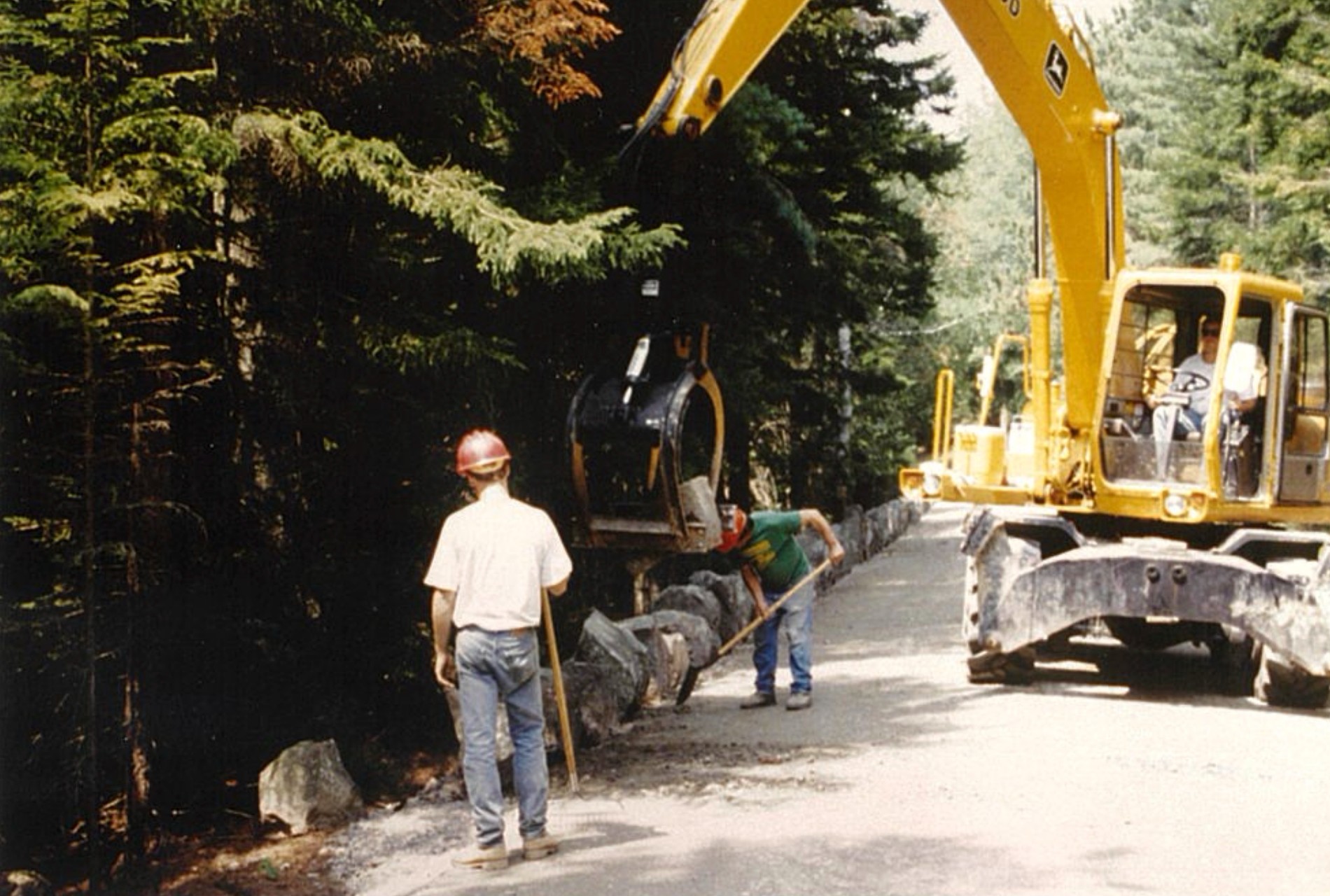
Construction workers operate machinery to place coping stone or large granite rocks, also known as “Rockefeller’s Teeth,” along the perimeter of the carriage roads in Acadia National Park during the carriage road reconstruction of 1993. (Carriage Road Archives/Friends of Acadia)
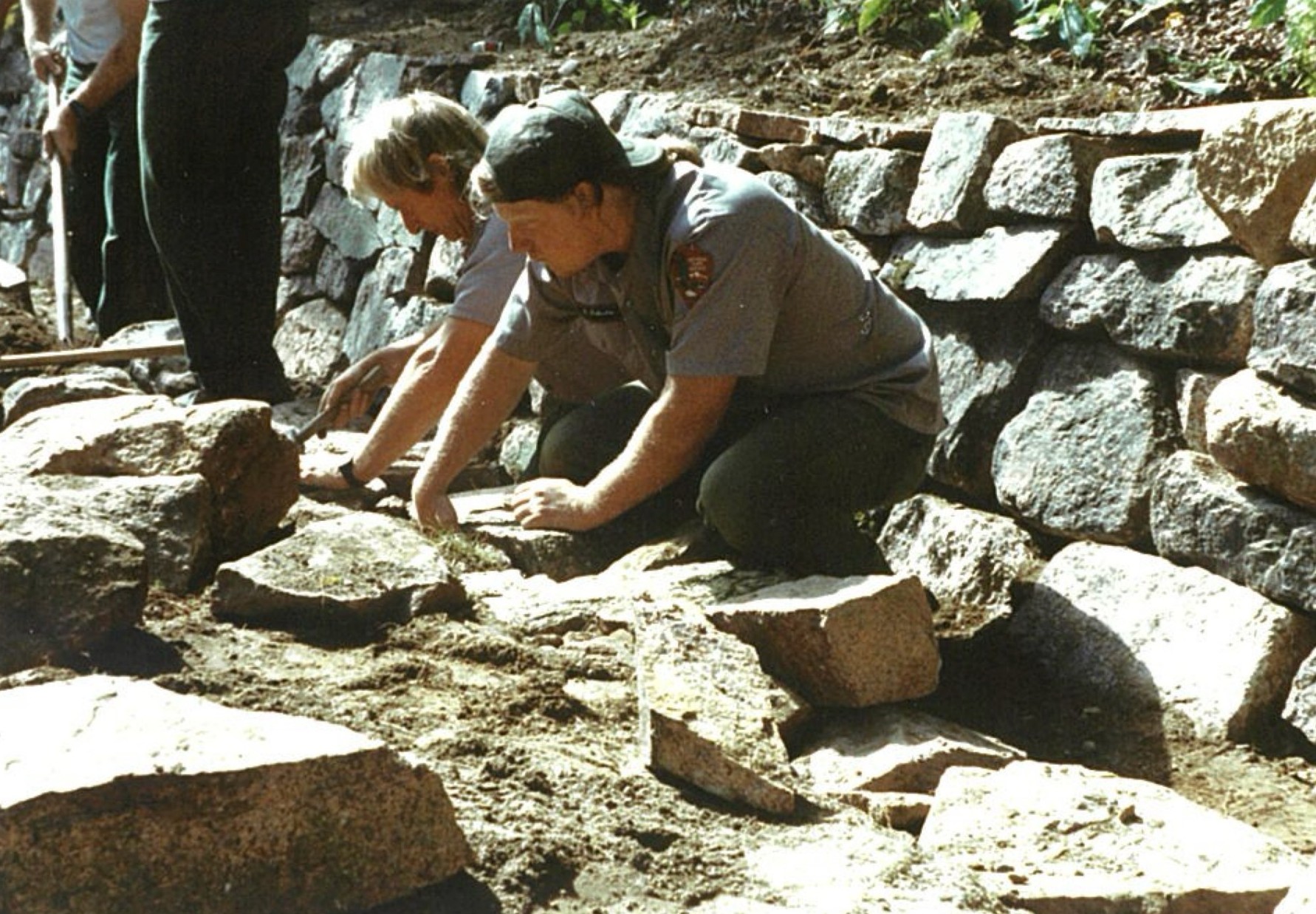
Acadia National Park staff Don Beal and Keith Johnston facilitate training on dry stone masonry with the trails and carriage roads crews while restoring a retaining wall along a carriage road in the 1990s. (Friends of Acadia photo)
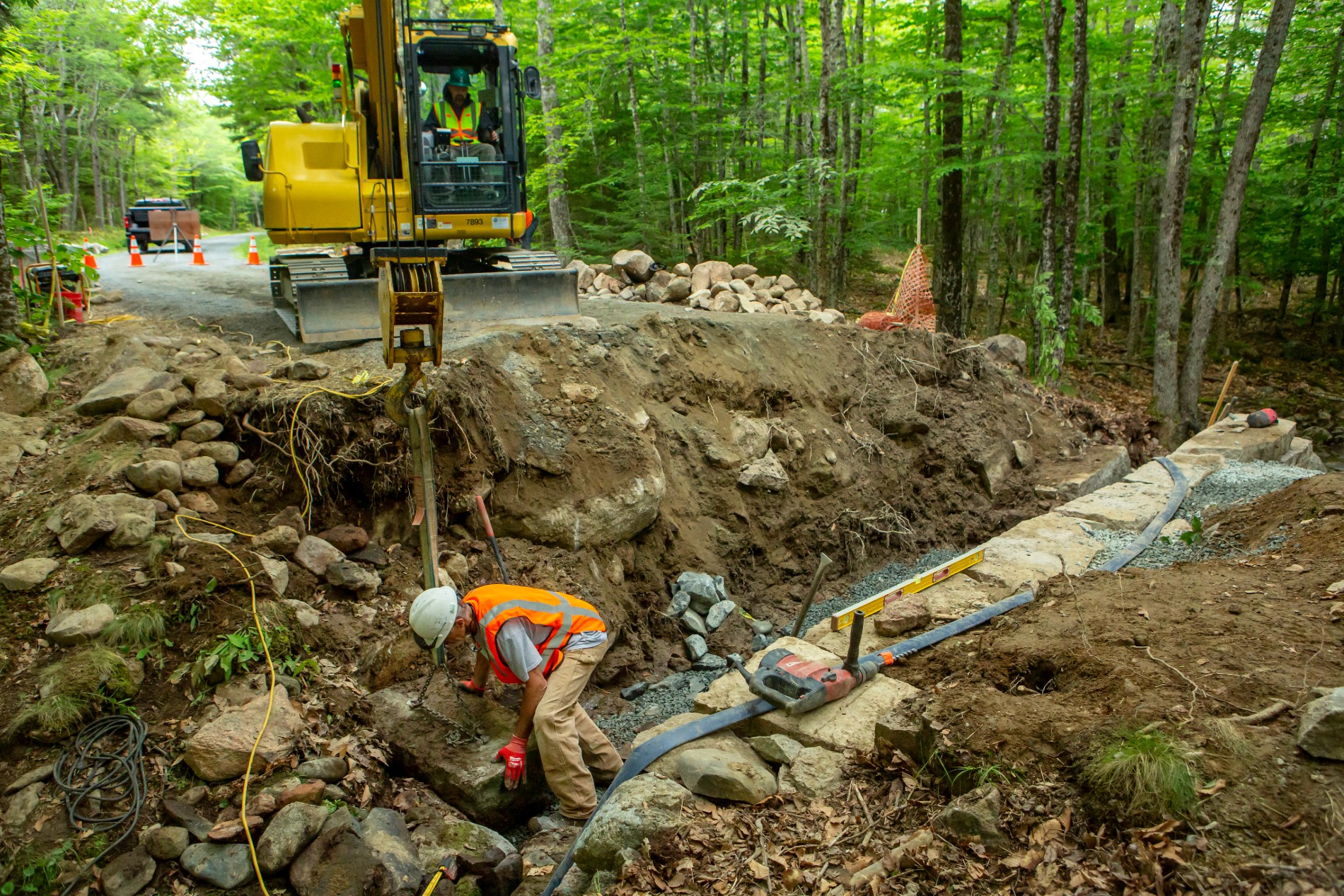
Mike Carr (left), stone mason of Freshwater Stone, carefully navigates a stone for Mario Quintal, stone mason subcontractor for Freshwater Stone, while rebuilding a historical dry laid stone box culvert as part of the Eagle Lake carriage road construction. (Photo by Ashley L. Conti/Friends of Acadia)
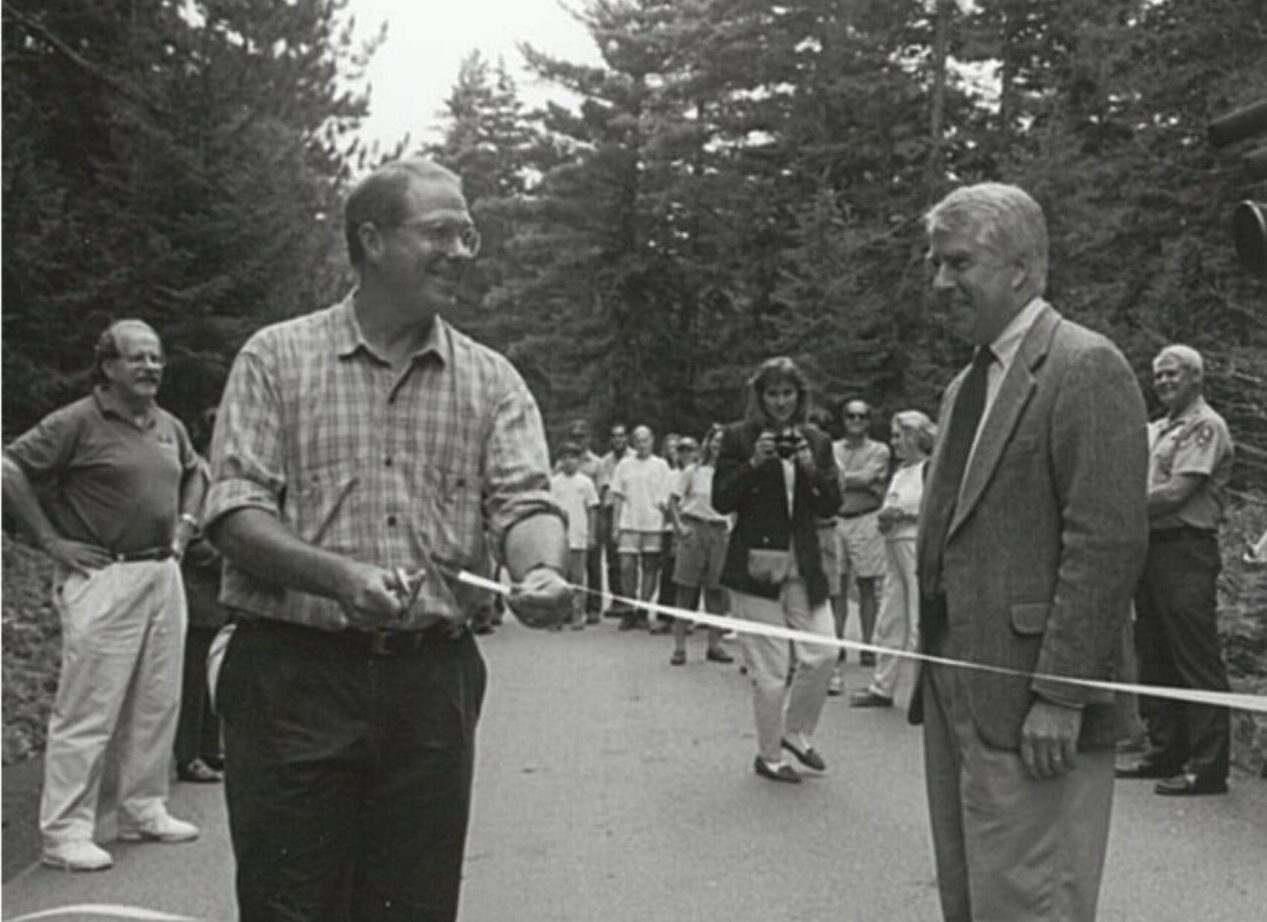
Frederic Bourke (left) and Charlie Tyson prepare to cut the ribbon during a ceremony to celebrate the completion of the carriage road reconstruction project in Acadia National Park as Duane Pierson (rear left) and Len Bobinchock (rear right) look on.
Keeping the carriage roads in tip-top shape is a priority for today’s park crews. A walk-around in early spring, following winter snowmelt and spring rains, also helps the road crew identify areas that need attention—washouts, clogged culverts and ditches, or dangerous hanging tree limbs.
“As soon as they’re dry enough to get a vehicle out, the crew goes out on the carriage roads,” Johnston said. “They get all the trees out of the way, get any deep ruts marked, coned, or filled, and they get carriage roads open to the public as quickly as possible.”
Regular maintenance during the season involves removing and replacing that single top-most layer of stone.
“It’s about an inch deep and comprised of what we call ‘the carriage road mix,’ a highly engineered aggregate mix that several local companies are able to make for us,” Johnston said. “When we do a major rehabilitation, we take off the top two courses of stone, re-crown it, restore all the ditching, and then bring the coping stones back into the appropriate 16-foot width,” he said. Then they reapply the top two layers.
What fewer visitors see is the critical—and complex—drainage system. There are more than 100 miles of “back drains” that help move water away from the park’s carriage roads. Johnston describes them as a “spaghetti of cuts and carves and handmade drainages in the landscape that was intended to protect the roads
from watershed.”
Those, too, needed to be restored and continue to be maintained.
Crews likewise use visitor use data to adjust maintenance cycles. For example, on heavily used carriage roads, bike tires tend to wear down the carriage road surface more quickly.
They’ve also come to understand how the tree canopy over the carriage roads impacts the longevity of the surface.
“The tree canopy was directing rainwater onto the road surface and not allowing it to naturally fall dispersed on
the road and make its way to the ditches,” said Johnston. “The tree branches concentrate water in very specific areas and were creating small rivulets, which then became washouts.”
A trimmed-back canopy also allows the carriage roads to dry out faster after winter snowmelt or heavy rains.
“They’re more aerated,” Johnston said. “They get more airflow, and they’re not as soupy for as long.”
Johnston’s predecessor started a program to remove the overhead canopy, trimming it back off the roads. “Those sections have seen much less loss of surface aggregate as a result of the canopy work,” Johnston said.
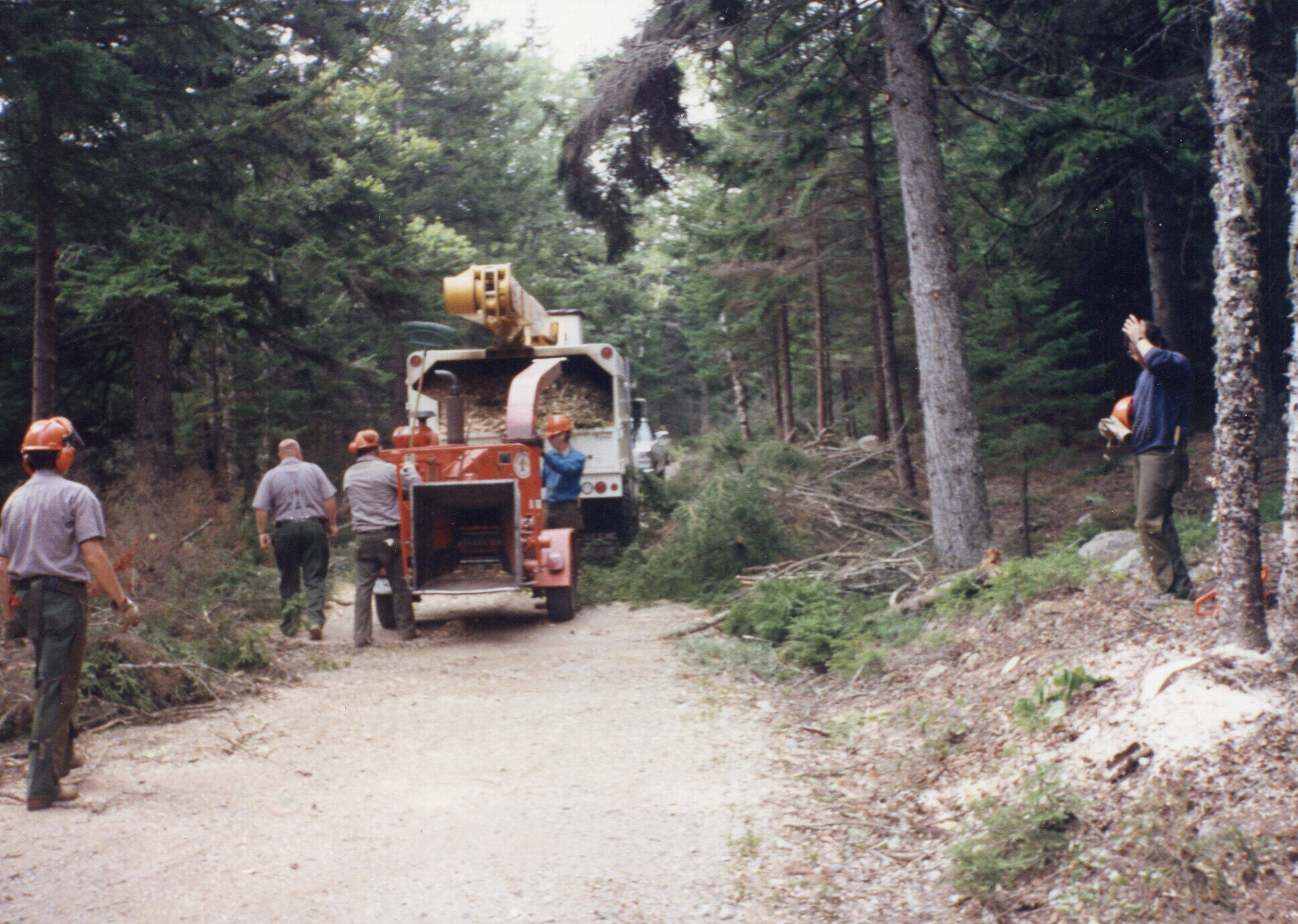
Crews clear trees and brush on the carriage roads. (NPS archives)
“We’re still learning ways and techniques to do a better job being stewards of the roads and resources by tackling it from different angles.”
Closing the carriage roads during “mud season,” when rain and snowmelt soften the gravel surface, helps a great deal. That concept was first implemented by Cousins during his tenure.
“I’ve seen a beautiful section of carriage road where someone got on a bicycle and left a rut an inch deep for a mile and a half,” Cousins said. “When it rains, where does the water go? That rut gets bigger and bigger and you get a whole washout.
Then you’ve got to repair it.” Cousins was also the mastermind behind Friends of Acadia’s annual Take
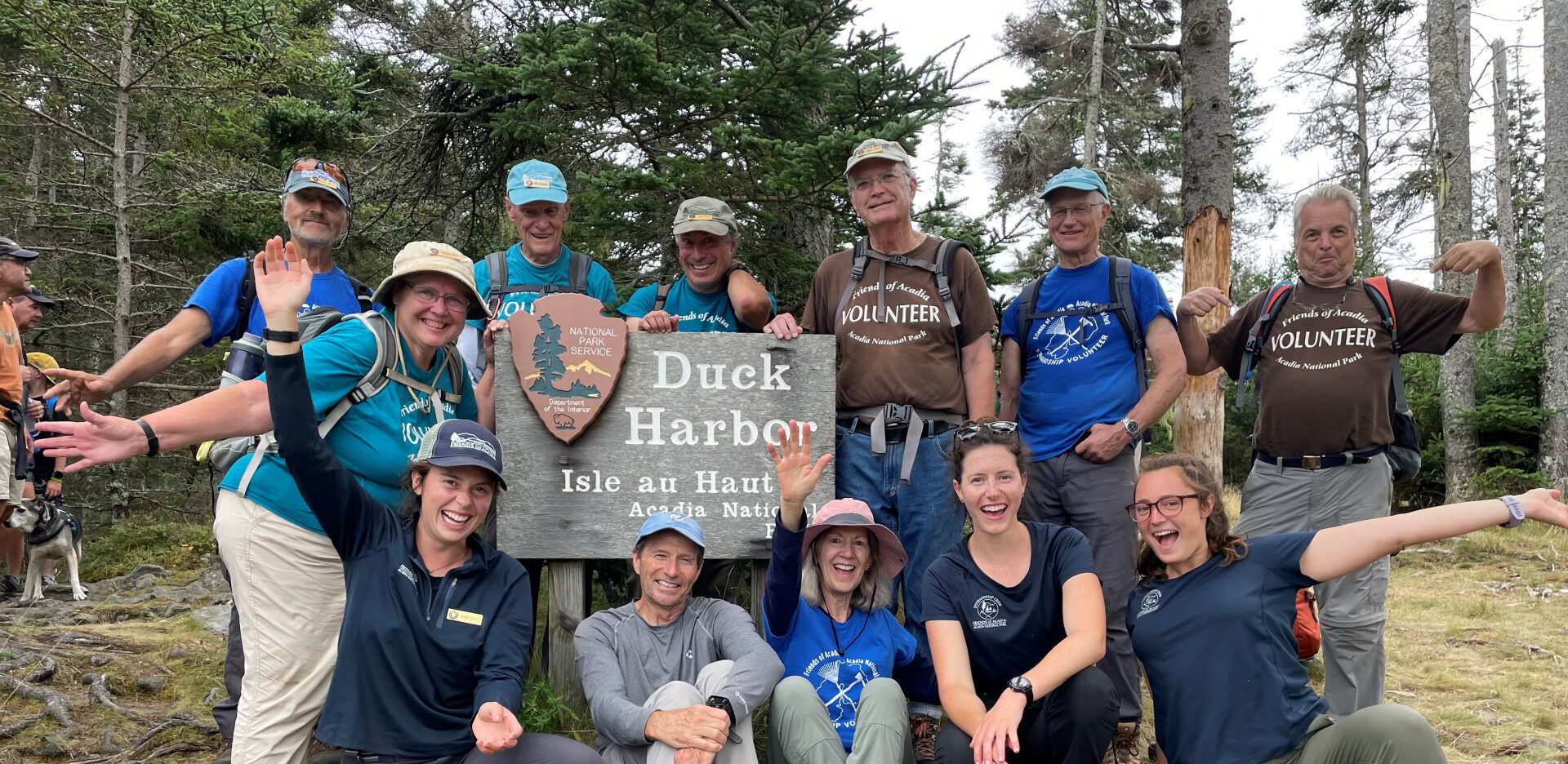
Pride in Acadia Day, which started in 1991—the year the Carriage Road Campaign was announced. Every fall, volunteers take to the carriage roads to rake leaves and clear drainage, helping to prevent erosion during the winter storms and spring thaw, and reducing the need for costly repairs.
“At the time, we didn’t have enough hired help to clean all 45 miles of ditches and culverts,” Cousins said. “It certainly helped and made things clean. And it was also a great thing for the public; people come year in, year out to help.”
Over the years, the original $4 million endowment created by Friends of Acadia has grown with additional gifts and investment returns, allowing Friends of Acadia to grant more than $200,000 from this endowment and other funds to the park each year. This funding supplements and amplifies federal dollars, including revenue from park entrance fees, and helps sustain the program when federal budgets fluctuate.
Friends of Acadia’s support helps fund park staff salaries, materials, and equipment. In 2024, Friends of Acadia purchased a new excavator, two dump trucks, and a diesel tractor for Acadia National Park—helping to ensure that the carriage road system is continuously maintained and repairs are completed when the unexpected happens.
That new equipment replaced some of the park’s aging fleet.
“We’re still using the grader that Friends of Acadia bought in 1993. Friends of Acadia also purchased the original dump trucks for the carriage roads,” said Johnston. “We managed to keep the fleet and the equipment going, but they are long past the end of their useful life. Friends of Acadia is investing in some newer equipment that’s smarter, smaller, easier to use, less impactful to visitors.”
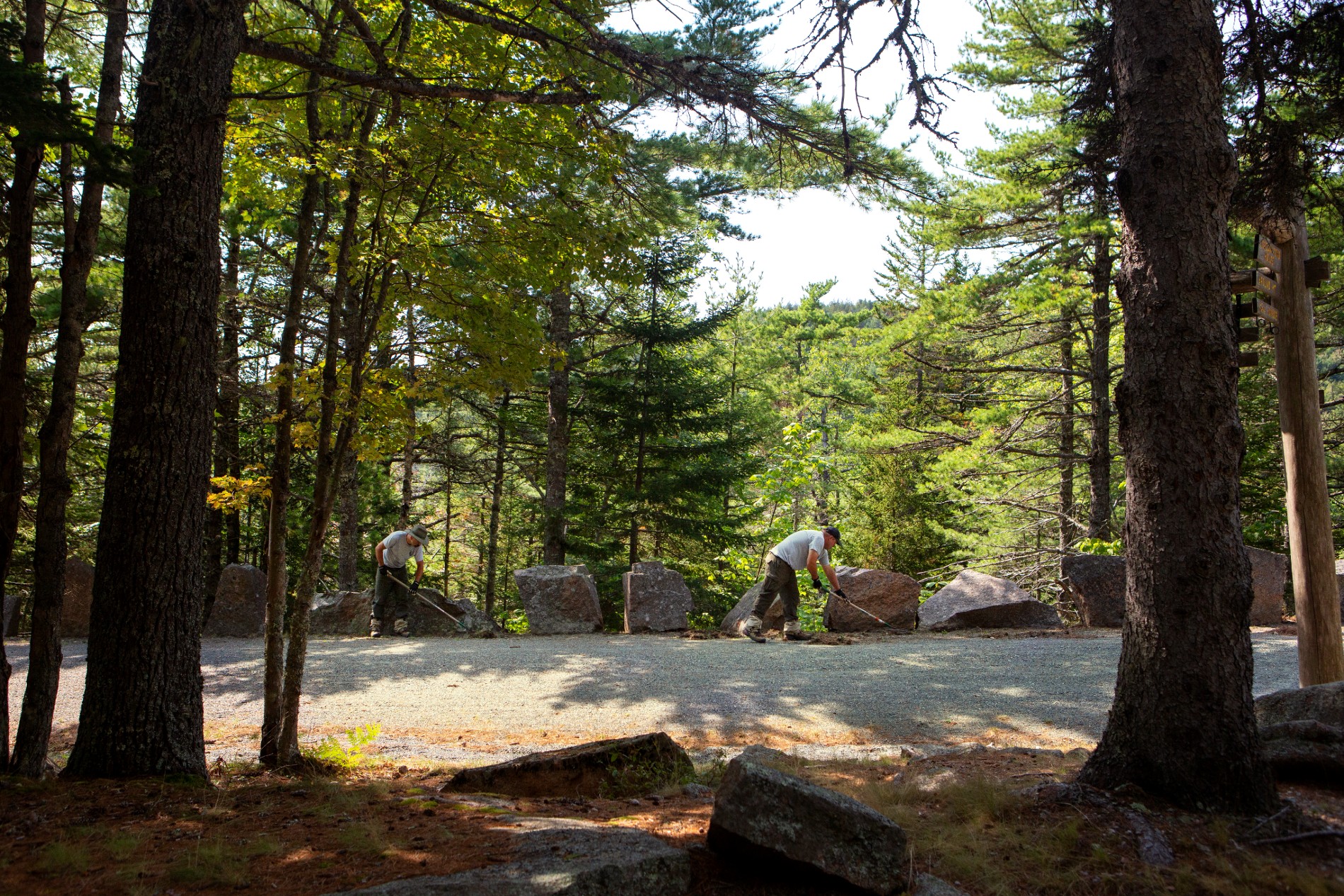
Acadia National Park road crew members Steve Anastasia (left) and Kyle Yarborough work to clear weeds from between the roads on the carriage road in Acadia National Park, Tuesday, September 8, 2020 to help mitigate erosion. (Photo by Ashley L. Conti/Friends of Acadia)
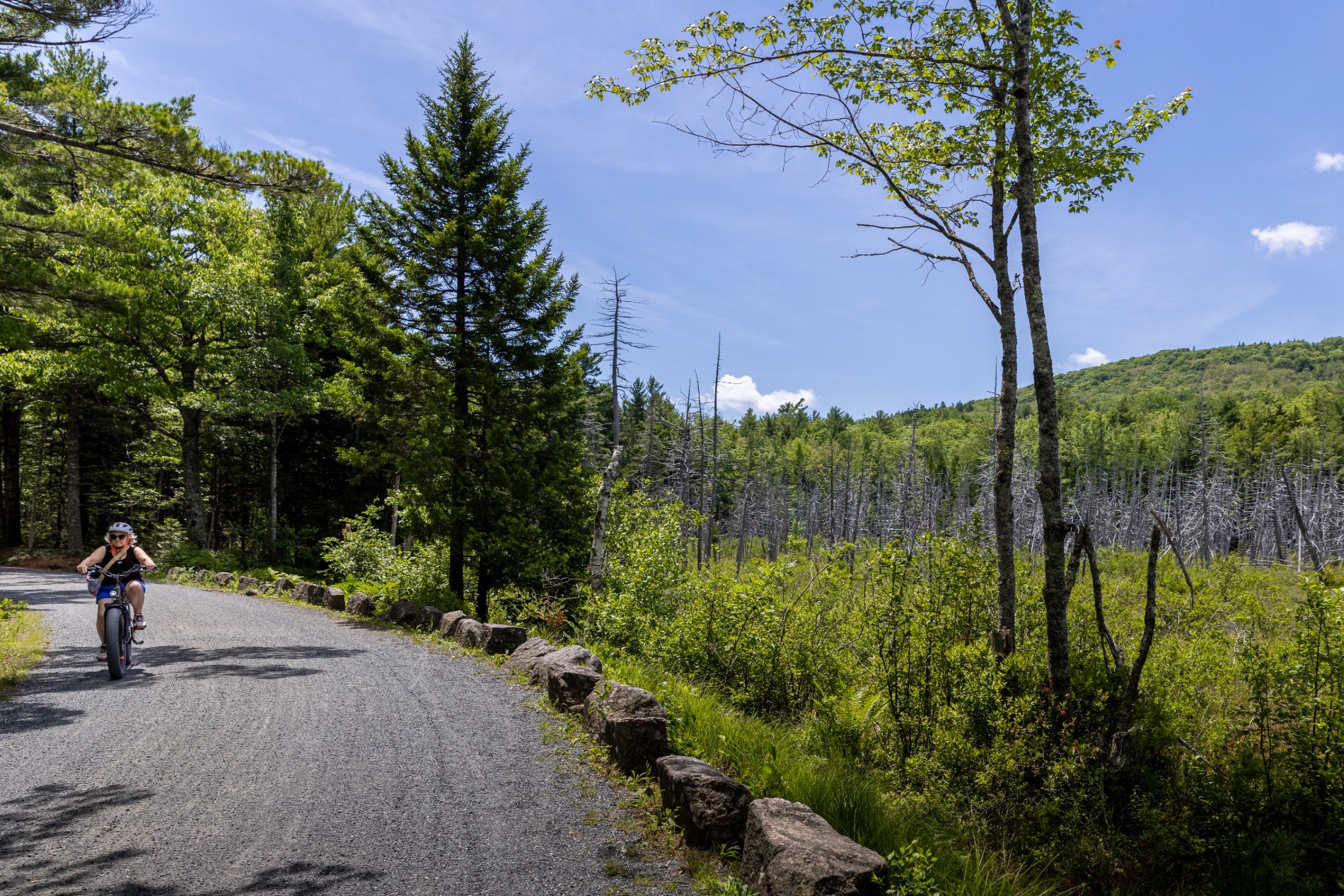
Bikers enjoy a ride on the Witch Hole Pond Carriage Road. (Rhiannon Johnston/Friends of Acadia)
Shifting weather patterns, which lean toward more frequent and more intense storms, may test the limits of the carriage roads’ original design and 100-year-old infrastructure. Park managers are also closely monitoring both how visitors use the carriage roads and the park’s growing number of users, as they consider the best ways to protect them for the future.
But whatever changes or challenges may come, the park is in a decidedly better position to meet them thanks to a public-private partnership created three decades ago.
“Acadia contains the best and most extensive example of a historic carriage road system in the United States,” said Acadia National Park Superintendent Kevin Schneider. “The carriage roads are in outstanding condition for visitors to enjoy thanks to Friends of Acadia and generous private philanthropy.”
Thanks to donor support, congressional action, and the expertise of the National Park Service, the carriage road system will continue to connect people with the scenic, natural, and cultural resources of the park for generations to come.
SHANNON BRYAN Friends of Acadia’s Content and Website Manager.
Stay off the carriage roads during “mud season” in early spring. As the snow melts and rainy days keep the carriage roads soft, the park closes the carriage roads to deter damage at a sensitive time of year.
Slow your roll when riding bikes on the carriage roads. Not only is that a courtesy for all the other visitors walking and riding the park’s carriage roads, but it also helps keep the carriage roads’ critical top layer of gravel in place. Hard stops and fast corners deplete the carriage road surface more rapidly.
And join us in caring for the carriage roads during our annual Take Pride in Acadia volunteer day the first Saturday in November!